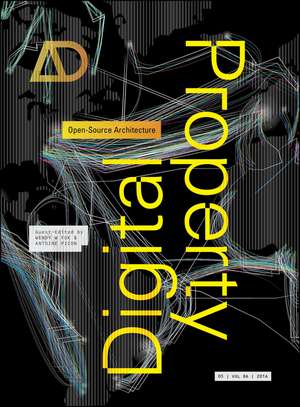
Digital Property
Autor Wendy W Fok, Antoine Piconen Limba Engleză Paperback – 7 noi 2016
Observăm de la prima interacțiune că Digital Property se prezintă ca un ghid portabil și dens, o ediție a celebrei serii Architectural Design de la Wiley, concepută să fie consultată intens în studio sau la cursuri. Volumul nu este doar un tratat teoretic, ci un obiect vizual hibrid, unde diagramele și randările de arhitectură digitală se împletesc cu o analiză juridică și etică tăioasă. Ne-a atras atenția modul în care autorii, Wendy W Fok și Antoine Picon, reușesc să transforme o problemă aridă de copyright într-o explorare senzorială a noilor moduri de producție. Subliniem importanța momentului în care apare această lucrare: într-o eră în care imprimarea 3D permite oricui să materializeze o structură dintr-un fișier digital, autoritatea arhitectului este pusă sub semnul întrebării. Textul ne poartă prin laboratoarele unor vizionari precum Carlo Ratti sau David Ruy, explorând cum colaborările globale și fluxurile de lucru open-source forțează redefinirea „semnăturii” de autor. Ca și Design Technology and Digital Production, acest volum pune în valoare evoluția tehnologică a ultimei decade, dar cu un accent critic pe aspectul legal și economic al proprietății intelectuale, depășind simpla estetică a algoritmului. Experiența lecturii este marcată de un ritm alert, fragmentat în eseuri și studii de caz care funcționează ca un manifest pentru o nouă etică a designului. Simțim tensiunea dintre dorința de democratizare a creației și necesitatea de a proteja munca intelectuală. Este o analiză esențială pentru cei care vor să înțeleagă cum se va schimba arhitectura atunci când obiectul final devine secundar procesului de generare.
Preț: 251.50 lei
Carte disponibilă
Livrare economică 23 iulie-06 august
Livrare express 09-15 iulie pentru 39.05 lei
Specificații
ISBN-10: 111895498X
Pagini: 136
Dimensiuni: 210 x 284 x 12 mm
Greutate: 0.59 kg
Ediția:1
Editura: Wiley
Locul publicării:Chichester, United Kingdom
V-ar putea interesa
-
 Structural DesignJames R Underwood-9%Preț: 872.32 lei958.58 lei
 -
 Frank Lloyd WrightRobert C TwomblyPreț: 392.67 lei
 -
 MontréalAnnick Germain-9%Preț: 938.66 lei1031.49 lei
 -
 Cities for CitizensMike Douglass-8%Preț: 409.69 lei445.32 lei
 -
 Preț: 300.48 lei
 -
 -37%Preț: 647.37 lei1021.77 lei
 -
 Procurement of Built AssetsDuncan CartlidgePreț: 306.72 lei
 -
 Architectures of Russian Identity, 1500 to the PresentJames Cracraft-27%Preț: 778.18 lei1066.00 lei
 -
 Smart CitiesAntoine PiconPreț: 298.62 lei
 -
 OrnamentAntoine PiconPreț: 252.17 lei
 -
 Managing Wildlife Habitat on Golf CoursesRonald G Dodson-8%Preț: 506.75 lei550.82 lei
 -
 -8%Preț: 433.20 lei470.87 lei
 -
 Turfgrass Maintenance Reduction HandbookDoug Brede-9%Preț: 703.77 lei773.38 lei
 -
 Le Corbusier and the Gras LampAntoine PiconPreț: 291.02 lei
 -
 Die Dresdner FrauenkircheJürgen HelfrichtPreț: 81.51 lei
Public țintă
Primary market: Architects and designers, and students of architecture and design.De ce să citești această carte
Această carte este o resursă vitală pentru arhitecții și studenții care navighează prin complexitatea designului computațional. Cititorul câștigă o înțelegere clară a modului în care proprietatea digitală și imprimarea 3D reconfigurează piața muncii. Este recomandată celor care vor să treacă de la statutul de simplu utilizator de software la cel de strateg al propriei proprietăți intelectuale, oferind soluții concrete pentru monetizarea proceselor creative într-o lume open-source.
Despre autor
Wendy W Fok este o arhitectă și cercetătoare recunoscută pentru explorările sale la intersecția dintre design, tehnologie și legislație, fiind fondatoarea studioului WE-DESIGNS. Antoine Picon este profesor la Harvard Graduate School of Design și un istoric de prestigiu al tehnologiilor arhitecturale, autor al numeroase lucrări despre impactul digitalului în mediul construit. Împreună, cei doi editori combină rigoarea academică cu expertiza practică, oferind o perspectivă panoramică asupra modului în care inovația tehnică modifică structura fundamentală a profesiei de arhitect.