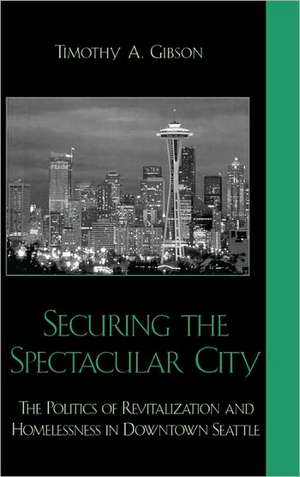
Securing the Spectacular City: The Politics of Revitalization and Homelessness in Downtown Seattle
Autor Timothy A. Gibsonen Limba Engleză Hardback – 5 noi 2003
Preț: 680.05 lei
Preț vechi: 1054.70 lei
-36%
Puncte Express: 1020
Carte tipărită la comandă
Livrare economică 19 noiembrie-03 decembrie
Livrare prin curier în România Termenul estimat este afișat lângă disponibilitate.
Transport gratuit pentru acest produs Plată online sau ramburs, în funcție de opțiunile comenzii.
Retur gratuit în 14 zile Comandă securizată și suport în română.
Specificații
ISBN-13: 9780739105696
ISBN-10: 0739105698
Pagini: 322
Dimensiuni: 158 x 236 x 29 mm
Greutate: 0.63 kg
Editura: Bloomsbury Publishing
Colecția Lexington Books
Locul publicării:New York, United States
ISBN-10: 0739105698
Pagini: 322
Dimensiuni: 158 x 236 x 29 mm
Greutate: 0.63 kg
Editura: Bloomsbury Publishing
Colecția Lexington Books
Locul publicării:New York, United States
V-ar putea interesa
-
 A Pattern Language: Towns, Buildings, ConstructionChristopher Alexander-8%Preț: 414.31 lei450.34 lei
 -
 Law and English Railway Capitalism 1825-1875R. W. Kostal-28%Preț: 514.61 lei716.92 lei
 -
 The Architecture of the CityAldo RossiPreț: 324.23 lei
 -
 Urban Coding and PlanningStephen Marshall-15%Preț: 435.94 lei512.88 lei
 -
 Proportion: Science, Philosophy, ArchitectureRichard Padovan-15%Preț: 690.19 lei811.99 lei
 -
 -8%Preț: 581.35 lei631.90 lei
 -
 Tour of Frank Gehry & Other L.A. ArchitectureLaura Massino SmithPreț: 80.95 lei
 -
 Towards an Urban RenaissanceThe Urban Task Force-25%Preț: 375.88 lei499.21 lei
Cuprins
Chapter 1 When Things Fall Apart
Part 1 Economic Crisis and the Mobilization of Spectacle
Chapter 2 Crisis and Opportunity in the Post-Fordist City
Part 2 Building the Spectacular City
Chapter 3 Seattle Elites and the Downtown Crisis
Part 3 Securing the Spectacular City
Chapter 4 Negotiating Urban Spectacle
Chapter 5 Public Resources, Private Power
Chapter 6 Securing Urban Spectacle
Chapter 7 The Urban Reststop vs. The World-Class City
Chapter 8 Defining Revitalization in the Spectacular City
Chapter 9 Building A City that Truly Lives
Part 1 Economic Crisis and the Mobilization of Spectacle
Chapter 2 Crisis and Opportunity in the Post-Fordist City
Part 2 Building the Spectacular City
Chapter 3 Seattle Elites and the Downtown Crisis
Part 3 Securing the Spectacular City
Chapter 4 Negotiating Urban Spectacle
Chapter 5 Public Resources, Private Power
Chapter 6 Securing Urban Spectacle
Chapter 7 The Urban Reststop vs. The World-Class City
Chapter 8 Defining Revitalization in the Spectacular City
Chapter 9 Building A City that Truly Lives
Recenzii
Securing the Spectacular City reveals that Seattle's construction as a media darling and high-tech metropolis is the product of a narrative that hides homelessness and poverty behind the facade of upscale consumption and downtown glitz. Gibson deftly situates Seattle's meteoric rise in the context of the sweeping events of globalization to make this a compelling story and an important addition to the urban literature.
In the tradition of Mike Davis on Los Angeles and Sharon Zukin on New York, Gibson examines the power politics that created today's Seattle. This careful and well-written account of Seattle's transformation from an industrial to a spectacular city examines the tradeoff between the gain produced by redevelopment through upscale leisure, tourism and consumption and the loss of public space for free speech, non-commercial pleasures, genuine social diversity, and sheer solitude.
Tim Adcock Gibson has written a fascinating, timely, and provocative analysis of urban development in Seattle in the 1990s. Sweeping in its scope, the book seemlessly integrates a wealth of primary research material with theoretical arguments from social theory, cultural geography, and contemporary cultural studies.
Timothy Gibson tells a fascinating story in Securing the Spectacular City. It is a story about Seattle's emergence as a world-class city and the decisions, manipulation, and backroom deals that led to its rise as a major player on the global stage.Although based on Seattle, the work has clear applications and lessons for most large cities in North America. It is, in essence, a case study of the conflicts and collisions that are all too commonplace between two groups in the urban United States. On one side are the civic boosters and the urban elite (for example, developers, real estate interests, and a seeming majority of any given community's politicians). On the other side are advocates for the disadvantaged and the disadvantaged themselves (for example, leaders of nonprofit agencies, socially oriented organizations and groups, low-income populations and the homeless). What one learns about the development process is quite revealing, making the book worthwhile reading for policymakers, academics interested in urban studies, and those from the development and real estate sector, whose decisions significantly affect the urban scene.
Gibson offers us an insightful theoretical analysis of the contemporary American city under conditions of globalization and welfare state devolution. These conditions push civic elites and business leaders into a merciless competition with other cities for jobs, business investment, tourists, and tax revenues at the expense of social justice and access to public space. His rich empirical story of Seattle explains how these dynamics play out to produce a metropolis where poverty and homelessness lie just beneath its spectacular veneer.
In the tradition of Mike Davis on Los Angeles and Sharon Zukin on New York, Gibson examines the power politics that created today's Seattle. This careful and well-written account of Seattle's transformation from an industrial to a spectacular city examines the tradeoff between the gain produced by redevelopment through upscale leisure, tourism and consumption and the loss of public space for free speech, non-commercial pleasures, genuine social diversity, and sheer solitude.
Tim Adcock Gibson has written a fascinating, timely, and provocative analysis of urban development in Seattle in the 1990s. Sweeping in its scope, the book seemlessly integrates a wealth of primary research material with theoretical arguments from social theory, cultural geography, and contemporary cultural studies.
Timothy Gibson tells a fascinating story in Securing the Spectacular City. It is a story about Seattle's emergence as a world-class city and the decisions, manipulation, and backroom deals that led to its rise as a major player on the global stage.Although based on Seattle, the work has clear applications and lessons for most large cities in North America. It is, in essence, a case study of the conflicts and collisions that are all too commonplace between two groups in the urban United States. On one side are the civic boosters and the urban elite (for example, developers, real estate interests, and a seeming majority of any given community's politicians). On the other side are advocates for the disadvantaged and the disadvantaged themselves (for example, leaders of nonprofit agencies, socially oriented organizations and groups, low-income populations and the homeless). What one learns about the development process is quite revealing, making the book worthwhile reading for policymakers, academics interested in urban studies, and those from the development and real estate sector, whose decisions significantly affect the urban scene.
Gibson offers us an insightful theoretical analysis of the contemporary American city under conditions of globalization and welfare state devolution. These conditions push civic elites and business leaders into a merciless competition with other cities for jobs, business investment, tourists, and tax revenues at the expense of social justice and access to public space. His rich empirical story of Seattle explains how these dynamics play out to produce a metropolis where poverty and homelessness lie just beneath its spectacular veneer.