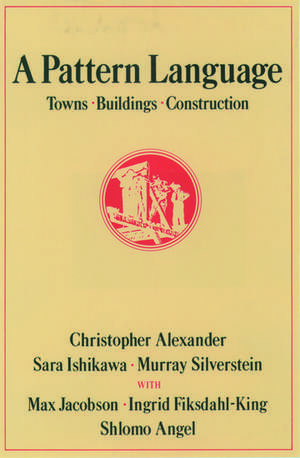
A Pattern Language: Towns, Buildings, Construction
Autor Christopher Alexanderen Limba Engleză Hardback – 17 aug 1978
Preț: 416.74 lei
Preț vechi: 452.98 lei
-8%
Puncte Express: 625
Carte disponibilă
Livrare economică 05-19 noiembrie
Livrare express 21-27 octombrie pentru 131.78 lei
Livrare prin curier în România Termenul estimat este afișat lângă disponibilitate.
Transport gratuit pentru acest produs Plată online sau ramburs, în funcție de opțiunile comenzii.
Retur gratuit în 14 zile Comandă securizată și suport în română.
Specificații
ISBN-13: 9780195019193
ISBN-10: 0195019199
Pagini: 1216
Ilustrații: photographs and drawings throughout
Dimensiuni: 144 x 204 x 46 mm
Greutate: 0.96 kg
Ediția:1
Editura: Oxford University Press
Colecția OUP USA
Locul publicării:New York, United States
ISBN-10: 0195019199
Pagini: 1216
Ilustrații: photographs and drawings throughout
Dimensiuni: 144 x 204 x 46 mm
Greutate: 0.96 kg
Ediția:1
Editura: Oxford University Press
Colecția OUP USA
Locul publicării:New York, United States
V-ar putea interesa
-
 GaudiGijs Van HensbergenPreț: 138.26 lei
 -
 The Timeless Way of BuildingChristopher Alexander-8%Preț: 398.69 lei433.36 lei
 -
 Inventing Future CitiesMichael Batty-21%Preț: 146.24 lei184.24 lei
 -
 The Image of the CityKevin LynchPreț: 277.67 lei
 -
 The Four Books of ArchitectureAndrea Palladio-18%Preț: 247.11 lei303.12 lei
 -
 ShadeSam BlochPreț: 197.19 lei
 -
 Notes on the Synthesis of FormChristopher AlexanderPreț: 235.55 lei
 -
 Preț: 119.82 lei
 -
 The Architecture of UrbanityVishaan ChakrabartiPreț: 242.47 lei
 -
 Building Structures IllustratedFrancis D. K. ChingPreț: 432.77 lei
 -
 -8%Preț: 522.41 lei567.84 lei
 -
 Preț: 476.46 lei
 -
 The Art of the New Urbanism, Volume 1Charles C. BohlPreț: 446.85 lei
 -
 The Four Books of ArchitectureAndrea PalladioPreț: 154.58 lei
 -
 His Dark MaterialsPhilip Pullman-21%Preț: 157.69 lei199.10 lei
 -
 Towards Another ArchitectureOwen HopkinsPreț: 309.95 lei
 -
 Draw in Order to SeeMark Alan HewittPreț: 224.40 lei
 -
 ResidensityGordon Gill ArchitecturePreț: 219.80 lei
 -
 100 Words for WaterEva Franch i GilabertPreț: 148.06 lei
 -
 On Architecture and the GreenfieldCharlotte Malterre-Barthes-21%Preț: 99.80 lei126.52 lei
 -
 Eine Muster-SpracheChristopher Alexander-14%Preț: 634.50 lei737.78 lei
Recenzii
A
Pattern
Language
by
Chris
Alexander
changed
the
way
I
think
about
the
way
space
is
organised
in
a
room,
a
house,
a
street
and
a
town
...
I
keep
giving
it
away
to
people
who
feel
their
homes
don't
quite
work
in
the
way
they
want
them
to.
Every
architect,
estage
agent
and
MP
should
read
it.