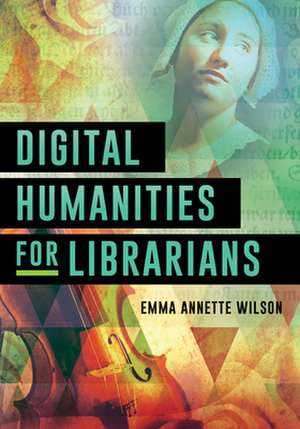
Digital Humanities for Librarians
Autor Emma Annette Wilsonen Limba Engleză Paperback – 15 ian 2020
Remarcăm în Digital Humanities for Librarians o abordare pragmatică, bazată pe studii de caz și documente de instruire care ghidează cititorul prin utilizarea tehnologiilor de cartografiere digitală, codificare de text (TEI și MEI) sau analiză computațională. Considerăm că forța acestui volum rezidă în echilibrul dintre tehnic și administrativ, oferind soluții concrete pentru bibliotecarii care trebuie să gestioneze proiecte complexe cu resurse financiare limitate.
Structura lucrării urmărește o progresie logică, de la definirea conceptului și a modelelor de suport în biblioteci, până la aspectele umane esențiale: formarea echipelor, managementul datelor și strategiile de colaborare. Spre deosebire de The Digital Humanities de Christopher Millson-Martula, care pune accent pe dezbaterea teoretică și inițiativele academice largi, volumul scris de Emma Annette Wilson funcționează ca un manual aplicat, oferind pași de urmat pentru implementarea efectivă a arhivelor și expozițiilor digitale. Cititorii familiarizați cu Digital Humanities in Practice vor aprecia aici focalizarea specifică pe rolul bibliotecarului ca manager de proiect și consultant, nu doar ca furnizor de conținut.
Această lucrare reprezintă o evoluție firească în opera autoarei, care a explorat anterior utilizarea tehnologiilor în educație în Quick Hits for Teaching with Digital Humanities. Dacă în volumul anterior accentul era pus pe strategii de predare la clasă, în Digital Humanities for Librarians Emma Annette Wilson își folosește experiența de coordonator al centrului Digitorium pentru a oferi un ghid de supraviețuire și dezvoltare instituțională. Este o resursă esențială pentru curriculumul de biblioteconomie, integrând armonios „partea digitală” (codificarea și bazele de date) cu „partea umană” (interviul de referință și sustenabilitatea).
Preț: 345.80 lei
Preț vechi: 462.30 lei
-25%
Carte tipărită la comandă
Livrare economică 07-21 decembrie
Specificații
ISBN-10: 1538116456
Pagini: 272
Ilustrații: 5 b/w illustrations; 2 tables; 13 textboxes
Dimensiuni: 177 x 253 x 16 mm
Greutate: 0.44 kg
Editura: Bloomsbury Publishing
Colecția Rowman & Littlefield
Locul publicării:New York, United States
V-ar putea interesa
-
 Feminist Digital Humanities: Intersections in PracticeLisa Marie RhodyPreț: 189.80 lei
 -
 Preț: 386.30 leiRecomandat
 -
 -13%Preț: 166.26 lei190.39 lei
 -
 -21%Preț: 184.49 lei234.61 lei
 -
 The Bloomsbury Handbook to the Digital HumanitiesDr. James O’Sullivan-46%Preț: 140.70 lei259.12 lei
 -
 Computational HumanitiesJessica Marie JohnsonPreț: 291.60 lei
 -
 Digital Futures of Graduate Study in the HumanitiesGabriel HankinsPreț: 289.08 lei
 -
 Doing digital historyJane WintersPreț: 131.73 lei
 -
 Practical Project Management for LibrariansKirsten Clark-16%Preț: 167.93 lei201.07 lei
 -
 Digital Asset Management for MuseumsMargaret C. McKee-27%Preț: 440.23 lei601.02 lei
 -
 Digital Preservation for Libraries, Archives, and MuseumsEdward M. Corrado-17%Preț: 251.80 lei303.67 lei
 -
 The Special Collections HandbookAlison Cullingford-19%Preț: 545.14 lei673.02 lei
 -
 Preț: 306.75 lei
 -
 Cultural Data ScienceHarald Klinke-20%Preț: 609.25 lei761.56 lei
 -
 Artificial Intelligence for LibrariesBrady D. Lund-11%Preț: 341.76 lei385.57 lei
 -
 -20%Preț: 258.92 lei324.42 lei
De ce să citești această carte
Recomandăm această carte bibliotecarilor și studenților la Științele Informării care doresc să treacă de la teorie la practică în Digital Humanities. Veți câștiga competențe clare în managementul proiectelor digitale și strategii de colaborare, învățând cum să dezvoltați programe sustenabile chiar și cu bugete restrânse. Este ghidul ideal pentru a transforma biblioteca într-un centru activ de cercetare digitală.
Descriere
Digital Humanities For Librarians. Some librarians are born to digital humanities; some aspire to digital humanities; and some have digital humanities thrust upon them. Digital Humanities For Librarians is a one-stop resource for librarians and LIS students working in this growing new area of academic librarianship. The book begins by introducing digital humanities, addressing key questions such as, "What is it?", "Who does it?", "How do they do it?", "Why do they do it?", and "How can I do it?". This broad overview is followed by a series of practical chapters answering those questions with step-by-step approaches to both the digital and the human elements of digital humanities librarianship. Digital Humanities For Librarians covers a wide range of technologies currently used in the field, from creating digital exhibits, archives, and databases, to digital mapping, text encoding, and computational text analysis (big data for the humanities). However, the book never loses sight of the all-important human component to digital humanities work, and culminates in a series of chapters on management and personnel strategies in this area. These chapters walk readers through approaches to project management, effective collaboration, outreach, the reference interview for digital humanities, sustainability, and data management, making this a valuable resource for administrators as well as librarians directly involved in digital humanities work. There is also a consideration of budgeting questions, including strategies for supporting digital humanities work on a shoestring. Special features include: ·Case studies of a wide range of projects and management issues ·Digital instructional documents guiding readers through specific digital technologies and techniques ·An accompanying website featuring digital humanities tools and resources and digital interviews with librarians and scholars leading the way in digital humanities work across North America, from a range of larger and smaller institutions Whether you are a librarian primarily working in digital humanities for the first time, a student hoping to do so, or a librarian in a cognate area newly-charged with these responsibilities, Digital Humanities For Librarians will be with you every step of the way, drawing on the author's experiences and those of a network of librarians and scholars to give you the practical support and guidance needed to bring your digital humanities initiatives to life.
Cuprins
Preface
Part 1: What is Digital Humanities?
What is Digital Humanities?Who is Doing Digital Humanities?Library Models for Supporting Digital HumanitiesPart 2: The Digital Part of Digital Humanities
Metadata and Digital HumanitiesCreating Digital Exhibitions, Archives, and DatabasesText Encoding with the Text Encoding Initiative (TEI) and Music Encoding Initiative (MEI)Digital MappingComputational Text Analysis, or, Big Data for Digital HumanitiesPart 3: The Human Part of Digital Humanities
Outreach for Digital HumanitiesWho is on My Team? Collaborators in Digital HumanitiesProject Management for Digital HumanitiesManaging Humans in Digital Humanities ProjectsManaging Data in Digital Humanities ProjectsAccompanying website: http://dhforlibrarians.com.
Recenzii
Wilson has written the comprehensive textbook on digital humanities (DH) work in libraries that she never had as a student or beginning practitioner. She reviews the theoretical and historical underpinnings of DH, then delves into the practice of librarians and their many roles on DH projects. Additional chapters focus on major projects, such as the Text Encoding Initiative, which leverages markup language to describe and provide access to manuscript material, marginalia, and a variety of other corpora. The author also considers technology and provides sample markup language, platform, and vendor information. Each chapter contains exercises that would be useful in a classroom environment, as well as references to more detailed works for further consultation. The real strength is in the third section, which focuses on the "humans in digital humanities," particularly with respect to establishing an outreach program. This work should be a core text for courses in MLIS programs and will be helpful for librarians beginning work in DH.
Wilson (Univ. of Alabama libraries) offers an impressively practical guide to the complex, interdisciplinary world of the digital humanities. She explains the technical side of digital humanities, including details on the most relevant digital humanities tools-for example, the Text Encoding Initiative (TEI), digital mapping, and big data analysis-and their uses in digital exhibitions. She also provides a digestible explanation of metadata types and their uses. In the final section, Wilson offers a lens library professionals can use to clearly define their roles, specifically enumerating the responsibilities of various digital humanities positions in libraries and the tasks involved in digital humanities projects. Wilson closes each chapter with thorough notes and selected resources for additional reading, along with a handful of exercises centered on the chapter's topic. These exercises support the suitability of this text for a digital humanities graduate course. Wilson's obvious expertise in the field renders Digital Humanities for Librarians at once a valuable, suitably detailed guide for those already in the library and information science profession and a trustworthy textbook for those preparing to enter the field. Summing Up: Recommended. Graduate students, researchers, faculty, and professionals.
Emma Wilson's Digital Humanities for Librarians is a welcome addition to the reading lists of academic librarians, administrators, and faculty who are engaged in DH work or who are toying with the idea of getting started. Building upon her years of experience at the University of Alabama and the convener of several DH conferences, Wilson writes from experience as well as with authority and clarity in answering key questions about what DH is and how and why libraries are at the core of this work before diving into five approaches (focusing on metadata, exhibitions, text encoding, digital mapping, and computational analysis) and the corollary skills and framing required by all collaborators who strive to see every project through to a successful launch. In short, Wilson has created an essential field guide for starting, sustaining, and accelerating digital humanities projects and collaborative environments where the library and librarians are front and center.
Emma Annette Wilson has drawn on her experience as head of the Alabama Digital Humanities Center, University of Alabama Libraries, to provide a road map for librarians involved in digital services and other related job positions. Digital Humanities for Librarians is a welcome introduction to this growing, inter-disciplinary field. The author herself is now an Assistant Professor of English, Southern Methodist University, and the book has the distinction of being the first single-author textbook on the digital humanities for librarians, and is intended for use in the classroom. Digital Humanities for Librarians is a useful, well-conceived book, which should be of equal use to both the practitioner and the student.
Emma Annette Wilson has pulled together a very approachable and packed resource for aspiring Master of Library Science (MLS) students and those new to digital humanities (DH). The book is as easy to follow as it is informative, providing a balance between the practicality of various digital humanities methodologies, the development of those methodologies, and approaches to engage with them.