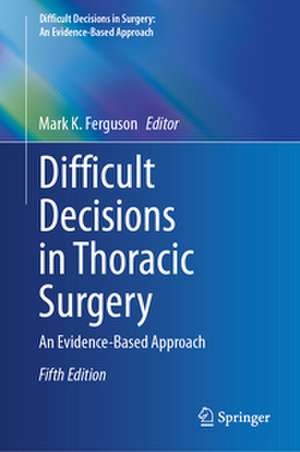
Difficult Decisions in Thoracic Surgery: Difficult Decisions in Surgery: An Evidence-Based Approach
Editat de Mark K. Fergusonen Limba Engleză Hardback – 11 feb 2025

Preț: 1647.11 lei
Preț vechi: 1733.80 lei
-5%
Puncte Express: 2471
Carte tipărită la comandă
Livrare economică 26 noiembrie-02 decembrie
Livrare prin curier în România Termenul estimat este afișat lângă disponibilitate.
Transport gratuit pentru acest produs Plată online sau ramburs, în funcție de opțiunile comenzii.
Retur gratuit în 14 zile Comandă securizată și suport în română.
Specificații
ISBN-13: 9783031786624
ISBN-10: 3031786629
Pagini: 700
Dimensiuni: 160 x 241 x 41 mm
Greutate: 1.28 kg
Ediția:Fifth Edition 2024
Editura: Springer
Colecția Difficult Decisions in Surgery: An Evidence-Based Approach
Seria Difficult Decisions in Surgery: An Evidence-Based Approach
ISBN-10: 3031786629
Pagini: 700
Dimensiuni: 160 x 241 x 41 mm
Greutate: 1.28 kg
Ediția:Fifth Edition 2024
Editura: Springer
Colecția Difficult Decisions in Surgery: An Evidence-Based Approach
Seria Difficult Decisions in Surgery: An Evidence-Based Approach
V-ar putea interesa
-
 Cardiothoracic Critical CareRobyn Smith-21%Preț: 360.34 lei457.32 lei
 -
 Oxford Handbook of Clinical SurgeryAnil AgarwalPreț: 303.07 lei
 -
 Cardiothoracic SurgeryJoanna Chikwe-22%Preț: 704.45 lei905.26 lei
 -
 Decision Making in Medicine: An Algorithmic ApproachStuart B. Mushlin-5%Preț: 772.18 lei812.82 lei
 -
 Sabiston Textbook of Surgery: The Biological Basis of Modern Surgical PracticeDouglas Scott Tyler-29%Preț: 1169.15 lei1645.26 leiRecomandat
 -
 Kirk's General Surgical OperationsRichard Novell-5%Preț: 944.50 lei994.20 lei
 -
 -30%Preț: 1315.82 lei1888.17 lei
 -
 -5%Preț: 1511.51 lei1591.06 leiRecomandat
 -
 Master Techniques in Surgery: Thoracic Surgery: Lung Resections, BronchoplastyDouglas J. Mathisen MD-24%Preț: 1640.59 lei2165.79 lei
 -
 Top Knife: The Art & Craft of Trauma SurgeryAsher Hirshberg MD-25%Preț: 234.81 lei312.58 lei
 -
 Evidence for Vascular Surgery: 2nd EditionJ J Earnshaw-20%Preț: 429.34 lei537.16 lei
 -
 Clinical Surgery Made Easy: A Companion to Problem-Based LearningProfessor Mohan de Silva MS FRCS-21%Preț: 313.95 lei397.69 lei
 -
 Key Questions in Cardiac SurgeryNarain Moorjani-21%Preț: 490.81 lei620.05 lei
 -
 -26%Preț: 179.39 lei241.90 lei
 -
 Key Questions in Thoracic SurgeryNarain Moorjani-19%Preț: 549.54 lei679.15 lei
 -
 The General Surgeon: Recollections from Four ContinentsMoshe Schein MD FACS FCS-17%Preț: 122.87 lei147.55 lei
 -
 -21%Preț: 1138.46 lei1444.18 lei
 -
 Fischer's Mastery of Surgery: Print + eBook with MultimediaE. Christopher Ellison-21%Preț: 2761.87 lei3499.03 lei
 -
 Complex General Surgical OncologyCarl Schmidt-5%Preț: 434.60 lei457.48 lei
 -
 Chest SurgeryHendrik C. Dienemann-5%Preț: 1711.44 lei1801.52 lei
Cuprins
1. Introduction.- 2. Evidence based medicine: levels of evidence and evaluation systems.- 3. Decision analytic techniques and other decision processes.- 4. Decision making - the surgeon's perspective.- 5. Decision making - the patient's perspective.- 6. EBUS vs mediastinoscopy for initial pathologic mediastinal staging in NSCLC.- 7. Is preoperative smoking cessation for lung resection patients effective in reducing surgical morbidity.- 8. Is low tech as good as high tech exercise testing in assessing healthy candidates for lung resection.- 9. Does assessment of frailty and sarcopenia in lung resection candidates affect oatient selection.- 10. Can frailty and sarcopenia be mitigated in lung resection candidates.- 11. Is antibiotic prophylaxis necessary for major lung resection.- 12. Uniportal vs multiportal VATS lobectomy.- 13. Robotic vs VATS for major lung resection.- 14. Does intrapleural therapy for persistent postoperative air leak reduce air leak duration.- 15. Segmentectomy vs lobectomy in patients with good pulmonary function.- 16. Is resection of persistent N2 disease after induction therapy effective.- 17. N2 disease discovered at the time of lung resection - resect or abort?.- 18. Is lung resection safe after immunotherapy.- 19. Is an enhanced recovery programs for lobectomy patients effective in improving surgical outcomes.- 20. Resection vs SBRT for stage I NSCLC in patients with good pulmonary function.- 21. Do endobronchial valves assist in resolution of postoperative persistent air leak.- 22. Is long-term surveillance effective after resection of stage I NSCLC.- 23. Does ECMO for lung failure in ICU patients improve survival.- 24. Does resection of oligometastatic disease in lung cancer patients improve survival.- 25. Is pulmonary metastasectomy effective in prolonging survival.- 26. Resection vs endoscopic therapy for T1bN0 esophageal adenocarcinoma.- 27. Does induction therapy for T2N0 esophageal adenocarcinoma improve survival.- 28. Do enhanced recovery programs for esophagectomy patients improve outcomes.- 29. Does jejunostomy after esophagectomy improve outcomes.- 30. Surgery vs definitive chemoradiotherapy for regionally advanced esophageal squamous cell cancer.- 31. Open vs robotic resection for esophageal adenocarcinoma.- 32. Two-field vs three-field lymphadenectomy for esophageal adenocarcinoma.- 33. Is resection of more nodes better for treating esophageal cancer.- 34. Salvage esophagectomy for persistent disease after definitive chemoradiotherapy.- 35. Early postoperative feeding after esophagectomy.- 36. Stent vs primary repair for esophageal perforation.- 37. Sump therapy vs stenting for esophageal anastomotic leak.- 38. Thoracoscopic vs endoscopic therapy for small submucosal esophageal tumors.- 39. Laparoscopic vs endoscopic therapy for achalasia.- 40. Laparoscopy or endoscopic therapy for recurrent symptoms from achalasia.- 41. Laparoscopy or thoracotomy for symptomatic recurrent paraesophageal hernia.- 42. Does diaphragm pacing for bilateral phrenic nerve paralysis improve function or quality of life.- 43. Does phrenic nerve reconstruction for unilateral diaphragm paralysis improve function or quality of life.- 44. Is plication for diaphragmatic eventration effective in improving function.- 45. Is temporary transvenous pacing effective in ventilator weaning.- 46. Does temporary diaphragm paralysis aid in eliminanting residual pleural space after lung resection.- 47. Is long-term stenting for benign airway obstruction effective.- 48. Are engineered tissues useful for tracheal reconstruction.- 49. Are positive margins acceptable in resection for low grade malignancies.- 50. Optimal management of posttransplant brochial stenosis - stenting or reoperation.- 51. Is tPA/Dnase therapy effective for managing pleural empyema.- 52. VATS vs open management of pleural empyema.- 53. Indewlling catheter vs chemical pleurodesis for symptomatic malignant pleural effusion.- 54. Extended pleurectomy sparing the diaphragm for malignant pleural mesothelioma.- 55. Quality of life: EPD vs EPP.- 56. Does thymectomy improve outcomes for myasthenia gravis.- 57. MRI for evaluation of suspected encapsulated thymoma.- 58. Lobectomy vs thymectomy for encapsulated thymoma.- 59. Robotic vs VATS thymectomy for thymoma.- 60. Resection of mediastinal parathyroid adenomas.- 61. Thymectomy in the setting of pleural metastases.- 62. Sympathectomy for malignant ventricular arrhythmias.- 63. Extent of surgery for palmar hyperhidrosis.- 64. Synthetic vs biologic reconstruction of bony chest wall defects.- 65. Traumatic rib fracture: conservative therapy or surgical fixation?.- 66. Is surgical management of flail chest effective.- 67. Epidural vs regional blocks for VATS and thoracotomy.- 68. Pectus deformities in adults - when is surgery indicated?.- 69. Pectus deformities in adults - Nuss bar vs open repair.
Notă biografică
Mark K. Ferguson, MD, is Professor of Surgery at University of Chicago Medical Center. He specializes in the surgical management of malignant and benign thoracic diseases. He has served on the boards and committees of numerous national societies and institutions including the Food and Drug Administration (FDA) and the National Institutes of Health. Dr. Ferguson has edited or authored books on esophageal reconstructive surgery, failed anti-reflux therapy, and decision-making in thoracic surgery, and two atlases of general thoracic surgery. Dr. Ferguson serves as an editor or associate editor for a number of cardiothoracic surgery journals. His research interests include risk analysis, long-term outcomes after cancer surgery, bias in medical care, and surgical education.
Textul de pe ultima copertă
This updated volume provides a practical guide to decision making within thoracic surgery. Focussed chapters contain pithy analyses and recommendations that allow useful information to be identified at a glance. All new chapters bring insight into the challenges faced operating on the lung, esophagus, diaphragm, airway, pleaura, mediastinum, and chest wall.
Difficult Decisions in Thoracic Surgery aims to help the reader navigate the complexities of thoracic surgery through clearly formatted and evidence-based chapters. The book is relevant to practicing and trainee surgeons, as well as medical professionals working within thoracic surgery.
Difficult Decisions in Thoracic Surgery aims to help the reader navigate the complexities of thoracic surgery through clearly formatted and evidence-based chapters. The book is relevant to practicing and trainee surgeons, as well as medical professionals working within thoracic surgery.
Caracteristici
Features new chapters on challenges faced operating on the lung and esophagus Contains a practical focus detailing information in an easy-to-digest format Provides recommendations of best practice for a range of scenarios