
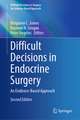
Difficult Decisions in Colorectal Surgery: Difficult Decisions in Surgery: An Evidence-Based Approach
Editat de Konstantin Umanskiy, Neil Hymanen Limba Engleză Paperback – 9 ian 2025


Preț: 1207.76 lei
Preț vechi: 1271.33 lei
-5%
Puncte Express: 1812
Carte tipărită la comandă
Livrare economică 01-07 decembrie
Livrare prin curier în România Termenul estimat este afișat lângă disponibilitate.
Transport gratuit pentru acest produs Plată online sau ramburs, în funcție de opțiunile comenzii.
Retur gratuit în 14 zile Comandă securizată și suport în română.
Specificații
ISBN-13: 9783031423055
ISBN-10: 3031423054
Pagini: 692
Dimensiuni: 155 x 235 x 37 mm
Greutate: 1.03 kg
Ediția:Second Edition 2023
Editura: Springer
Colecția Difficult Decisions in Surgery: An Evidence-Based Approach
Seria Difficult Decisions in Surgery: An Evidence-Based Approach
ISBN-10: 3031423054
Pagini: 692
Dimensiuni: 155 x 235 x 37 mm
Greutate: 1.03 kg
Ediția:Second Edition 2023
Editura: Springer
Colecția Difficult Decisions in Surgery: An Evidence-Based Approach
Seria Difficult Decisions in Surgery: An Evidence-Based Approach
V-ar putea interesa
-
 Colorectal SurgeryRichard G Molloy-21%Preț: 620.31 lei789.96 lei
 -
 Oxford Handbook of Clinical SurgeryAnil AgarwalPreț: 303.07 lei
 -
 Sabiston Textbook of Surgery: The Biological Basis of Modern Surgical PracticeDouglas Scott Tyler-29%Preț: 1169.15 lei1645.26 leiRecomandat
 -
 Surgery of the Anus, Rectum and Colon, 2- Volume SetMichael R. B. Keighley-26%Preț: 2962.79 lei4012.54 lei
 -
 Kirk's General Surgical OperationsRichard Novell-5%Preț: 944.50 lei994.20 lei
 -
 Principles and Practice of SurgeryO. James Garden-29%Preț: 391.49 lei548.90 lei
 -
 -28%Preț: 596.77 lei825.93 lei
 -
 -30%Preț: 1315.82 lei1888.17 lei
 -
 -5%Preț: 1525.26 lei1605.54 leiRecomandat
 -
 Colorectal Surgery: Expert Consult - Online and PrintH. Randolph Bailey-26%Preț: 872.64 lei1179.04 lei
 -
 Frontiers in Colorectal SurgeryRobin K S Phillips-19%Preț: 290.86 lei361.18 lei
 -
 Evidence for Vascular Surgery: 2nd EditionJ J Earnshaw-20%Preț: 429.34 lei537.16 lei
 -
 -5%Preț: 589.77 lei620.80 lei
 -
 The General Surgeon: Recollections from Four ContinentsMoshe Schein MD FACS FCS-18%Preț: 119.23 lei144.62 lei
 -
 Fischer's Mastery of Surgery: Print + eBook with MultimediaE. Christopher Ellison-21%Preț: 2761.87 lei3499.03 lei
 -
 Essential Articles in Colorectal SurgeryDorin Colibaseanu-5%Preț: 557.97 lei587.35 lei
 -
 Surgical Intensive Care MedicineJohn M. O'Donnell-5%Preț: 1584.98 lei1668.40 lei
Cuprins
1. Inflammatory Bowel Disease.- What are the treatment options for painful anal fissure in patients with Crohn’s disease?.- Elective surgical management in patients with ulcerative colitis: How many stages?.- Which patients with ulcerative colitis benefit from ileal pouch-anal anastomosis?.- How to manage pouch-perineal and pouch-vaginal fistula after ileal pouch–anal anastomosis.- Ileal pouch–anal anastomosis failure: what to do?.- Perioperative Steroid Management in IBD Patients Undergoing Colorectal Surgery.- Colonic dysplasia in patients with Ulcerative Colitis. Endoscopic or surgical management?.- Which patients benefit from biologic agents to prevent disease recurrence after resection in Crohn’s disease?.- 2. Colon Cancer.- Is intensive surveillance necessary after curative resection for colon cancer?.- Surgical vs endoscopic options for management of malignant large bowel obstruction.- Metastatic colorectal cancer in the asymptomatic patient. Is there a benefit in resection of primary tumor?.- What are the options for management of large colonic polyps?.- Management of the malignant colon polyp. Colon resection or surveillance?.- Stage II Colon Cancer: Towards an individualized treatment approach.- Is there a benefit in cytoreduction and hyperthermic intraperitoneal chemotherapy in colorectal cancer?.- CRC management in elderly frail patients. Treatment for cure vs palliation.- Colon cancer in the splenic flexure. Which operation?.- 3. Rectal Cancer.- Can total mesorectal excision be avoided in T2 rectal cancer?.- Watch and wait vs conventional surgical treatment in rectal cancer.- Which patients are the right candidates for total neoadjuvant therapy (TNT)?.- Management of the Patient with Rectal Cancer Presenting with Synchronous Liver Metastasis.- Who Needs a Loop Ileostomy After Low Anterior Resection for Rectal Cancer?.- Reoperative Surgery for Locally Recurrent Rectal Cancer.- 4. Anal Dysplasia/Cancer.- Intensive vs conservative management of patients with low grade squamous intraepithelial lesions.- How aggressive should we be in magement of patients with high grade squamous intraepithelial lesion?.- Is high resolution anoscopy superior to direct evaluation of anal dysplasia?.- 5. Benign Colon Disease.- Surgical management options in severe difficile.- Are antibiotics needed for the management of uncomplicated diverticulitis?.- Do We Need to Operate on Patients After Successful Percutaneous Drainage of a Diverticular Abscess?.- How to manage diverticular abscess not amenable to percutaneous drainage?.- Hartmann procedure vs primary anastomosis for acute complicated diverticulitis.- Deciding on an IRA vs. IPAA for FAP.- Rectal prolapse: Rectopexy vs perineal proctosigmoidectomy.- Optimal Management of the Transsphincteric Anal Fistula Surgery vs. conservative management for third degree hemorrhoids?.- Management options for bleeding hemorrhoids in a patients on anticoagulation.- Operative vs non-operative management of outlet obstruction.- 6. Quality Improvement.- Is bowel prep necessary for patients undergoing colon resection?.- Enhanced recovery vs conventional perioperative management.- 7. Technique Intracorporeal vs extracorporeal anastomosis for right colectomy.- Management of anastomotic leak following low anterior resection.- Colorectal anastomosis construction: Is there a benefit to a reservoir?.- Management of the Unhealed Perineal Wound After Proctectomy.- Gender affirmation procedure: what are the reconstructive options?.
Notă biografică
Neil H. Hyman, MD, has authored more than 250 peer-reviewed original articles or textbook chapters. He serves as Associate Editor for the Annals of Surgery and the Journal of Gastrointestinal Surgery. . In addition, he has been an invited Visiting Professor at many academic institutions and presented his work at invited lectureships around the world. He has been President of the American Society of Colon and Rectal Surgeons and served on the American Board of Colon and Rectal Surgery. Dr. Hyman is consistently named to the list of Best Doctors in America by Best Doctors, Inc. and America's Top Doctors for Cancer by Castle Connolly Medical Ltd.
Konstantin Umanskiy, MD, specializes in the treatment of a wide variety of colon and rectal diseases such as colon and rectal cancer, inflammatory bowel disease (ulcerative colitis and Crohn’s disease), complex anorectal disorders and diverticulitis. His area of clinicaland research interests include the treatment of patients with pelvic floor disorders (constipation, incontinence and pelvic organ prolapse). Dr. Umanskiy uses traditional surgical approaches, as well as state-of-the-art minimally invasive laparoscopic and robotic techniques. Dr. Umanskiy has strong clinical and research interests in innovative surgical techniques, especially robotic and telemedicine applications for colon and rectal surgery.
Konstantin Umanskiy, MD, specializes in the treatment of a wide variety of colon and rectal diseases such as colon and rectal cancer, inflammatory bowel disease (ulcerative colitis and Crohn’s disease), complex anorectal disorders and diverticulitis. His area of clinicaland research interests include the treatment of patients with pelvic floor disorders (constipation, incontinence and pelvic organ prolapse). Dr. Umanskiy uses traditional surgical approaches, as well as state-of-the-art minimally invasive laparoscopic and robotic techniques. Dr. Umanskiy has strong clinical and research interests in innovative surgical techniques, especially robotic and telemedicine applications for colon and rectal surgery.
Textul de pe ultima copertă
This thoroughly revised second edition reflects the exponential growth in the complex field of decision making in colorectal surgery, since the first edition published in 2017. Recommendations are based on newly published data and this book has 30% new additions with 58% chapters completely rewritten by new authors. The chapters in each volume adhere to a specific format. This approach provides uniformity to the presentations, making it possible to identify useful material at a glance.
Covering new technology, brief chapters are multi-authored, and each devoted to one or two specific questions or decisions within that specialty that are difficult or controversial.
Physicians from nonsurgical specialties give alternative and competing therapies for what was once the exclusive province of the surgeon.
Covering new technology, brief chapters are multi-authored, and each devoted to one or two specific questions or decisions within that specialty that are difficult or controversial.
Physicians from nonsurgical specialties give alternative and competing therapies for what was once the exclusive province of the surgeon.
Caracteristici
Use of a PICO table and recommendation boxes allows the reader to easily identify useful clinical guidelines Each chapter has questions using standard formatting so the reader can quickly identify the issue at hand A new edition written by recognized experts in the field