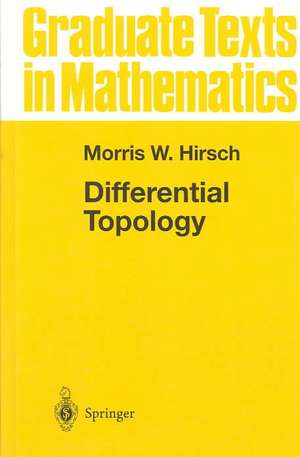
Differential Topology: Graduate Texts in Mathematics, cartea 33
Autor Morris W. Hirschen Limba Engleză Hardback – iul 1976
Cititorii familiarizați cu A Short Course in Differential Topology de Bjørn Ian Dundas vor aprecia în lucrarea lui Morris W. Hirsch o focalizare mult mai accentuată pe aspectele geometrice și intuitive, realizată prin eliminarea deliberată a formalismului greoi al topologiei algebrice. În timp ce alte cursuri introduc rapid omologia, Differential Topology alege să distileze conceptele de bază — cum ar fi gradul unei aplicații sau numărul Euler — direct din materia primă a geometriei și analizei. Considerăm că această abordare oferă o fundație solidă înainte ca studentul să treacă la tehnici abstracte. Poziționată în contextul operei autorului, această carte servește drept ancoră teoretică pentru lucrările sale mai aplicate, precum Differential Equations, Dynamical Systems, and an Introduction to Chaos. Dacă în textele despre sisteme dinamice accentul cade pe evoluție și stabilitate, aici Morris W. Hirsch investighează structura intrinsecă a spațiilor pe care au loc aceste fenomene. Structura volumului este una progresivă: pornește de la definirea varietăților și a structurilor diferențiale, trece prin studiul spațiilor de funcții și al transversalității (unde este prezentată teorema Morse-Sard) și culminează cu elemente fundamentale de teorie Morse și mănunchiuri vectoriale. Observăm un echilibru pedagogic rar: autorul a inclus sute de exerciții care extind teoria fără a fragmenta demonstrațiile principale. Publicată de Springer, această ediție rămâne un text de referință la nivel universitar (Graduate) tocmai pentru că reușește să prezinte o tratare cuprinzătoare a topologiei diferențiale în puțin peste 200 de pagini, menținând în același timp rigoarea matematică necesară.
Din seria Graduate Texts in Mathematics
- 13%
 Preț: 407.97 lei
 -
 Preț: 401.21 lei
 -
 Preț: 508.82 lei
 - 15%
 Preț: 414.37 lei
 - 15%
 Preț: 552.46 lei
 - 15%
 Preț: 407.56 lei
 - 15%
 Preț: 530.03 lei
 - 15%
 Preț: 448.00 lei
 - 15%
 Preț: 412.20 lei
 - 15%
 Preț: 413.35 lei
 - 15%
 Preț: 450.20 lei
 - 15%
 Preț: 449.14 lei
 - 15%
 Preț: 530.66 lei
 - 15%
 Preț: 418.70 lei
 - 15%
 Preț: 486.50 lei
 - 15%
 Preț: 526.92 lei
 - 13%
 Preț: 406.59 lei
 -
 Preț: 446.38 lei
 - 15%
 Preț: 579.99 lei
 -
 Preț: 381.34 lei
 - 15%
 Preț: 455.36 lei
 - 15%
 Preț: 560.82 lei
 - 17%
 Preț: 445.95 lei
 - 15%
 Preț: 590.39 lei
 -
 Preț: 500.30 lei
 -
 Preț: 451.05 lei
 -
 Preț: 386.90 lei
 - 15%
 Preț: 614.52 lei
 - 15%
 Preț: 477.57 lei
 -
 Preț: 460.05 lei
 - 15%
 Preț: 498.36 lei
 -
 Preț: 504.56 lei
 - 18%
 Preț: 808.24 lei
 -
 Preț: 472.04 lei
 - 15%
 Preț: 621.81 lei
 -
 Preț: 398.40 lei
 - 15%
 Preț: 656.51 lei
Preț: 448.85 lei
Preț vechi: 540.78 lei
-17%
Carte indisponibilă temporar
Specificații
ISBN-10: 0387901485
Pagini: 240
Ilustrații: X, 222 p.
Dimensiuni: 160 x 241 x 19 mm
Greutate: 0.48 kg
Ediția:1976
Editura: Springer
Colecția Graduate Texts in Mathematics
Seria Graduate Texts in Mathematics
Locul publicării:New York, NY, United States
V-ar putea interesa
-
 -23%Preț: 158.84 lei205.91 lei
 -
 -32%Preț: 526.37 lei770.55 lei
 -
 An Introductory Course in Commutative AlgebraA. W. Chatters-20%Preț: 362.22 lei450.89 lei
 -
 Fractals: A User's Guide for the Natural SciencesHarold M. Hastings-30%Preț: 496.09 lei710.78 lei
 -
 Projective Geometry: An introductionRey Casse-29%Preț: 462.56 lei648.40 lei
 -
 Chaos and FractalsHeinz-Otto Peitgen-23%Preț: 724.70 lei941.16 lei
 -
 Fractals and Scaling in FinanceBenoit B. Mandelbrot-18%Preț: 1049.92 lei1280.39 lei
 -
 Geometry: Euclid and BeyondRobin HartshornePreț: 508.72 lei
 -
 Topology from the Differentiable ViewpointJohn MilnorPreț: 375.92 lei
 -
 Drawing GeometryJon AllenPreț: 94.11 lei
 -
 The Foundations of GeometryDavid HilbertPreț: 69.28 lei
 -
 Geometry and PhysicsJürgen Jost-15%Preț: 489.53 lei575.92 lei
 -
 Computational GeometryMark de BergPreț: 441.16 lei
 -
 Gems of GeometryJohn Barnes-8%Preț: 420.17 lei456.71 lei
 -
 Diagram GeometryFrancis Buekenhout-18%Preț: 718.47 lei876.18 lei
Public țintă
GraduateDe ce să citești această carte
Această carte este ideală pentru studenții la matematică sau fizică teoretică care doresc să înțeleagă varietățile diferențiabile fără a fi copleșiți de topologia algebrică. Veți câștiga o perspectivă geometrică clară asupra unor concepte precum imersiunile, scufundările și numărul Euler. Este o resursă excelentă de auto-studiu datorită setului vast de exerciții și a cerințelor minime de pregătire prealabilă (analiză și topologie generală).
Descriere scurtă
Cuprins
Recenzii
Differential Topology
"A very valuable book. In little over 200 pages, it presents a well-organized and surprisingly comprehensive treatment of most of the basic material in differential topology, as far as is accessible without the methods of algebraic topology. Newly introduced concepts are usually well motivated, and often the historical development of an idea is described. There is an abundance of exercises, which supply many beautiful examples and much interesting additional information, and help the reader to become thoroughly familiar with the material of the main text. "—MATHEMATICAL REVIEWS