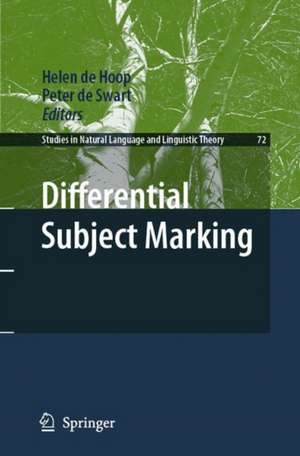
Differential Subject Marking
Editat de Helen De Hoop, Peter De Swarten Limba Engleză Hardback – 12 feb 2008
Relatively much is known about cross-linguistic variation in the marking of subjects, yet little attempt has been made to formalize the facts. This volume aims to unify formal approaches to language and presents both specific case studies of DSM and theoretical approaches.
| Toate formatele și edițiile | Preț | Express |
|---|---|---|
| Paperback (1) | 1171.01 lei 6-8 săpt. | |
| Springer – 12 mar 2009 | 1171.01 lei 6-8 săpt. | |
| Hardback (1) | 1176.59 lei 6-8 săpt. | |
| Springer – 12 feb 2008 | 1176.59 lei 6-8 săpt. |
Preț: 1176.59 lei
Preț vechi: 1434.86 lei
-18% Nou
Puncte Express: 1765
Preț estimativ în valută:
208.20€ • 244.14$ • 182.85£
208.20€ • 244.14$ • 182.85£
Carte tipărită la comandă
Livrare economică 13-27 februarie
Preluare comenzi: 021 569.72.76
Specificații
ISBN-13: 9781402064982
ISBN-10: 1402064985
Pagini: 306
Ilustrații: XII, 312 p.
Dimensiuni: 160 x 235 x 18 mm
Greutate: 0.63 kg
Ediția:2008 edition
Editura: Springer
Locul publicării:Dordrecht, Netherlands
ISBN-10: 1402064985
Pagini: 306
Ilustrații: XII, 312 p.
Dimensiuni: 160 x 235 x 18 mm
Greutate: 0.63 kg
Ediția:2008 edition
Editura: Springer
Locul publicării:Dordrecht, Netherlands
V-ar putea interesa
-
 Eats, Shoots and LeavesLynne TrussPreț: 74.66 lei
 -
 The King's EnglishKingsley AmisPreț: 68.54 lei
 -
 -18%Preț: 341.92 lei417.49 lei
 -
 Modals and Conditionals: New and Revised PerspectivesAngelika KratzerPreț: 362.63 lei
 -
 The Paradigmatic Structure of Person MarkingMichael Cysouw-18%Preț: 339.99 lei415.93 lei
 -
 -19%Preț: 337.80 lei414.64 lei
 -
 Auxiliary Verb ConstructionsGregory D. S. Anderson-18%Preț: 411.48 lei503.47 lei
 -
 Comparisons and ContrastsRichard Kayne-8%Preț: 357.58 lei389.69 lei
 -
 Preț: 170.39 lei
 -
 English Grammar Workbook For Dummies, UK EditionGeraldine WoodsPreț: 135.29 lei
 -
 English Grammar: Understanding the BasicsEvelyn P. AltenbergPreț: 243.03 lei
 -
 -41%Preț: 131.99 lei225.52 lei
 -
 Could Do BetterNorman McGreevyPreț: 126.98 lei
Public țintă
ResearchCuprins
Cross-linguistic Variation in Differential Subject Marking.- Differential Subject Marking at Argument Structure, Syntax, and PF.- Quantitative Variation in Korean Case Ellipsis: Implications for Case Theory.- Ergative Case-marking in Hindi.- DOM and Two Types of DSM in Turkish.- Differential Subject Marking in Polish: The Case of Genitive vs. Nominative Subjects in “X was not at Y”-constructions.- Differential Argument Marking in Two-term Case Systems and its Implications for the General Theory of Case Marking.- Non-canonical Agent Marking in Agul.- From Topic to Subject Marking: Implications for a Typology of Subject Marking.- Grammaticalization and Strategies in Resolving Subject Marking Paradoxes: The Case of Tsimshianic.- Different Subjects, Different Marking.- Differential Marking of Intransitive Subjects in Kambera (Austronesian).
Recenzii
From the reviews:“This book originates from a 2004 workshop on ‘Differential Subject Marking’ held in Nijmegen. … chapters address DSM phenomena in particular languages. … This collection of articles … succeeds in advancing our understanding of DSM and the factors that determine it. … Researchers interested in case, agreement, and argument structure … will find a rich amount of data in this volume. Linguists with an interest in modeling animacy effects … will be as stimulated by some of the proposals developed here as I have been.” (Raúl Aranovich, Language, Vol. 85 (4), 2009)
Textul de pe ultima copertă
Although (almost) all sentences have subjects, not all sentences encode their subjects in the same way. Some languages overtly mark some subjects, but not others, depending on certain features of the subject argument or the sentence in which the subject figures. This phenomenon is known as Differential Subject Marking (DSM). Languages differ in which conditions govern DSM. Some languages differentiate their subjects on the basis of semantic features of the argument such as thematic role, volitionality, animacy, whereas others differentiate on the basis of clausal features such as tense/aspect and the main/dependent clause distinction. DSM comes in different formal guises: case marking, agreement, inverse systems, and voice alternations.
Relatively much is known about cross-linguistic variation in the marking of subjects, yet little attempt has been made to formalize the facts. This volume aims to unify formal approaches to language and presents both specific case studies of DSM and theoretical approaches.
Relatively much is known about cross-linguistic variation in the marking of subjects, yet little attempt has been made to formalize the facts. This volume aims to unify formal approaches to language and presents both specific case studies of DSM and theoretical approaches.
Caracteristici
Contains numerous illuminating discussions of Differential Subject Marking from languages all over the world Provides an important step forwards in our understanding the complex nature of Differential Subject Marking (complex as compared to Differential Object Marking) Shows that Differential Subject Marking is often the result of interactions between conflicting constraints on language use