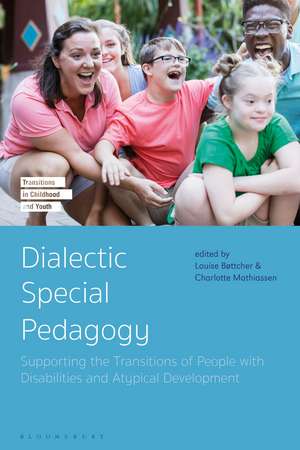
Dialectic Special Pedagogy: Supporting the Transitions of People with Disabilities and Atypical Development: Transitions in Childhood and Youth
Editat de Louise Bøttcher, Charlotte Mathiassenen Limba Engleză Paperback – 25 iun 2026




Preț: 204.52 lei
Preț vechi: 279.32 lei
-27%
Puncte Express: 307
Carte disponibilă
Livrare economică 06-20 noiembrie
Livrare prin curier în România Termenul estimat este afișat lângă disponibilitate.
Transport gratuit de la 400.00 lei Plată online sau ramburs, în funcție de opțiunile comenzii.
Retur gratuit în 14 zile Comandă securizată și suport în română.
Specificații
ISBN-13: 9781350360617
ISBN-10: 1350360619
Pagini: 232
Ilustrații: 10 bw illus
Dimensiuni: 152 x 232 x 16 mm
Greutate: 0.36 kg
Editura: Bloomsbury Publishing
Colecția Bloomsbury Academic
Seria Transitions in Childhood and Youth
Locul publicării:London, United Kingdom
ISBN-10: 1350360619
Pagini: 232
Ilustrații: 10 bw illus
Dimensiuni: 152 x 232 x 16 mm
Greutate: 0.36 kg
Editura: Bloomsbury Publishing
Colecția Bloomsbury Academic
Seria Transitions in Childhood and Youth
Locul publicării:London, United Kingdom
Cuprins
Introduction: Dialectic Special Pedagogy, Louise Bøttcher and Charlotte Mathiassen (Aarhus University, Denmark)
Part I: Fundamental Issues in Dialectic Special Pedagogy
1. Deaf Education Controversies: A History of Special Education, Jesper Dammeyer (University of Copenhagen, Denmark) and Madeleine Chapman (University of Westminster, UK)
2. Mediation, Remediation and Prolepsis in Dialectical Special Pedagogy, Louise Bøttcher (Aarhus University, Denmark)
3. Addressing Secondary Disability: Special Pedagogy for Children with Disabilities and their Inclusion in Mainstream Settings, Fatema Taj Johora, Marilyn Fleer and Marie Hammer (Monash University, Australia)
Part II: Special Pedagogy in Schools
4. How the Ideology, Organization and Layout of the School Create Different Opportunities for Special Pedagogy with Children and Young People, Harry Daniels (Oxford University, UK)
5, Transitions Through and From Alternative Programs: Expanding Chronotopes as Frames for Social Futures, Jennifer A. Vadeboncoeur and Natalia Panina-Beard (University of British Columbia, Canada) and Kristiina Kumpulainen (Simon Fraser University, Canada)
6. A Play-Based Curriculum for Emancipation and Cultural Competence, Bert van Oers (VU University Amsterdam, the Netherlands)
Part III: Special Pedagogy in Relation to Particular Groups
7. Special Pedagogy in Relation to Incarcerated Youth and Adults Having Committed Criminal Acts, Charlotte Mathiassen (Aarhus University, Denmark)
8. Pedagogies of Agency in Families of Young Children Affected by Adversity, Nick Hopwood (University of Technology Sydney, Australia)
9. The Necessity of Community in Mental Illness Recovery, Sofie Pedersen, (Roskilde University, Denmark)
10. Special Pedagogy with Vulnerable Youth, Kirsten Elisa Petersen (Aarhus University, Denmark)
Conclusion, Louise Bøttcher and Charlotte Mathiassen (Aarhus University, Denmark)
References
Index
Part I: Fundamental Issues in Dialectic Special Pedagogy
1. Deaf Education Controversies: A History of Special Education, Jesper Dammeyer (University of Copenhagen, Denmark) and Madeleine Chapman (University of Westminster, UK)
2. Mediation, Remediation and Prolepsis in Dialectical Special Pedagogy, Louise Bøttcher (Aarhus University, Denmark)
3. Addressing Secondary Disability: Special Pedagogy for Children with Disabilities and their Inclusion in Mainstream Settings, Fatema Taj Johora, Marilyn Fleer and Marie Hammer (Monash University, Australia)
Part II: Special Pedagogy in Schools
4. How the Ideology, Organization and Layout of the School Create Different Opportunities for Special Pedagogy with Children and Young People, Harry Daniels (Oxford University, UK)
5, Transitions Through and From Alternative Programs: Expanding Chronotopes as Frames for Social Futures, Jennifer A. Vadeboncoeur and Natalia Panina-Beard (University of British Columbia, Canada) and Kristiina Kumpulainen (Simon Fraser University, Canada)
6. A Play-Based Curriculum for Emancipation and Cultural Competence, Bert van Oers (VU University Amsterdam, the Netherlands)
Part III: Special Pedagogy in Relation to Particular Groups
7. Special Pedagogy in Relation to Incarcerated Youth and Adults Having Committed Criminal Acts, Charlotte Mathiassen (Aarhus University, Denmark)
8. Pedagogies of Agency in Families of Young Children Affected by Adversity, Nick Hopwood (University of Technology Sydney, Australia)
9. The Necessity of Community in Mental Illness Recovery, Sofie Pedersen, (Roskilde University, Denmark)
10. Special Pedagogy with Vulnerable Youth, Kirsten Elisa Petersen (Aarhus University, Denmark)
Conclusion, Louise Bøttcher and Charlotte Mathiassen (Aarhus University, Denmark)
References
Index
Recenzii
As someone who has spent many years researching young children's transitions, this book brings something new in terms of considering children who have additional needs. Transitions for all children need to be approached with care, as each child's transition is unique to their own specific circumstances, this book opens up opportunities to view children through a wider lens.
I would recommend this book to anyone working with disability, but also, any teacher who works in even neurotypical spaces. The pedagogy outlined here is not solely applicable to those with developmental delays or disabilities but is also a practical pedagogy for teaching in general.
I would recommend this book to anyone working with disability, but also, any teacher who works in even neurotypical spaces. The pedagogy outlined here is not solely applicable to those with developmental delays or disabilities but is also a practical pedagogy for teaching in general.