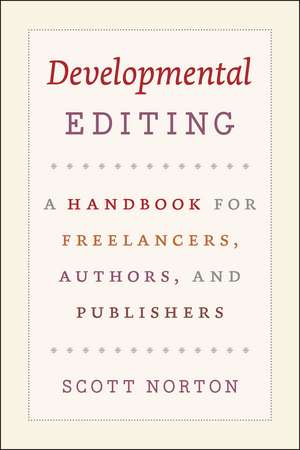
Developmental Editing: A Handbook for Freelancers, Authors, and Publishers: Chicago Guides to Writing, Editing, and Publishing
Autor Scott Nortonen Limba Engleză Paperback – 30 noi 2011
Găsim în Developmental Editing pachetul complet de resurse necesare oricărui profesionist din industria cărții, structurat ca un manual de referință ce include profiluri de autori, studii de caz (assignments) și ghiduri metodologice pentru colaborarea dintre editor și client. Merită menționat că, spre deosebire de alte manuale tehnice, Scott Norton abordează editarea ca pe o simbioză între rigoarea analitică și viziunea creativă, fiind un ghid esențial pentru cei care doresc să transforme un manuscris brut într-o lucrare publicabilă.
Reținem din cuprinsul cărții o progresie logică: totul începe cu „Conceptul” și modelarea propunerii de carte, continuă cu evaluarea potențialului de conținut și se oprește asupra „Tezei”, acel element distinctiv (the hook) care vinde volumul. Această abordare metodologică completează excelent titluri precum The Dissertation-to-Book Workbook de Katelyn E. Knox; în timp ce lucrarea lui Knox se concentrează pe transformarea academică a tezei, Norton extinde perspectiva asupra întregii piețe editoriale de non-ficțiune, oferind instrumente de diagnosticare a defectelor structurale. De asemenea, lucrarea aduce un plus de valoare față de Fix Your Damn Book! de James Osiris Baldwin, mutând accentul de pe auto-editarea de bază către o strategie editorială complexă, potrivită atât pentru liber-profesioniști, cât și pentru edituri.
Experiența de lectură este marcată de un ton pragmatic și realist, presărat cu umor, care nu evită dificultățile meseriei. Norton demonstrează cum tehnici specifice ficțiunii — precum gestionarea perspectivei sau a ritmului — pot fi adaptate pentru a face non-ficțiunea mai atractivă pentru publicul larg, oferind astfel o metodologie de lucru rară în literatura de specialitate.
Din seria Chicago Guides to Writing, Editing, and Publishing
-
 Preț: 97.91 lei
 -
 Preț: 137.44 lei
 -
 Preț: 139.26 lei
 -
 Preț: 124.29 lei
 -
 Preț: 139.80 lei
 -
 Preț: 436.54 lei
 -
 Preț: 138.28 lei
 -
 Preț: 153.90 lei
 -
 Preț: 148.71 lei
 -
 Preț: 253.72 lei
 -
 Preț: 105.22 lei
 -
 Preț: 181.32 lei
 -
 Preț: 119.88 lei
 -
 Preț: 176.52 lei
 -
 Preț: 152.54 lei
 -
 Preț: 112.29 lei
 -
 Preț: 241.68 lei
 -
 Preț: 131.01 lei
 -
 Preț: 163.08 lei
 -
 Preț: 113.99 lei
 -
 Preț: 185.38 lei
 -
 Preț: 181.57 lei
 - 23%
 Preț: 468.76 lei
 -
 Preț: 354.20 lei
 -
 Preț: 176.78 lei
 -
 Preț: 103.56 lei
 -
 Preț: 181.57 lei
 -
 Preț: 128.16 lei
 -
 Preț: 136.81 lei
 -
 Preț: 141.19 lei
 -
 Preț: 158.99 lei
 -
 Preț: 185.41 lei
 -
 Preț: 127.82 lei
 -
 Preț: 140.07 lei
 -
 Preț: 210.58 lei
 -
 Preț: 162.44 lei
 -
 Preț: 114.43 lei
 -
 Preț: 171.47 lei
 -
 Preț: 155.84 lei
 -
 Preț: 144.41 lei
 -
 Preț: 222.58 lei
 -
 Preț: 138.84 lei
 -
 Preț: 117.64 lei
 -
 Preț: 175.98 lei
Preț: 226.54 lei
Carte tipărită la comandă
Livrare economică 24 noiembrie-08 decembrie
Specificații
ISBN-10: 0226595153
Pagini: 256
Ilustrații: 4 tables
Dimensiuni: 152 x 229 x 18 mm
Greutate: 0.34 kg
Editura: University of Chicago Press
Colecția University of Chicago Press
Seria Chicago Guides to Writing, Editing, and Publishing
V-ar putea interesa
-
 Fowler's Dictionary of Modern English UsageJeremy Butterfield-16%Preț: 206.53 lei245.65 lei
 -
 From Dissertation to Book, Second EditionWilliam GermanoPreț: 137.44 lei
 -
 The Chicago Guide to Grammar, Usage, and PunctuationBryan A. GarnerPreț: 354.20 lei
 -
 HorrorConScott NortonPreț: 91.65 lei
 -
 Historical Atlas of California,Warren A. BeckPreț: 239.83 lei
 -
 The Merriam-Webster Dictionary of Synonyms and AntonymsMerriam-Webster-14%Preț: 26.06 lei30.33 lei
 -
 American Made: Discover Your Amazing Ancestor at Work in the USANancy Bronte MathenyPreț: 156.47 lei
 -
 Emancipaciòn MasculinaJosé Víctor DelgadoPreț: 491.00 lei
 -
 Our Swedish RootsDusty GormanPreț: 423.30 lei
 -
 McWp 2-14 - CounterintelligenceU. S. Marine CorpsPreț: 189.04 lei
 -
 Signals Intelligence - MCWP 2-22 (formerly MCWP 2-15.2)U. S. Marine CorpsPreț: 130.54 lei
 -
 A Unit Training Management Guide - McRp 3-0U. S. Marine CorpsPreț: 127.97 lei
 -
 Unmanned Aerial Vehicle Operations - McWp 3-42.1U. S. Marine CorpsPreț: 100.53 lei
 -
 AfghanistanMarine Corps InstitutePreț: 107.31 lei
 -
 Amphibious Ships and Landing Craft Data Book - MCRP 3-31BU. S. Marine CorpsPreț: 100.00 lei
 -
 Antenna Handbook - McRp 3-40.3c (Formerly McRp 6-22d)U. S. Marine CorpsPreț: 162.63 lei
 -
 Combat Stress - FM 90-44/6-22.5 - NTTP 1-15M - MCRP 6-11CU. S. Marine CorpsPreț: 130.20 lei
 -
 Flame, Riot Control Agents and Herbicide Operations - McRp 3-37c - FM 3-11U. S. Marine CorpsPreț: 136.14 lei
 -
 Preț: 161.75 lei
 -
 Radio Operator's Handbook - McRp 3-40.3b (Formerly McRp 6-22c)U. S. Marine CorpsPreț: 144.06 lei
 -
 Close Combat - MCRP 3-02BU. S. Marine CorpsPreț: 125.77 lei
 -
 War Crimes Investigation - McRp 4-11.8bU. S. Marine CorpsPreț: 100.04 lei
 -
 Lightbearers' Course Tamil VersionRev Phillip LemkinPreț: 125.81 lei
 -
 Life In The UK - Passing Your Life In The UK TestAndrew HannonPreț: 134.65 lei
 -
 Versi D'AmoreSilvio PellicoPreț: 42.27 lei
 -
 -27%Preț: 531.93 lei725.43 lei
De ce să citești această carte
Această carte este o investiție strategică pentru editorii independenți și autorii care doresc să înțeleagă arhitectura din spatele unei cărți de succes. Cititorul câștigă o metodologie clară pentru a identifica „cârligul” narativ și pentru a structura argumentele într-un mod convingător. Este recomandată celor care vor să treacă de la simpla corectură la modelarea profundă a conținutului, transformând ideile brute în bestselleruri de non-ficțiune.
Despre autor
Scott Norton este un editor de prestigiu cu o vastă experiență în colaborarea cu diverse edituri comerciale și academice. În opera sa, care include și Developmental Editing, Second Edition, Norton s-a specializat în transformarea manuscriselor complexe în volume accesibile și de impact. Deși a explorat teme diverse în alte scrieri, precum analize ale serviciului militar sau chiar incursiuni în zona de ficțiune horror, expertiza sa principală rămâne ancorată în procesele editoriale de profunzime. Lucrările sale sunt recunoscute pentru modul în care îmbină sfaturile practice cu o înțelegere profundă a pieței de carte contemporane.
Descriere scurtă
Author Scott Norton has worked with a diverse range of authors, editors, and publishers, and his handbook provides an approach to developmental editing that is logical, collaborative, humorous, and realistic. He starts with the core tasks of shaping the proposal, finding the hook, and building the narrative or argument, and then turns to the hard work of executing the plan and establishing a style.
Developmental Editing includes detailed case studies featuring a variety of nonfiction books—election-year polemic, popular science, memoir, travel guide—and authors ranging from first-timer to veteran, journalist to scholar. Handy sidebars offer advice on how to become a developmental editor, create effective illustration programs, and adapt sophisticated fiction techniques (such as point of view, suspense, plotting, character, and setting) to nonfiction writing.
Norton’s book also provides freelance copyeditors with a way to earn higher fees while introducing more creativity into their work lives. It gives acquisitions, marketing, and production staff a vocabulary for diagnosing a manuscript’s flaws and techniques for transforming it into a bestseller. And perhaps most importantly, Developmental Editing equips authors with the concrete tools they need to reach their audiences.
Notă biografică
Cuprins
Introduction
Whom This Book Is For
What This Book Covers
Some Ground Rules
1 Concept: Shaping the Proposal
Author Profile: The Veteran
Client Profile: The Agent
Assignment: The Proposal with Too Many Concepts
Locate the Concept
Profile the Audience
Evaluate Market Potential
Bring the Vision into Focus
2 Content: Assessing Potential
Author Profile: The First-timer
Client Profile: The Big Trade House
Assignment: The Tome with Too Many Subjects
Size Up the Author
Size Up the Publisher
Size Up the DE
Create a Content Summary
Find the Main Subject
3 Thesis: Finding the Hook
Author Profile: The Coauthors
Client Profile: The Small Trade House
Assignment: The Study with Too Many Theses
Cull Theses from Topics
Beware of the Rehash
Choose the Main Thesis
Create a Working Title
4 Narrative: Tailoring the Timeline
Author Profile: The Historian
Client Profile: The Copublisher
Assignment: The Sprawling Saga
Untangle Timelines from Arguments
Find the Main Timelines
Brainstorm Timeline Strategies
Compose the New Timeline
Finetune the Timeline
Restore Bits of Argument
5 Exposition: Deploying the Argument
Author Profile: The Theorist
Client Profile: The University Press
Assignment: The Theory with Too Many Tangents
Untangle Arguments from Timelines
Find the Main Arguments
Brainstorm Argument Strategies
Compose the New Argument
Finetune the Argument
Restore Bits of Timeline
6 Plan: Drafting a Blueprint
Write Up the Plan
Compose Chapter Theses
Intervene Strategically
7 Rhythm: Setting the Pace
Author Profile: The Sole Authority
Client Profile: The Regional House
Assignment: The Local History Turned Personal
Rearrange the Furniture
Draft New Passages
Balance Chapter Weights
Edit for Pace
8 Transitions: Filling in the Blanks
Author Profile: The Dead Author
Client Profile: The Self-Publisher
Assignment: The Memoir with Lapses
Create Opening Transitions
Create Closing Transitions
Draw Conclusions
Place Those Conclusions
9 Style: Training the Voice
Author Profile: The Journalist
Client Profile: The Book Packager
Assignment: The Story with Too Many Voices
Set the Tone
Parse the Rhetoric
Master Abstraction
Gauge the Ironies
Harmonize the Voices
10 Display: Dressing Up the Text
Author Profile: The Author-for-Hire
Client Profile: The Trade Reference House
Assignment: The Guidebook with Poor Signage
Consider Subheads
Consider Epigraphs
Draft an Art Plan
Illustrate Concepts
Visualize Data
Test-Drive Maps
Add Lagniappe
Afterword
Further Reading
Acknowledgments
Index