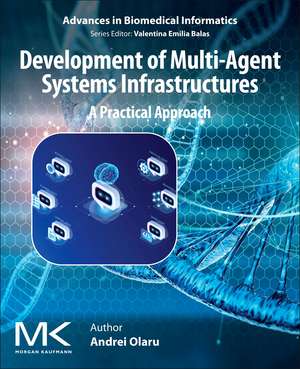
Development of Multi-Agent Systems Infrastructures: A Practical Approach: Advances in Biomedical Informatics
Autor Andrei Olaruen Limba Engleză Paperback – oct 2026
- Presents models and languages for multi-agent systems (MAS) development
- Includes three key sections covering: modeling and languages for multi-agent systems; entity deployment and interaction; and practical considerations for implementing contemporary MAS frameworks
- Provides a hands-on method for developing working MAS solutions across a variety of applications
- Showcases solutions in a structured, modular format so they can be replicated and used independently from one another


Preț: 795.98 lei
Preț vechi: 994.97 lei
-20% Precomandă
Puncte Express: 1194
Preț estimativ în valută:
140.77€ • 163.05$ • 122.24£
140.77€ • 163.05$ • 122.24£
Carte nepublicată încă
Doresc să fiu notificat când acest titlu va fi disponibil:
Se trimite...
Specificații
ISBN-13: 9780443404955
ISBN-10: 044340495X
Pagini: 200
Dimensiuni: 191 x 235 mm
Greutate: 0.45 kg
Editura: ELSEVIER SCIENCE
Seria Advances in Biomedical Informatics
ISBN-10: 044340495X
Pagini: 200
Dimensiuni: 191 x 235 mm
Greutate: 0.45 kg
Editura: ELSEVIER SCIENCE
Seria Advances in Biomedical Informatics
V-ar putea interesa
-
 Multi-Agent Reinforcement LearningFilippos Christianos-20%Preț: 463.85 lei579.81 lei
 -
 Formal Methods for Multi-Agent Feedback Control SystemsDimos V. Dimarogonas-20%Preț: 581.10 lei726.37 lei
 -
 Modern Big Data ArchitecturesDominik Ryzko-20%Preț: 308.42 lei385.54 lei
 -
 Machine Learning For DummiesJohn Paul Mueller-20%Preț: 170.82 lei213.52 lei
 -
 Agentic AI for DummiesPam Baker-20%Preț: 139.01 lei173.76 lei
 -
 AI Agents in ActionMicheal Lanham-20%Preț: 315.31 lei394.13 lei
 -
 -20%Preț: 325.79 lei407.24 lei
 -
 -18%Preț: 1081.21 lei1318.55 lei
 -
 Engineering Information Systems with Large Language ModelsFrancesca de Luzi-24%Preț: 916.62 lei1206.07 lei
 -
 Networked SystemsSalem Lahlou-20%Preț: 949.89 lei1187.37 lei
 -
 -20%Preț: 505.27 lei631.59 lei
 -
 -20%Preț: 1224.15 lei1530.19 lei
 -
 -5%Preț: 350.89 lei369.36 lei
 -
 -20%Preț: 327.36 lei409.20 lei
 -
 -20%Preț: 317.68 lei397.10 lei
 -
 -20%Preț: 318.67 lei398.33 lei
 -
 -20%Preț: 623.89 lei779.85 lei
 -
 -20%Preț: 1390.63 lei1738.28 lei
 -
 AI and MicroservicesDileep Kumar Pandiya-20%Preț: 253.04 lei316.29 lei
Cuprins
1. Introduction: Applications, Challenges and Requirements
2. A comparative study of current MAS frameworks
Part 1: Modeling agents and infrastructures
3. The nested-entity model in FLASH-MAS
4. The S-CLAIM agent-oriented programming language
5. The Entity-operation model
Part 2: Interaction and Deployment
6. Decentralized communication protocols
7. Leveraging the advantages of web standards
8. Region-based decentralized communication
9. Entity systems deployed over heterogeneous environments
Part 3: Practical aspects in implementing a modern MAS framework
10. Complex deployment scenarios
11:. Monitoring and controlling a distributed system
12. Integrating machine learning
2. A comparative study of current MAS frameworks
Part 1: Modeling agents and infrastructures
3. The nested-entity model in FLASH-MAS
4. The S-CLAIM agent-oriented programming language
5. The Entity-operation model
Part 2: Interaction and Deployment
6. Decentralized communication protocols
7. Leveraging the advantages of web standards
8. Region-based decentralized communication
9. Entity systems deployed over heterogeneous environments
Part 3: Practical aspects in implementing a modern MAS framework
10. Complex deployment scenarios
11:. Monitoring and controlling a distributed system
12. Integrating machine learning