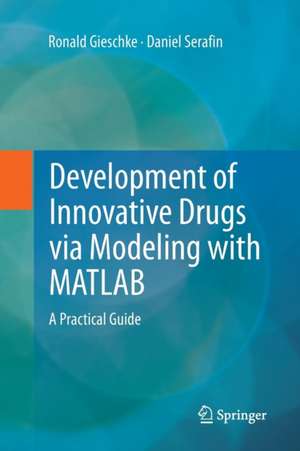
Development of Innovative Drugs via Modeling with MATLAB: A Practical Guide
Autor Ronald Gieschke, Daniel Serafinen Limba Engleză Paperback – 26 aug 2016
Written from the industry perspective and based on many years of experience, this book offers:
- Concepts for creation of drug-disease models, introduced and supplemented with extensive MATLAB programs
- Guidance for exploration and modification of these programs to enhance the understanding of key principles
- Usage of differential equations to pharmacokinetic, pharmacodynamic and (patho-) physiologic problems thereby acknowledging their dynamic nature
- A range of topics from single exponential decay to adaptive dosing, from single subject exploration to clinical trial simulation, and from empirical to mechanistic disease modeling.
Students with an undergraduate mathematical background or equivalent education, interest in life sciences and skills in a high-level programming language such as MATLAB, are encouraged to engage in model-based pharmaceutical research and development.
| Toate formatele și edițiile | Preț | Express |
|---|---|---|
| Paperback (1) | 1361.18 lei 6-8 săpt. | |
| Springer Berlin, Heidelberg – 26 aug 2016 | 1361.18 lei 6-8 săpt. | |
| Hardback (1) | 1365.90 lei 6-8 săpt. | |
| Springer Berlin, Heidelberg – 11 dec 2013 | 1365.90 lei 6-8 săpt. |
Preț: 1361.18 lei
Preț vechi: 1432.82 lei
-5% Nou
Puncte Express: 2042
Preț estimativ în valută:
240.85€ • 282.82$ • 211.41£
240.85€ • 282.82$ • 211.41£
Carte tipărită la comandă
Livrare economică 27 ianuarie-10 februarie 26
Preluare comenzi: 021 569.72.76
Specificații
ISBN-13: 9783662521106
ISBN-10: 3662521105
Pagini: 414
Ilustrații: XV, 399 p. 192 illus., 112 illus. in color.
Dimensiuni: 155 x 235 x 22 mm
Greutate: 0.58 kg
Ediția:Softcover reprint of the original 1st ed. 2014
Editura: Springer Berlin, Heidelberg
Colecția Springer
Locul publicării:Berlin, Heidelberg, Germany
ISBN-10: 3662521105
Pagini: 414
Ilustrații: XV, 399 p. 192 illus., 112 illus. in color.
Dimensiuni: 155 x 235 x 22 mm
Greutate: 0.58 kg
Ediția:Softcover reprint of the original 1st ed. 2014
Editura: Springer Berlin, Heidelberg
Colecția Springer
Locul publicării:Berlin, Heidelberg, Germany
V-ar putea interesa
-
 Drug Safety Data: How to Analyze, Summarize and Interpret to Determine RiskMichael J. Klepper-5%Preț: 714.11 lei751.69 lei
 -
 -5%Preț: 365.60 lei384.85 lei
 -
 -5%Preț: 390.18 lei410.71 lei
 -
 -5%Preț: 349.32 lei367.70 lei
 -
 -5%Preț: 770.32 lei810.86 lei
 -
 -5%Preț: 539.74 lei568.14 lei
 -
 -5%Preț: 340.08 lei357.98 lei
 -
 -5%Preț: 370.74 lei390.25 lei
 -
 Lehrbuch der PharmakognosieErnst Gilg-5%Preț: 458.76 lei482.91 lei
 -
 -5%Preț: 397.50 lei418.43 lei
 -
 -5%Preț: 768.38 lei808.81 lei
 -
 -5%Preț: 374.35 lei394.05 lei
 -
 Efaproxiral et transfusions sanguinesFabien MAUVIGNANT-5%Preț: 415.75 lei437.63 lei
 -
 La prescription d'hypnotiques aux personnes âgées institutionnaliséesJulie Bricau-Vignol-5%Preț: 298.29 lei313.99 lei
 -
 Neuropeptides Et AntidepresseursBruno Guiard-5%Preț: 479.18 lei504.40 lei
 -
 -5%Preț: 409.86 lei431.42 lei
 -
 Décès suspects et recherche des causes de la mortHélène Monlong-5%Preț: 410.90 lei432.52 lei
Cuprins
Background of pharmacologic modeling.- First example of a computational model.- Differential equations in MATLAB.- Pharmacologic modeling.- Drug-disease modeling.- Population analyses.- Clinical trial simulation.- Graphics-based modeling.- Outlook.- Appendix A: Hints to MATLAB programs.- Appendix B: Solution to exercises.
Textul de pe ultima copertă
The development of innovative drugs is becoming more difficult while relying on empirical approaches. This inspired all major pharmaceutical companies to pursue alternative model-based paradigms. The key question is: How to find innovative compounds and, subsequently, appropriate dosage regimens?
Written from the industry perspective and based on many years of experience, this book offers:
§ Concepts for creation of drug-disease models, introduced and supplemented with extensive MATLAB programs
§ Guidance for exploration and modification of these programs to enhance the understanding of key principles
§ Usage of differential equations to pharmacokinetic, pharmacodynamic and (patho-) physiologic problems thereby acknowledging their dynamic nature
§ A range of topics from single exponential decay to adaptive dosing, from single subject exploration to clinical trial simulation, and from empirical to mechanistic disease modeling.
Students with an undergraduate mathematical background or equivalent education, interest in life sciences and skills in a high-level programming language such as MATLAB, are encouraged to engage in model-based pharmaceutical research and development.
Written from the industry perspective and based on many years of experience, this book offers:
§ Concepts for creation of drug-disease models, introduced and supplemented with extensive MATLAB programs
§ Guidance for exploration and modification of these programs to enhance the understanding of key principles
§ Usage of differential equations to pharmacokinetic, pharmacodynamic and (patho-) physiologic problems thereby acknowledging their dynamic nature
§ A range of topics from single exponential decay to adaptive dosing, from single subject exploration to clinical trial simulation, and from empirical to mechanistic disease modeling.
Students with an undergraduate mathematical background or equivalent education, interest in life sciences and skills in a high-level programming language such as MATLAB, are encouraged to engage in model-based pharmaceutical research and development.
Caracteristici
Provides concepts for the creation of drug-disease models
Written from the industry perspective
Based on many years of experience
Includes supplementary material: sn.pub/extras
Written from the industry perspective
Based on many years of experience
Includes supplementary material: sn.pub/extras