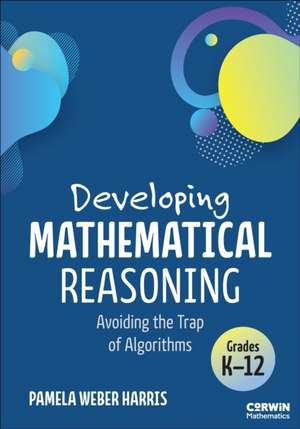
Developing Mathematical Reasoning: Corwin Mathematics Series
Autor Pamela Weber Harrisen Limba Engleză Paperback – 12 mai 2025
Author Pam Harris argues that teaching real math-math that is free of distortions-will reach more students more effectively and result in deeper understanding and longer retention. This book is about teaching undistorted math using the kinds of mental reasoning that mathematicians do.
Memorization tricks and algorithms meant to make math "easier" are full of traps that sacrifice long-term student growth for short-lived gains. Students and teachers alike have been led to believe that they've learned more and more math as they move through the content, but in reality students are not necessarily progressing in their ability to reason mathematically.
Using tricks may make facts easier to memorize in isolation, but that very disconnect distorts the reality of math. The mountain of trivia piles up until students hit a breaking point. Humanity¿s most powerful system of understanding, organizing, and making an impact on the world becomes a soul-draining exercise in confusion, chaos, and lost opportunities.
In her landmark book Developing Mathematical Reasoning: Avoiding the Trap of Algorithms, Pam emphasizes the importance of teaching students increasingly sophisticated mathematical reasoning and understanding underlying concepts rather than relying on set rules for solving problems. Now, in this next companion volume, Developing Mathematical Reasoning: The Strategies, Models, and Lessons to Teach the Big Ideas in Grades 3-5 equips educators with practical tools to move beyond rote memorization toward true mathematical thinking for students in upper elementary grades. Focusing on additive and multiplicative reasoning, the book introduces strategies designed to improve mathematical reasoning, Problem Strings, and strategic modeling to strengthen student understanding.
Highlights include:
- Reasoning-based strategies: Replace traditional algorithms with approaches that build critical thinking while ensuring understanding.
- Problem Strings: Step-by-step guidance on walking students through a sequence of problems that spark insight.
- Grade 3-5 focus: Comprehensive coverage of additive and multiplicative reasoning tailored for upper elementary learners.
- Practical tools: Ready-to-use routines, discussion prompts, and modeling techniques for immediate classroom application.
Din seria Corwin Mathematics Series
-
 Preț: 282.36 lei
 -
![Simplifying Stem [6-12]](https://i1.books-express.ro/bs/9781071917060/simplifying-stem-6-12.jpg) Preț: 263.20 lei
Preț: 263.20 lei -
 Preț: 285.03 lei
 -
 Preț: 286.22 lei
 -
 Preț: 294.99 lei
 -
 Preț: 301.50 lei
 -
 Preț: 319.65 lei
 -
 Preț: 274.16 lei
 -
 Preț: 325.14 lei
 -
 Preț: 314.67 lei
 -
 Preț: 283.54 lei
 -
 Preț: 291.55 lei
 -
 Preț: 278.20 lei
 -
 Preț: 260.96 lei
 -
 Preț: 285.37 lei
 -
 Preț: 314.64 lei
 -
 Preț: 288.63 lei
 -
 Preț: 273.43 lei
 -
 Preț: 284.56 lei
 -
 Preț: 277.31 lei
 -
 Preț: 321.03 lei
 -
 Preț: 285.09 lei
 -
 Preț: 289.00 lei
 -
 Preț: 284.80 lei
 -
 Preț: 277.56 lei
 -
 Preț: 308.29 lei
 -
 Preț: 291.20 lei
 -
 Preț: 268.96 lei
 -
 Preț: 281.39 lei
 -
 Preț: 287.57 lei
 -
![Jackson, C: Simplifying Stem [Prek-5]](https://i0.books-express.ro/bs/9781071917053/jackson-c-simplifying-stem-prek-5.jpg) Preț: 285.11 lei
Preț: 285.11 lei -
![The Five Practices in Practice [High School]: Successfully Orchestrating Mathematics Discussions in Your High School Classroom](https://i3.books-express.ro/bs/9781544321233/the-five-practices-in-practice-high-school.jpg) Preț: 283.13 lei
Preț: 283.13 lei -
 Preț: 291.97 lei
 -
 Preț: 259.12 lei
 -
![Answers to Your Biggest Questions About Teaching Elementary Math: Five to Thrive [series]](https://i1.books-express.ro/bs/9781071857717/answers-to-your-biggest-questions-about-teaching-elementary-math.jpg) Preț: 288.67 lei
Preț: 288.67 lei -
 Preț: 288.00 lei
 -
 Preț: 183.41 lei
 -
 Preț: 191.12 lei
 -
 Preț: 183.41 lei
 - 34%
 Preț: 211.38 lei
 -
 Preț: 191.12 lei
 -
 Preț: 191.12 lei
 -
 Preț: 198.80 lei
 -
 Preț: 191.12 lei
 -
 Preț: 191.12 lei
 -
 Preț: 198.80 lei
 - 32%
 Preț: 225.26 lei
Preț: 284.46 lei
Puncte Express: 427
Carte disponibilă
Livrare economică 31 octombrie-14 noiembrie
Livrare express 17-23 octombrie pentru 41.60 lei
Livrare prin curier în România Termenul estimat este afișat lângă disponibilitate.
Transport gratuit de la 400.00 lei Plată online sau ramburs, în funcție de opțiunile comenzii.
Retur gratuit în 14 zile Comandă securizată și suport în română.
Specificații
ISBN-13: 9781071948262
ISBN-10: 1071948261
Pagini: 296
Dimensiuni: 254 x 178 x 21 mm
Greutate: 0.64 kg
Editura: Sage Publications, Inc
Colecția Corwin Mathematics Series
Seria Corwin Mathematics Series
ISBN-10: 1071948261
Pagini: 296
Dimensiuni: 254 x 178 x 21 mm
Greutate: 0.64 kg
Editura: Sage Publications, Inc
Colecția Corwin Mathematics Series
Seria Corwin Mathematics Series
Notă biografică
Pamela Weber Harris is changing the way we view and teach mathematics. Pam is the author of several books, including the Numeracy Problems Strings K-5 series, Building Powerful Numeracy, and the series Foundations for Strategies. As a mom, a former high school math teacher, a university lecturer, and an author, she believes everyone can do more math when it is based in reasoning rather than rote-memorizing or mimicking. Pam has created online Building Powerful Mathematics workshops and presents frequently at national and international conferences. Her particular interests include teaching real math, building powerful numeracy, sequencing rich tasks to construct mathematics, using technology appropriately, and facilitating smart assessment and vertical connectivity in curricula in schools PK-12. Pam helps leaders and teachers to make the shift that supports students to learn real math because math is figureoutable!
Cuprins
Preface
About This Book
Language Use in This Book
Acknowledgments
About the Author
PART I: SETTING THE STAGE
CHAPTER 1: MATHEMATICS FOR TEACHING
What's the Purpose of Learning Math?
The Development of Mathematical Reasoning
Spatial, Algebraic, and Statistical Reasoning
Major Strategies
Conclusion
Discussion Questions
PART II: DEVELOPING ADDITIVE AND MULTIPLICATIVE REASONING
CHAPTER 2: DEVELOPING ADDITIVE REASONING
Additive Reasoning
Important Foundations
The Major Addition Strategies
The Foundational Addition Strategies
The Add a Friendly Number Over Strategy
The Give and Take Strategy
Comparing Major Addition Strategies
The Major Subtraction Strategies
The Early Strategies: Remove a Friendly Number and Remove to a Friendly Number
The Remove a Friendly Number Over Strategy
Finding the Distance/Difference With the Constant Difference Strategy
Comparing Major Subtraction Strategies
Implications for Developing Mathematical Reasoning
Conclusion
Discussion Questions
CHAPTER 3: DEVELOPING MULTIPLICATIVE REASONING
Multiplicative Reasoning
Important Foundations
The Major Multiplication Strategies
Multiplication Strategies That Are More Additive
Multiplication Strategies That Are More Multiplicative
The Most Multiplicative Major Multiplication Strategies
Comparing Major Multiplication Strategies
The Major Division Strategies
Division Strategies That Are More Additive
A More Multiplicative Division Strategy
The Most Multiplicative Major Division Strategy
Comparing Major Division Strategies
Implications for Developing Mathematical Reasoning
Conclusion
Discussion Questions
PART III: DEVELOPING PROPORTIONAL REASONING
CHAPTER 4: DEVELOPING PROPORTIONAL REASONING
Proportional Reasoning
It's All Interconnected!
Important Foundations
Interpretations of Ratio
Inverse Proportions
Toward Functional Reasoning
Conclusion
Discussion Questions
CHAPTER 5: PROPORTIONAL REASONING STRATEGIES
Solving Proportions
Scaling in Tandem From Unit to Non-Unit Rates
Models to Build Proportional Reasoning Strategies
Strategies for Solving Proportions
The Scale Up to Scale Down Strategy
The Scale Down to Scale Up Strategy
The Scale in One Fell Swoop Strategy
Generalizing the Relationships in Solving Proportions
Percentage Strategies
Conclusion
Discussion Questions
PART IV: PUTTING IT ALL TOGETHER
CHAPTER 6: TASKS TO DEVELOP MATHEMATICAL REASONING
Sequencing Tasks
Problem Strings
Other Instructional Routines
Conclusion
Discussion Questions
CHAPTER 7: MODELING AND MODELS
Strategies Versus Models
The Many Meanings of Model
Exploring Models by Their Best Uses
Our Modeling Framework
Conclusion
Discussion Questions
CHAPTER 8: MOVING FORWARD
Where to Start
If You're Ready to Shift
Conclusion
Discussion Questions
References
Index
About This Book
Language Use in This Book
Acknowledgments
About the Author
PART I: SETTING THE STAGE
CHAPTER 1: MATHEMATICS FOR TEACHING
What's the Purpose of Learning Math?
The Development of Mathematical Reasoning
Spatial, Algebraic, and Statistical Reasoning
Major Strategies
Conclusion
Discussion Questions
PART II: DEVELOPING ADDITIVE AND MULTIPLICATIVE REASONING
CHAPTER 2: DEVELOPING ADDITIVE REASONING
Additive Reasoning
Important Foundations
The Major Addition Strategies
The Foundational Addition Strategies
The Add a Friendly Number Over Strategy
The Give and Take Strategy
Comparing Major Addition Strategies
The Major Subtraction Strategies
The Early Strategies: Remove a Friendly Number and Remove to a Friendly Number
The Remove a Friendly Number Over Strategy
Finding the Distance/Difference With the Constant Difference Strategy
Comparing Major Subtraction Strategies
Implications for Developing Mathematical Reasoning
Conclusion
Discussion Questions
CHAPTER 3: DEVELOPING MULTIPLICATIVE REASONING
Multiplicative Reasoning
Important Foundations
The Major Multiplication Strategies
Multiplication Strategies That Are More Additive
Multiplication Strategies That Are More Multiplicative
The Most Multiplicative Major Multiplication Strategies
Comparing Major Multiplication Strategies
The Major Division Strategies
Division Strategies That Are More Additive
A More Multiplicative Division Strategy
The Most Multiplicative Major Division Strategy
Comparing Major Division Strategies
Implications for Developing Mathematical Reasoning
Conclusion
Discussion Questions
PART III: DEVELOPING PROPORTIONAL REASONING
CHAPTER 4: DEVELOPING PROPORTIONAL REASONING
Proportional Reasoning
It's All Interconnected!
Important Foundations
Interpretations of Ratio
Inverse Proportions
Toward Functional Reasoning
Conclusion
Discussion Questions
CHAPTER 5: PROPORTIONAL REASONING STRATEGIES
Solving Proportions
Scaling in Tandem From Unit to Non-Unit Rates
Models to Build Proportional Reasoning Strategies
Strategies for Solving Proportions
The Scale Up to Scale Down Strategy
The Scale Down to Scale Up Strategy
The Scale in One Fell Swoop Strategy
Generalizing the Relationships in Solving Proportions
Percentage Strategies
Conclusion
Discussion Questions
PART IV: PUTTING IT ALL TOGETHER
CHAPTER 6: TASKS TO DEVELOP MATHEMATICAL REASONING
Sequencing Tasks
Problem Strings
Other Instructional Routines
Conclusion
Discussion Questions
CHAPTER 7: MODELING AND MODELS
Strategies Versus Models
The Many Meanings of Model
Exploring Models by Their Best Uses
Our Modeling Framework
Conclusion
Discussion Questions
CHAPTER 8: MOVING FORWARD
Where to Start
If You're Ready to Shift
Conclusion
Discussion Questions
References
Index