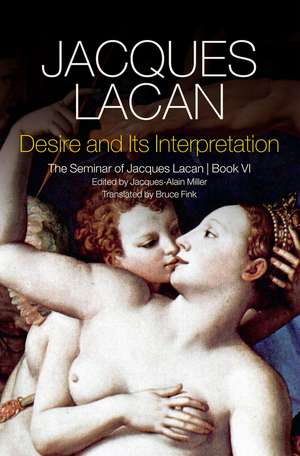
Desire and its Interpretation
Autor Jacques Lacan Editat de Jacques-Alain Miller Traducere de Bruce Finken Limba Engleză Paperback – 15 ian 2021
NIVEL DE STUDIU: Masterat și referință profesională în psihanaliză. Observăm în Lacan, J: Desire and its Interpretation un moment de cotitură în gândirea lacaniană, unde autorul părăsește terenul sigur al formalizării complexului lui Oedip pentru a explora caracterul extravagant al dorinței. Această ediție a Seminarului VI, publicată de John Wiley and Sons Ltd, ne propune o analiză riguroasă a modului în care dorința, nefiind o funcție biologică, se structurează în jurul unui obiect fantasmatic. Lacan argumentează că, în absența recunoașterii, dorința produce simptome, iar sarcina psihanalizei este de a descifra mesajul ascuns în aceste manifestări. Ceea ce ne-a atras atenția este modul în care Lacan anticipează „explozia conformismelor” și declinul patriarhatului sub presiunea capitalismului și a tehnologiei. Utilizând exemplul lui Hamlet, el demonstrează cum tatăl devine un simptom, deschizând calea către o înțelegere a perversiunii ca rebeliune împotriva rutinelor sociale. Ca alternativă la Lacan de Professor Miguel de Beistegui pentru cursurile de teorie critică, această lucrare aduce avantajul accesului direct la prelegerile lui Lacan, oferind o perspectivă primară asupra genezei conceptului de „graf al dorinței”. Dacă titlul lui Beistegui oferă o genealogie istorică, Seminarul VI este textul viu care provoacă cititorul să înțeleagă subiectivitatea modernă prin prisma fanteziei ireductibile la idealurile comune. Stilul este dens, specific discursului oral al lui Lacan, necesitând o lectură atentă a montajelor semnificante propuse.
Preț: 174.53 lei
Carte disponibilă
Livrare economică 14-28 noiembrie
Livrare express 31 octombrie-06 noiembrie pentru 50.34 lei
Specificații
ISBN-10: 1509500286
Pagini: 464
Dimensiuni: 153 x 226 x 43 mm
Greutate: 0.86 kg
Ediția:Book VI
Editura: Polity Press
Locul publicării:Chichester, United Kingdom
V-ar putea interesa
-
 Be as You AreDavid Godman-25%Preț: 64.17 lei85.96 lei
 -
 -19%Preț: 318.60 lei394.32 lei
 -
 Phenomenology of IllnessHavi Carel-22%Preț: 213.53 lei272.68 lei
 -
 Action and InteractionShaun GallagherPreț: 350.25 lei
 -
 Enactivist Interventions: Rethinking the MindShaun Gallagher-16%Preț: 218.46 lei259.15 lei
 -
 The Embodied Mind, revised editionEleanor Rosch-19%Preț: 232.41 lei287.53 lei
 -
 The Seminar of Jacques Lacan: Freud's Papers on TechniqueJacques Alain-MillerPreț: 146.21 lei
 -
 The Seminar of Jacques Lacan – Book IIIJacques LacanPreț: 162.04 lei
 -
 Preț: 157.94 lei
 -
 The Seminar of Jacques LacanJacques LacanPreț: 142.42 lei
 -
 On Feminine Sexuality, the Limits of Love and KnowledgeJacques LacanPreț: 119.11 lei
 -
 EcritsJacques LacanPreț: 250.90 lei
 -
 The Seminar of Jacques LacanJacques LacanPreț: 127.44 lei
 -
 Preț: 175.17 lei
 -
 Preț: 430.98 lei
 -
 The Wisdom of Birch, Oak, and YewPenny Billington-19%Preț: 115.56 lei142.68 lei
 -
 -27%Preț: 318.81 lei435.26 lei
 -
 Preț: 165.32 lei
 -
 The Enigma of Health: The Art of Healing in a Scientific AgeHans-Georg GadamerPreț: 152.37 lei
 -
 Illness: The cry of the fleshHavi CarelPreț: 334.02 lei
 -
 AnxietyJacques LacanPreț: 136.31 lei
 -
 The SinthomeJacques LacanPreț: 160.16 lei
 -
 Transference - The Seminar of Jacques Lacan, Book VIIIJacques LacanPreț: 164.20 lei
 -
 Culture Is the BodyTadashi SuzukiPreț: 110.36 lei
 -
 -26%Preț: 286.94 lei389.41 lei
 -
 Ethics of the RealAlenka ZupancicPreț: 145.93 lei
 -
 -18%Preț: 70.50 lei86.48 lei
De ce să citești această carte
Recomandăm această lucrare terapeuților și studenților la psihologie care doresc să depășească interpretările clasice ale complexului lui Oedip. Cititorul câștigă o înțelegere profundă a modului în care dorința funcționează dincolo de normele sociale, într-o eră a rețelelor și a fluxurilor constante. Este un instrument esențial pentru a interpreta simptomele contemporane într-o lume în care vechile repere ierarhice s-au dizolvat.
Despre autor
Jacques Lacan (1901–1981) a fost un psihiatru și psihanalist francez a cărui operă a redefinit fundamentele psihanalizei prin integrarea lingvisticii și a matematicii. Cunoscut pentru celebra sa „întoarcere la Freud”, Lacan a explorat inconștientul ca fiind structurat ca un limbaj. Seminarul său, desfășurat pe parcursul a câteva decenii, a devenit un punct de referință nu doar în clinică, ci și în filozofie, critică literară și teoria artei. În Seminarul VI, el demonstrează capacitatea sa unică de a citi texte clasice precum Hamlet pentru a extrage adevăruri clinice universale despre dorință și fantezie.
Descriere
What does Lacan show us? He shows us that desire is not a biological function; that it is not correlated with a natural object; and that its object is fantasized. Because of this, desire is extravagant. It cannot be grasped by those who might try to master it. It plays tricks on them. Yet if it is not recognized, it produces symptoms. In psychoanalysis, the goal is to interpret—that is, to read—the message regarding desire that is harbored within the symptom.
Although desire upsets us, it also inspires us to invent artifices that can serve us as a compass. An animal species has a single natural compass. Human beings, on the other hand, have multiple compasses: signifying montages and discourses. They tell you what to do: how to think, how to enjoy, and how to reproduce. Yet each person's fantasy remains irreducible to shared ideals.
Up until recently, all of our compasses, no matter how varied, pointed in the same direction: toward the Father. We considered the patriarch to be an anthropological invariant. His decline accelerated owing to increasing equality, the growth of capitalism, and the ever-greater domination of technology. We have reached the end of the Father Age.
Another discourse is in the process of taking the former's place. It champions innovation over tradition; networks over hierarchies; the draw of the future over the weight of the past; femininity over virility. Where there had previously been a fixed order, transformational flows constantly push back any and all limits.
Freud was a product of the Father Age. He did a great deal to save it. The Catholic Church finally realized this. Lacan followed the way paved by Freud, but it led him to posit that the father is a symptom. He demonstrates that here using Hamlet as an example.
What people have latched onto about Lacan's work—his formalization of the Oedipus complex and his emphasis on the Name-of-the-Father—was merely his point of departure. Seminar VI already revises this: the Oedipus complex is not the only solution to desire, it is merely a normalized form thereof; it is, moreover, a pathogenic form; it does not exhaustively explain desire’s course. Hence the eulogy of perversion with which this seminar ends: Lacan views perversion here as a rebellion against the identifications that assure the maintenance of social routines.
This Seminar predicted “the revamping of formally established conformisms and even their explosion.” We have reached that point. Lacan is talking about us.
Notă biografică
Jacques Lacan (1901-81) was one of the twentieth century's most influential thinkers. His works include Écrits, The Four Fundamental Concepts of Psychoanalysis and the many other volumes of The Seminar.