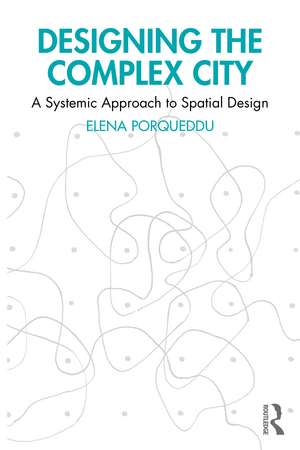
Designing the Complex City: A Systemic Approach to Spatial Design
Autor Elena Porquedduen Limba Engleză Hardback – 7 aug 2025
Designing the Complex City provides insights for students, researchers, and academics in architecture, interior design, urban and landscape design, planning theory, and urban studies. It is essential reading for all designers who seek to proactively and meaningfully intervene in spontaneous socio-spatial dynamics.
Preț: 1114.12 lei
Preț vechi: 1358.68 lei
-18%
Puncte Express: 1671
Carte tipărită la comandă
Livrare economică 10-24 noiembrie
Livrare prin curier în România Termenul estimat este afișat lângă disponibilitate.
Transport gratuit pentru acest produs Plată online sau ramburs, în funcție de opțiunile comenzii.
Retur gratuit în 14 zile Comandă securizată și suport în română.
Specificații
ISBN-13: 9781032801407
ISBN-10: 1032801409
Pagini: 186
Ilustrații: 82
Dimensiuni: 152 x 229 x 14 mm
Greutate: 0.5 kg
Ediția:1. Auflage
Editura: Taylor & Francis
Colecția Routledge
Locul publicării:Oxford, United Kingdom
ISBN-10: 1032801409
Pagini: 186
Ilustrații: 82
Dimensiuni: 152 x 229 x 14 mm
Greutate: 0.5 kg
Ediția:1. Auflage
Editura: Taylor & Francis
Colecția Routledge
Locul publicării:Oxford, United Kingdom
V-ar putea interesa
-
 Wild CitiesChris FitchPreț: 140.76 lei
 -
 The Nature of Our CitiesNadina GallePreț: 162.85 lei
 -
 The Image of the CityKevin LynchPreț: 268.25 lei
 -
 Notes on the Synthesis of FormChristopher AlexanderPreț: 228.57 lei
 -
 Preț: 352.39 lei
 -
 A New Index for Public Space: After DistancingTali HatukaPreț: 380.91 lei
 -
 Rural Design for the FutureDewey ThorbeckPreț: 382.91 lei
 -
 Open Design in PracticeFrans van der WerfPreț: 392.45 lei
 -
 Preț: 380.83 lei
 -
 Public Places Urban Spaces: The Dimensions of Urban DesignMatthew CarmonaPreț: 448.58 lei
 -
 A Planner's Encounter with ComplexityGert de Roo-8%Preț: 461.49 lei501.62 lei
 -
 Preț: 384.10 lei
 -
 -15%Preț: 215.67 lei254.28 lei
 -
 The Homegrown CityMatias EchanovePreț: 150.05 lei
 -
 Preț: 391.59 lei
 -
 Understanding Emergent UrbanismSotir Dhamo-24%Preț: 768.19 lei1010.77 lei
 -
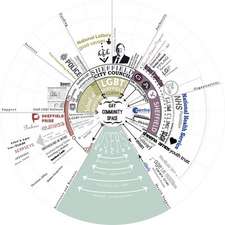 Urban Design MethodsUndine GisekePreț: 212.08 lei
 -
 Flux CitiesGregor H. MewsPreț: 304.76 lei
Public țintă
Postgraduate and Professional Practice & DevelopmentCuprins
1. Introduction: Urban complexity, systems thinking, spatial design
2. An embodied approach: Intervening in spontaneous socio-spatial dynamics
3. Open design: Directing rather than mastering emergent transformations
4. Design as a ‘good perturbation’: Navigating adaptive cycles in cities
5. A multi-scale living atlas: Detecting leverage points for spatial action
6. Systemic spatial design: Enhancing synergies between different design disciplines
7. An eco-systemic approach: Fostering city vitality
8. Conclusion: Cultivating urban complexity: The systemic turn in spatial design disciplines
2. An embodied approach: Intervening in spontaneous socio-spatial dynamics
3. Open design: Directing rather than mastering emergent transformations
4. Design as a ‘good perturbation’: Navigating adaptive cycles in cities
5. A multi-scale living atlas: Detecting leverage points for spatial action
6. Systemic spatial design: Enhancing synergies between different design disciplines
7. An eco-systemic approach: Fostering city vitality
8. Conclusion: Cultivating urban complexity: The systemic turn in spatial design disciplines
Recenzii
"Complexity calls for alternative spatial designs, a message Elena Porqueddu conveys with compelling clarity. Highlighting flow, change and adaptability across various levels, she leaves no room for doubt about their implications for designers. Furthermore, she proposes an approach to design that gracefully addresses the challenges of spontaneous urban transformation"
Gert de Roo, Professor in Planning, University of Groningen, Netherlands
“The field of design seems to often undervalue the disruptive implications of complexity. This book tries to fill this gap in an original way by developing a fresh approach that is both theoretically and practically challenging in this regard.”
Stefano Moroni, Professor in Planning, Polytechnic University of Milan, Italy
Gert de Roo, Professor in Planning, University of Groningen, Netherlands
“The field of design seems to often undervalue the disruptive implications of complexity. This book tries to fill this gap in an original way by developing a fresh approach that is both theoretically and practically challenging in this regard.”
Stefano Moroni, Professor in Planning, Polytechnic University of Milan, Italy
Notă biografică
Elena Porqueddu is an architect and researcher based in Milan. After gaining a Ph.D. in Architecture, Urban Design and Conservation of Housing and Landscape from the Polytechnic of Milan, she continues to dedicate her activities as a scholar and lecturer to exploring the interplay between spatial design disciplines and the emergence/evolution of spontaneous social-spatial configurations, and to studying the implications of systems thinking for spatial design.
Descriere
Using key concepts from systems thinking, complexity sciences, life sciences, cognitive sciences, and social sciences, the book frames a systemic spatial design approach aimed at enhancing the potential of different spatial design disciplines to navigate place-specific emergent transformations without overdetermining their formal outcome.