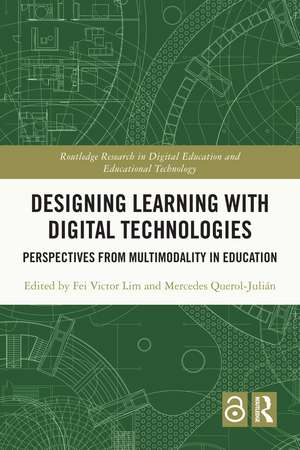
Designing Learning with Digital Technologies: Perspectives from Multimodality in Education: Routledge Research in Digital Education and Educational Technology
Editat de Fei Victor Lim, Mercedes Querol-Juliánen Limba Engleză Paperback – 27 oct 2025
Digital education is of increasing importance in today’s digital society and the editors bring together international thought-leaders and well-established academics across geographical regions to explore the topic. The book addresses the need to design learning with digital technologies, especially in a post-pandemic environment where blended learning has become ubiquitous. The book is organised around five themes: designing learning, digital learning designs, digital learning with embodied teaching, digital learning interactions, and digital multimodal literacies. The chapters focus on digital technologies as multimodal semiotic resources and the educational implication of each theme is drawn out from illustrative cases across contexts of learning.
Essential reading for researchers and postgraduate students, this book offers state-of-the-art thinking on how educators can design new learning experiences for students through the meaningful and effective use of digital technologies.
Chapter 1 of this book is freely available as a downloadable Open Access PDF at http://www.taylorfrancis.com under a Creative Commons Attribution-Non Commercial-No Derivatives (CC-BY-NC-ND) 4.0 license.






Preț: 443.52 lei
Puncte Express: 665
Carte tipărită la comandă
Livrare economică 24 noiembrie-08 decembrie
Livrare prin curier în România Termenul estimat este afișat lângă disponibilitate.
Transport gratuit pentru acest produs Plată online sau ramburs, în funcție de opțiunile comenzii.
Retur gratuit în 14 zile Comandă securizată și suport în română.
Specificații
ISBN-13: 9781032416946
ISBN-10: 1032416947
Pagini: 310
Ilustrații: 126
Dimensiuni: 156 x 234 x 17 mm
Greutate: 0.44 kg
Ediția:1
Editura: Taylor & Francis
Colecția Routledge
Seria Routledge Research in Digital Education and Educational Technology
Locul publicării:Oxford, United Kingdom
ISBN-10: 1032416947
Pagini: 310
Ilustrații: 126
Dimensiuni: 156 x 234 x 17 mm
Greutate: 0.44 kg
Ediția:1
Editura: Taylor & Francis
Colecția Routledge
Seria Routledge Research in Digital Education and Educational Technology
Locul publicării:Oxford, United Kingdom
Public țintă
Academic, Postgraduate, and Undergraduate AdvancedNotă biografică
Fei Victor Lim is an Associate Professor at the National Institute of Education, Nanyang Technological University, Singapore. He is interested in how and what we should teach learners in today’s digital age. He researches and teaches on multiliteracies, multimodal discourse analyses, and digital learning. He is an editor of Multimodality and Society and an associate editor of Computers & Composition and Designs for Learning. He is also author of the book, Designing Learning with Embodied Teaching: Perspectives from Multimodality, and lead author of the book, Designing Learning for Multimodal Literacy: Teaching Viewing and Representing, both published in the Routledge Studies in Multimodality.
Mercedes Querol-Julián is an Associate Professor at Universidad Internacional de La Rioja (Spain) in the Department of English teaching where she leads the research group PRODIGI (Personal and Professional Development through Digital Genres). Her research interests include multimodal literacy, multimodal analysis, digital interaction, digital teaching, EMI, and teacher professional development. She has published in leading international journals including English for Specific Purposes, English for Academic Purposes or System.
Mercedes Querol-Julián is an Associate Professor at Universidad Internacional de La Rioja (Spain) in the Department of English teaching where she leads the research group PRODIGI (Personal and Professional Development through Digital Genres). Her research interests include multimodal literacy, multimodal analysis, digital interaction, digital teaching, EMI, and teacher professional development. She has published in leading international journals including English for Specific Purposes, English for Academic Purposes or System.
Cuprins
PART I DESIGNING LEARNING 1. Learning with technologies in the digital age: Now and the future 2. Designs for learning in the digital age: Towards a new understanding of knowledge representations and cultures of recognition in digitised learning environments PART II DIGITAL LEARNING DESIGNS 3. The multimodal community of inquiry: A framework for evaluating online learning environments in higher education 4. Reflections on the design of heutagogical learning in online higher education modules 5. Designing learning with tools for monitoring metasemiotic awareness PART III DIGITAL LEARNING WITH EMBODIED TEACHING 6. The repurposing of gaze in video-mediated spaces: Implications for designing learning 7. Genre, pedagogy, and the multimodal design of online teaching videos: The case of English language teaching micro-lectures 8. A multimodal analysis of phrasal verbs in OpenCourseWare lecture video clips: Insights for listening comprehension in English language teaching PART IV DIGITAL LEARNING INTERACTIONS 9. Asynchronous video discussions in online communities: A new perspective from multimodality in FL learning 10. Designing multimodal learning for developing multilingual undergraduate students’ communication competences in English: A case study 11. Designing for collaborative critical reading online with WiREAD+ PART IV DIGITAL MULTIMODAL LITERACIES 12. Exploring the multimodal genre of online video game reviews: Research and pedagogical implications for ESP 13. Developing a pedagogic metalanguage for primary students’ learning and engagement with hypermedia 14. Tracing semiotic choices in ‘new writing’ – the role of guidance in students’ work with semiotic technologies
Recenzii
“Designing Learning with Digital Technologies offers a timely and insightful exploration of the convergence of technology and pedagogy through a lens of multimodality in education. A key strength of the book lies in its global perspective, incorporating insights from scholars and practitioners worldwide to present a comprehensive view of the challenges and opportunities brought about by digital technologies in educational settings. The chapters are meticulously researched, delivering strong theoretical foundations and analytical tools that are not only accessible but also adaptable to diverse educational environments.”
Enyao Li, Designing learning with digital technologies: perspectives from multimodality in education, Social Semiotics, DOI: 10.1080/10350330.2024.2396125
"The research reported in the chapters of this book captures the rich professional lives of highly motivated and forward-thinking teachers. The authors show the ways in which these teachers use a dazzling array of technologies to bring multimodal learning into their classrooms. Every teacher we encounter in the book is a designer of rich learning. As such, each is a designer of our collective futures."
William Cope, Professor, Educational Policy, Organization & Leadership, University of Illinois, Urbana-Champaign, United States of America
"The book’s editors and contributors are experts in the fields of teaching and learning, digital and computer technology, language, and communication... Readers will find that this book offers constructive insights into theoretical and practical issues."
Rohmatulloh Rohmatulloh, Lecturer, Universitas Islam An Nur Lampung, Book Review in Open Learning: The Journal of Open, Distance and e-Learning
"Readers interested in digital technologies' implications in education, effective use to enhance student learning, and facilitating meaningful multimodal engagement will not be disappointed. I value its explicit theoretical underpinnings and analytical frameworks, grounded in relevant principles. New research and professional learning proposed show great promise for our collective futures, with the same vigour and ethos as envisaged by the New London Group."
Caroline Ho, Lead Specialist, English Language Institute of Singapore, Ministry of Education, ELIS Book Recommendations
"The volume’s engagement with post-pandemic realities is both current and relevant, responding to current teaching demands while offering critical reflections on how digital learning has evolved. Now, a few years on, what was once described as the post-pandemic period increasingly appears not as a temporary phase but as a structural feature of contemporary education. For this reason, Designing Learning with Digital Technologies offers timely insights and frameworks that hopefully align with and help shape this ongoing transformation, in support of educators and researchers."
Mariasophia Falcone, Adjunct Professor of English Language, University of Bergamo, Italy, Book Review in EuroAmerican Journal of Applied Linguistics and Language
Enyao Li, Designing learning with digital technologies: perspectives from multimodality in education, Social Semiotics, DOI: 10.1080/10350330.2024.2396125
"The research reported in the chapters of this book captures the rich professional lives of highly motivated and forward-thinking teachers. The authors show the ways in which these teachers use a dazzling array of technologies to bring multimodal learning into their classrooms. Every teacher we encounter in the book is a designer of rich learning. As such, each is a designer of our collective futures."
William Cope, Professor, Educational Policy, Organization & Leadership, University of Illinois, Urbana-Champaign, United States of America
"The book’s editors and contributors are experts in the fields of teaching and learning, digital and computer technology, language, and communication... Readers will find that this book offers constructive insights into theoretical and practical issues."
Rohmatulloh Rohmatulloh, Lecturer, Universitas Islam An Nur Lampung, Book Review in Open Learning: The Journal of Open, Distance and e-Learning
"Readers interested in digital technologies' implications in education, effective use to enhance student learning, and facilitating meaningful multimodal engagement will not be disappointed. I value its explicit theoretical underpinnings and analytical frameworks, grounded in relevant principles. New research and professional learning proposed show great promise for our collective futures, with the same vigour and ethos as envisaged by the New London Group."
Caroline Ho, Lead Specialist, English Language Institute of Singapore, Ministry of Education, ELIS Book Recommendations
"The volume’s engagement with post-pandemic realities is both current and relevant, responding to current teaching demands while offering critical reflections on how digital learning has evolved. Now, a few years on, what was once described as the post-pandemic period increasingly appears not as a temporary phase but as a structural feature of contemporary education. For this reason, Designing Learning with Digital Technologies offers timely insights and frameworks that hopefully align with and help shape this ongoing transformation, in support of educators and researchers."
Mariasophia Falcone, Adjunct Professor of English Language, University of Bergamo, Italy, Book Review in EuroAmerican Journal of Applied Linguistics and Language
Descriere
This book draws out the educational implications of digital technologies in teaching and learning through a discussion of their multimodal features and a reflection on the ways they can be used in the designs for learning.