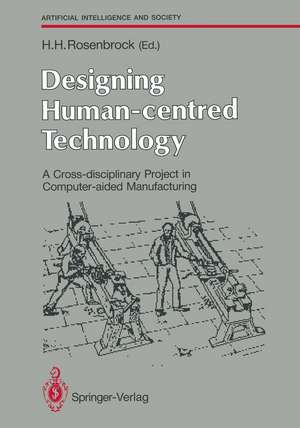
Designing Human-centred Technology: Human-centred Systems
Editat de Howard H. Rosenbrocken Limba Engleză Paperback – 7 dec 1989






Preț: 320.35 lei
Preț vechi: 400.43 lei
-20%
Puncte Express: 481
Carte tipărită la comandă
Livrare economică 27 noiembrie-11 decembrie
Livrare prin curier în România Termenul estimat este afișat lângă disponibilitate.
Transport gratuit de la 400.00 lei Plată online sau ramburs, în funcție de opțiunile comenzii.
Retur gratuit în 14 zile Comandă securizată și suport în română.
Specificații
ISBN-13: 9783540195672
ISBN-10: 354019567X
Pagini: 228
Ilustrații: XVI, 208 p.
Dimensiuni: 170 x 242 x 13 mm
Greutate: 0.4 kg
Ediția:Softcover reprint of the original 1st ed. 1989
Editura: Springer
Colecția Human-centred Systems
Seria Human-centred Systems
Locul publicării:London, United Kingdom
ISBN-10: 354019567X
Pagini: 228
Ilustrații: XVI, 208 p.
Dimensiuni: 170 x 242 x 13 mm
Greutate: 0.4 kg
Ediția:Softcover reprint of the original 1st ed. 1989
Editura: Springer
Colecția Human-centred Systems
Seria Human-centred Systems
Locul publicării:London, United Kingdom
V-ar putea interesa
-
 Human-Centered AIBen Shneiderman-30%Preț: 108.58 lei155.38 lei
 -
 Shared WisdomAlex PentlandPreț: 157.02 lei
 -
 If Anyone Builds It, Everyone DiesEliezer Yudkowsky-20%Preț: 130.65 lei163.30 lei
 -
 The Technological SocietyJacques EllulPreț: 91.29 lei
 -
 Computational Intelligence in Design and ManufacturingAndrew Kusiak-14%Preț: 930.45 lei1081.92 lei
 -
 Against the MachinePaul KingsnorthPreț: 194.17 lei
 -
 Notes on the Synthesis of FormChristopher AlexanderPreț: 235.55 lei
 -
 Hacking HumanityLara LewingtonPreț: 123.80 lei
 -
 The Power of Design and Convergence of AITai Lee Siang-20%Preț: 419.95 lei524.93 lei
 -
 Design Philosophy after the Technology TurnDr Fernando Secomandi-33%Preț: 554.31 lei821.31 lei
 -
 -20%Preț: 201.82 lei252.28 lei
 -
 Universal Methods of Design, Expanded and RevisedBruce Hanington-21%Preț: 162.25 lei205.95 lei
 -
 Human + Machine, Updated and ExpandedH. James WilsonPreț: 197.19 lei
 -
 The Atomic HumanNeil D. LawrencePreț: 94.41 lei
 -
 Augmenting HumanityAnees Janee AliPreț: 415.93 lei
 -
 At the Edge of AI: Human Computation Systems and Their Intraverting RelationsLibuše Hannah Veprek-24%Preț: 341.15 lei451.38 lei
 -
 Machine Knitter''s ReferenceBeleke Den HartogPreț: 185.45 lei
 -
 Design. Think. Make. Break. Repeat.: Revised editionMartin Tomitsch-22%Preț: 178.54 lei227.56 lei
Public țintă
ResearchCuprins
1. The Background to the Project.- Why is Taylorism so Widespread?.- An Alternative Technology?.- The Steering Committee.- The Application for Funding.- Steering Committee Discussions.- Methodology.- The Aims of the Project.- 2. The Technical Problem.- Some History.- Numerical Control.- Record-Playback.- Cutting Technology.- Design.- Learning, but Learning What?.- My Own View.- Terminology.- 3. Towards a Design Methodology: A Psychologist’s View.- The Design Context.- Design Criteria Related to the Human as a Component of the System.- Design Criteria Related to the System as the Operator’s Environment.- Heuristics in Design Negotiation: The ’Blank Table Debate’.- Towards an Interactive Design Process.- Conclusion.- Appendix: Operator Control and Automation Howard Rosenbrock and Martin Corbett.- 4. The Social and Engineering Design of Computer Numerically Controlled Technology.- Numerical Control Technology.- The Development of Cutting Technology Software.- The ’Blank Table Debate’ — A Divergence of Opinion.- Conclusions and Personal Reflections — The Engineer as a Social Scientist.- 5. A Computer Science View.- Software Structure.- Aspects of the UMIST System.- Software Development.- Use of Alternative Programming Methods.- Conclusion.- Appendix: Skeleton Syntax for Part-programs.- 6. On the Collaboration Between Social Scientists and Engineers.- Background — The Dynamics.- Models of Science.- Operational Issues.- Making It Happen — Institutions and Infrastructure.- 7. (How) Can Technology be Redirected? A Scandinavian Perspective.- The Concept of Non-subordinating Machinery.- Methodologies for Designing Redirected Technology.- Was the Project Appropriate and Efficacious in a Redirection Effort?.- Future Developments.- 8. A Works Director’s View.-Evolution of New Technology and Human Skills.- The Operator, His Machine, and a Human-centred Approach to Technology.- The UMIST Project.- Conclusion.- 9. The Coordinator’s View.- General Achievements.- The Conduct of the Project.- Cross-disciplinary Work by Engineers and Social Scientists.- The Importance of Management and of Technical Process Development in Human-centred Working.- The Future.- Final Comment.- 10. Human-centred Systems.- The Early Stages.- Technology, Science and Ideology.- Proposals for a New Approach.- First Practical Moves.- Issues of Status, Skill and Uncertainty.- Human-centred Capabilities.- Future Development of Human-centredness.- 11. The ESPRIT Project.- and Summary.- The Meaning of Human-centredness.- The Factory of the Future.- ESPRIT Project 1217 (1199).- CIM Design Considerations.- The BITZ Demonstration Site.- The Shop-floor Monitor and Controller.- The Sketching Module.- The BICC Demonstration Site.- The Rolls Royce Demonstration Site.- The Human-centred Lathe Controller.- Concluding Remarks.- Appendix: Participating Organisations.- 12. Postscript.- Appendices.- 1. Short CVs of Contributors.- 2. SERC Application.- 3. Transcript of a Part of the Steering Committee Meeting Held on 12 July 1982.