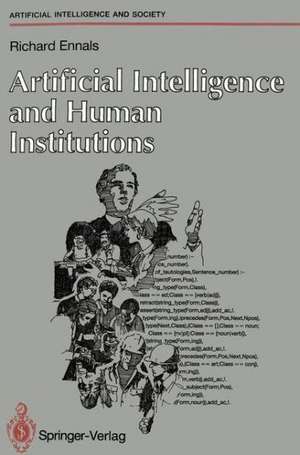
Artificial Intelligence and Human Institutions: Human-centred Systems
Autor Richard Ennalsen Limba Engleză Paperback – 3 dec 1990







Preț: 330.94 lei
Preț vechi: 413.67 lei
-20%
Puncte Express: 496
Carte tipărită la comandă
Livrare economică 30 noiembrie-14 decembrie
Livrare prin curier în România Termenul estimat este afișat lângă disponibilitate.
Transport gratuit de la 400.00 lei Plată online sau ramburs, în funcție de opțiunile comenzii.
Retur gratuit în 14 zile Comandă securizată și suport în română.
Specificații
ISBN-13: 9783540195795
ISBN-10: 3540195793
Pagini: 196
Ilustrații: XII, 181 p.
Dimensiuni: 170 x 242 x 11 mm
Greutate: 0.35 kg
Ediția:1st Edition.
Editura: Springer
Colecția Human-centred Systems
Seria Human-centred Systems
Locul publicării:London, United Kingdom
ISBN-10: 3540195793
Pagini: 196
Ilustrații: XII, 181 p.
Dimensiuni: 170 x 242 x 11 mm
Greutate: 0.35 kg
Ediția:1st Edition.
Editura: Springer
Colecția Human-centred Systems
Seria Human-centred Systems
Locul publicării:London, United Kingdom
V-ar putea interesa
-
 -20%Preț: 89.95 lei112.23 lei
 -
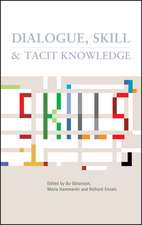 Dialogue, Skill and Tacit KnowledgeBo Goranzon-9%Preț: 768.20 lei844.18 lei
 -
 Computer VisionSimon J. D. Prince-20%Preț: 582.72 lei728.39 lei
 -
 Machine LearningPeter Flach-20%Preț: 386.84 lei483.55 lei
 -
 Multi-Agent Machine LearningSchwartz-20%Preț: 675.81 lei844.77 lei
 -
 Wavelet Neural NetworksAntonis K Alexandridis-20%Preț: 634.18 lei792.72 lei
 -
 Practical Introduction to CompDawson-Howe-20%Preț: 518.21 lei647.76 lei
 -
 Work Life 2000 Yearbook 3Richard EnnalsPreț: 388.24 lei
 -
 Work Life 2000 Yearbook 1 1999Richard EnnalsPreț: 387.27 lei
 -
 Machine Learning: An Algorithmic Perspective, Second EditionStephen Marsland-20%Preț: 625.22 lei781.53 lei
 -
 -9%Preț: 987.33 lei1084.98 lei
 -
 Work Life 2000Richard EnnalsPreț: 407.38 lei
 -
 Work Life 2000 Yearbook 3Richard EnnalsPreț: 406.10 lei
 -
 -20%Preț: 1276.71 lei1595.89 lei
 -
 -38%Preț: 781.97 lei1261.36 lei
 -
 Knowledge Science, Engineering and ManagementRobert Buchmann-20%Preț: 341.01 lei426.26 lei
 -
 Design of Experiments for Reinforcement LearningChristopher Gatti-20%Preț: 670.06 lei837.57 lei
 -
 Preț: 369.16 lei
 -
 Methods and Applications of Artificial IntelligenceIoannis P. Vlahavas-20%Preț: 332.81 lei416.02 lei
 -
 Believable BotsPhilip Hingston-20%Preț: 676.70 lei845.88 lei
 -
 Computers and CreativityJon McCormack-20%Preț: 765.79 lei957.23 lei
 -
 Advanced Concepts in Fuzzy Logic and Systems with Membership UncertaintyJanusz T. Starczewski-20%Preț: 650.00 lei812.51 lei
 -
 Patterns of IntuitionGerhard Nierhaus-20%Preț: 800.51 lei1000.64 lei
Public țintă
ResearchCuprins
1. Approaches to Artificial Intelligence.- A Reassessment of Artificial Intelligence.- Artificial Intelligence and Human Institutions.- An Alternative Model of Artificial Intelligence.- Artificial Intelligence as Tool and Institution.- The Artificial Intelligence Debate.- Logic and Problem Solving.- Developments in Applied Artificial Intelligence.- 2 Perspectives from the Humanities.- Knowledge, Information and Data.- Interpretation and Codebreaking.- Logicist Analysis and Artificial Intelligence.- Argument in the Humanities.- Representation.- Quantification.- Modelling with Artificial Intelligence Tools.- Computational Politics: Modelling Bureaucrats.- 3. Education.- Education Before Computers.- Generations of Computer-Assisted Learning.- Presuppositions: Logic Programming and the Culture of the Classroom.- Technology Transfer is Often Accomplished Through People Transfer.- New Partnerships for CAL Researchers.- Integrated Systems: From Theory to Practice.- Evaluation of CAL.- Knowledge Engineering and the Knowledge Society: Process and Structure.- 4. Work.- What are Skills?.- Transferring Skills.- Preconditions for the Transfer of Skills.- Technology and Skills.- Artificial Intelligence and Skills.- Knowledge Based Systems and Work Based Learning.- The Politics of Skills.- Materials Selection, Materials Science and Artificial Intelligence.- Work, Skill and Management.- 5. Computer Systems.- The Two Cultures of Artificial Intelligence and Software Engineering.- Artificial Intelligence and CASE: The Analogy of Pottery.- The New Concern for Methodology.- Current Difficulties in Introducing New Tools and Methodologies into Industrial and Commercial Use.- Prospects for Adding Artificial Intelligence to CASE Tools.- “New Generation Software Technology” Based onDeclarative Systems.- The Logic Programming Initiative.- Problems of Knowledge and Problems of People.- 6. Social Institutions.- Changing Technology and People.- Human Centred Systems.- Commitment.- Artificial Intelligence and Voluntary Sector Groups.- Institutions and Dissent.- The Artificial Intelligence for Society Club.- Social Applications for Artificial Intelligence.- Organisational Preconditions for Collaborative Artificial Intelligence Activity.- New Technology and Human Institutions.- Case Studies in AI for Problem Finding.- 7. Human Resource Development in Information Technology.- The Human Resource Development in Information Technology Survey.- The IT Skills Crisis.- Survey Findings.- Conclusions from the HRDIT Survey.- 8. Politics.- Observing Patterns of Behaviour in Human Institutions.- Artificial Intelligence and Politics.- A Case Study in Politics and Artificial Intelligence: Star Wars.- Modelling Policy and Institutions: The Case of Welfare Benefits.- Artificial Intelligence and Coping with Change.- The Virtues of Virtual Systems.- Intelligence.- Policy Perspectives.- Conclusion.- References.- Name Index.