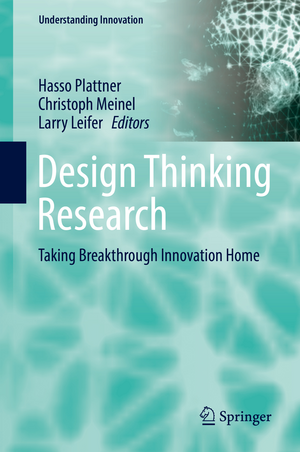
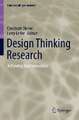
Design Thinking Research: Taking Breakthrough Innovation Home: Understanding Innovation
Editat de Hasso Plattner, Christoph Meinel, Larry Leiferen Limba Engleză Hardback – 19 aug 2016


Preț: 1072.25 lei
Preț vechi: 1307.62 lei
-18%
Puncte Express: 1608
Preț estimativ în valută:
189.61€ • 217.42$ • 163.87£
189.61€ • 217.42$ • 163.87£
Carte tipărită la comandă
Livrare economică 27 aprilie-11 mai
Specificații
ISBN-13: 9783319403816
ISBN-10: 3319403818
Pagini: 326
Ilustrații: VIII, 317 p. 121 illus., 75 illus. in color.
Dimensiuni: 155 x 235 x 19 mm
Greutate: 0.64 kg
Ediția:1st ed. 2016
Editura: Springer International Publishing
Colecția Springer
Seria Understanding Innovation
Locul publicării:Cham, Switzerland
ISBN-10: 3319403818
Pagini: 326
Ilustrații: VIII, 317 p. 121 illus., 75 illus. in color.
Dimensiuni: 155 x 235 x 19 mm
Greutate: 0.64 kg
Ediția:1st ed. 2016
Editura: Springer International Publishing
Colecția Springer
Seria Understanding Innovation
Locul publicării:Cham, Switzerland
V-ar putea interesa
-
 Broadcasting in the 21st CenturyRichard RudinPreț: 245.00 lei
 -
 Preț: 373.98 lei
 -
 Basic Radio JournalismPaul ChantlerPreț: 374.34 lei
 -
 Branding TV: Principles and PracticesWalter McDowell-15%Preț: 453.27 lei533.26 lei
 -
 Preț: 375.27 lei
 -
 -20%Preț: 245.15 lei306.44 lei
 -
 International Communication: A ReaderDaya Kishan Thussu-8%Preț: 451.96 lei491.26 lei
 -
 Essentials of Business Processes and Information SystemsSimha R Magal-19%Preț: 531.69 lei656.41 lei
 -
 Public Sector Records Management: A Practical GuideKelvin Smith-18%Preț: 1069.56 lei1304.34 lei
 -
 The Internet and the Mass MediaLucy Küng-15%Preț: 460.43 lei541.68 lei
 -
 Arab Television TodayNaomi Sakr-26%Preț: 164.17 lei222.87 lei
 -
 Web Services: Concepts, Architectures and ApplicationsGustavo Alonso-20%Preț: 493.00 lei616.24 lei
Cuprins
Introduction: Design Thinking for the 21st Century Organization.- Thisisdesignthinking.net: A Storytelling Project.- Part I: Design Thinking in Practice.- Part II: Exploring Human-Technology Interaction.- Part III: Prototyping.- Part IV: Developing DT Teaching and Coaching Tools & Approaches.
Textul de pe ultima copertă
In a very unique way, design thinking enables teams and organizations to find completely novel solutions to even complex challenges and to become sustainably innovative. The desire to understand the reason for this effect and to improve our knowledge about innovation drives the HPI Stanford Design Thinking Research Program. Since 2008 scientists from the Hasso Plattner Institute and Stanford University have engaged in multifaceted research projects to find out more about the underlying principles of this method and how and why it works. The outcomes of their studies, experiments, and investigations in the 7th program year have again been compiled and are presented in this book.
Special emphasis is placed on exploring how design thinking is applied in practice. This book presents insights from studies and real-world investigations. Research also focuses on design processes with regard to the rising importance of human-technology interaction that comes with technological progress. The third part of this publication compiles findings about prototyping—a core element in design thinking. Finally, design thinking education and training is addressed, presenting promising new approaches and tools.
Meaningful insights have been gained by applying rigorous academic methods. And they are not only intended for scientific discourse. Instead they provide guidance and inspiration for all practitioners interested in really comprehending innovation. As we gain a deeper understanding of design innovation processes, the probability of breakthrough innovation increases.
Meaningful insights have been gained by applying rigorous academic methods. And they are not only intended for scientific discourse. Instead they provide guidance and inspiration for all practitioners interested in really comprehending innovation. As we gain a deeper understanding of design innovation processes, the probability of breakthrough innovation increases.
Caracteristici
Illustrates how Design Thinking can be used to innovate IT development Covers much more than just best practices in Design Thinking and innovation Based on scientific evidence from the HPI Stanford Design Thinking Research program Includes supplementary material: sn.pub/extras
Recenzii
From the book reviews:
“The book is divided into four parts, each comprising three to five papers related to design thinking. Interestingly, the titles of all parts are full sentences, informing the reader of specific design thinking activities. … I would recommend it to engineers, managers, and designers for afternoon reading, as well as to scientists who want to grasp the virtues of engineering processes, which actual scientific discoveries may lead to.” (Janusz Zalewski, Computing Reviews, July, 2014)
“The book is divided into four parts, each comprising three to five papers related to design thinking. Interestingly, the titles of all parts are full sentences, informing the reader of specific design thinking activities. … I would recommend it to engineers, managers, and designers for afternoon reading, as well as to scientists who want to grasp the virtues of engineering processes, which actual scientific discoveries may lead to.” (Janusz Zalewski, Computing Reviews, July, 2014)