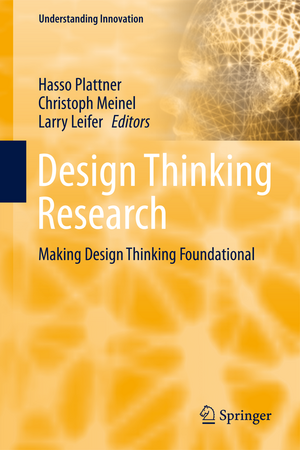
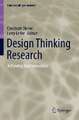
Design Thinking Research: Making Design Thinking Foundational: Understanding Innovation
Editat de Hasso Plattner, Christoph Meinel, Larry Leiferen Limba Engleză Hardback – 19 aug 2015

Preț: 1070.72 lei
Preț vechi: 1305.75 lei
-18%
Puncte Express: 1606
Carte tipărită la comandă
Livrare economică 14-28 noiembrie
Livrare prin curier în România Termenul estimat este afișat lângă disponibilitate.
Transport gratuit pentru acest produs Plată online sau ramburs, în funcție de opțiunile comenzii.
Retur gratuit în 14 zile Comandă securizată și suport în română.
Specificații
ISBN-13: 9783319196404
ISBN-10: 3319196405
Pagini: 315
Ilustrații: VIII, 290 p. 127 illus., 68 illus. in color.
Dimensiuni: 155 x 235 x 22 mm
Greutate: 0.59 kg
Ediția:1st ed. 2016
Editura: Springer International Publishing
Colecția Springer
Seria Understanding Innovation
Locul publicării:Cham, Switzerland
ISBN-10: 3319196405
Pagini: 315
Ilustrații: VIII, 290 p. 127 illus., 68 illus. in color.
Dimensiuni: 155 x 235 x 22 mm
Greutate: 0.59 kg
Ediția:1st ed. 2016
Editura: Springer International Publishing
Colecția Springer
Seria Understanding Innovation
Locul publicării:Cham, Switzerland
V-ar putea interesa
-
 Broadcasting in the 21st CenturyRichard RudinPreț: 256.34 lei
 -
 Creating Preschool TelevisionJ. SteemersPreț: 384.57 lei
 -
 Basic Radio JournalismPaul ChantlerPreț: 394.29 lei
 -
 Branding TV: Principles and PracticesWalter McDowell-15%Preț: 468.70 lei551.41 lei
 -
 Preț: 394.17 lei
 -
 -20%Preț: 264.37 lei330.46 lei
 -
 International Communication: A ReaderDaya Kishan Thussu-15%Preț: 475.08 lei558.92 lei
 -
 -19%Preț: 579.71 lei715.68 lei
 -
 Public Sector Records Management: A Practical GuideKelvin Smith-18%Preț: 1128.65 lei1376.40 lei
 -
 The Internet and the Mass MediaLucy Küng-18%Preț: 692.76 lei844.83 lei
 -
 Arab Television TodayNaomi Sakr-26%Preț: 164.17 lei222.87 lei
 -
 Web Services: Concepts, Architectures and ApplicationsGustavo Alonso-20%Preț: 493.00 lei616.24 lei
Public țintă
ResearchCuprins
Part I: Tools and Techniques for Improved Team Interaction.- Part II: Creativity and Creative Confidence.- Part III: Measuring Design Thinking.- Part IV: Documentation and Information Transfer in Design Thinking Processes.
Textul de pe ultima copertă
What is the actual impact of design thinking? Which tools and techniques could conceivably improve team interaction in design processes? What influences creativity? And how can information be secured? These are just a few of the questions that were addressed by research teams from Stanford University, USA, and the Hasso Plattner Institute for Software Systems Engineering, Potsdam, Germany, within their joint Design Thinking Research Program.
Scientists from both institutions have been studying the user-centric innovation method of design thinking for many years now to gain a deep, evidence-based understanding of its underlying principles and functioning. The outcome of their studies, experiments and investigations in the sixth program year are summarized in this volume. Again research covers a diverse range of design thinking domains. The aim, however, is not only to advance design thinking theory and knowledge within the research community. Rather the program strives to ultimately improve design practice and education by gathering scientific evidence that supports design activities.
The first part of this book presents tools and techniques for improved team interaction that have been investigated and developed by the research teams. Creativity and creative confidence as central factors in design thinking are the focus of the second part. The book continues with investigations on the actual impact of design thinking and conceivable metrics. The fourth and final part of the book addresses issues of documentation and information transfer in innovation processes.
By taking the understanding of innovation to a new level that is relevant to all disciplines, our research provides a significant contribution toward making design thinking a foundational science.
Scientists from both institutions have been studying the user-centric innovation method of design thinking for many years now to gain a deep, evidence-based understanding of its underlying principles and functioning. The outcome of their studies, experiments and investigations in the sixth program year are summarized in this volume. Again research covers a diverse range of design thinking domains. The aim, however, is not only to advance design thinking theory and knowledge within the research community. Rather the program strives to ultimately improve design practice and education by gathering scientific evidence that supports design activities.
The first part of this book presents tools and techniques for improved team interaction that have been investigated and developed by the research teams. Creativity and creative confidence as central factors in design thinking are the focus of the second part. The book continues with investigations on the actual impact of design thinking and conceivable metrics. The fourth and final part of the book addresses issues of documentation and information transfer in innovation processes.
By taking the understanding of innovation to a new level that is relevant to all disciplines, our research provides a significant contribution toward making design thinking a foundational science.
Caracteristici
Based on scientific evidence from the HPI Stanford Design Thinking Research Program Covers more than just best practice in design thinking and innovation Points out how design thinking can be used to innovate IT development
Recenzii
From the book reviews:
“The book is divided into four parts, each comprising three to five papers related to design thinking. Interestingly, the titles of all parts are full sentences, informing the reader of specific design thinking activities. … I would recommend it to engineers, managers, and designers for afternoon reading, as well as to scientists who want to grasp the virtues of engineering processes, which actual scientific discoveries may lead to.” (Janusz Zalewski, Computing Reviews, July, 2014)
“The book is divided into four parts, each comprising three to five papers related to design thinking. Interestingly, the titles of all parts are full sentences, informing the reader of specific design thinking activities. … I would recommend it to engineers, managers, and designers for afternoon reading, as well as to scientists who want to grasp the virtues of engineering processes, which actual scientific discoveries may lead to.” (Janusz Zalewski, Computing Reviews, July, 2014)