
Demos: Stress Relieving Patterns
Autor George Gissingen Limba Engleză Paperback – 6 dec 2015
Preț: 136.15 lei
Puncte Express: 204
Carte disponibilă
Livrare economică 09-23 noiembrie
Livrare prin curier în România Termenul estimat este afișat lângă disponibilitate.
Transport gratuit de la 400.00 lei Plată online sau ramburs, în funcție de opțiunile comenzii.
Retur gratuit în 14 zile Comandă securizată și suport în română.
Specificații
ISBN-13: 9781519701381
ISBN-10: 1519701381
Pagini: 472
Dimensiuni: 189 x 246 x 24 mm
Greutate: 0.84 kg
Editura: CreateSpace Independent Publishing Platform
ISBN-10: 1519701381
Pagini: 472
Dimensiuni: 189 x 246 x 24 mm
Greutate: 0.84 kg
Editura: CreateSpace Independent Publishing Platform
V-ar putea interesa
-
 Keep the Aspidistra FlyingGeorge Orwell-27%Preț: 52.63 lei71.65 lei
 -
 The Grapes of WrathJohn Steinbeck-25%Preț: 55.22 lei73.18 lei
 -
 The Making of the English Working ClassE. P. ThompsonPreț: 161.69 lei
 -
 British Socialist Fiction, 1884–1914, Volume 1Deborah MutchPreț: 509.46 lei
 -
 British Socialist Fiction, 1884-1914, Volume 2Deborah MutchPreț: 508.78 lei
 -
 British Socialist Fiction, 1884–1914, Volume 3Deborah MutchPreț: 511.22 lei
 -
 British Socialist Fiction, 1884–1914, Volume 4Deborah MutchPreț: 507.92 lei
 -
 The Conquest of BreadPeter KropotkinPreț: 56.82 lei
 -
 Mary BartonElizabeth Cleghorn GaskellPreț: 58.31 lei
 -
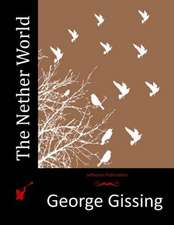 The Nether WorldGeorge GissingPreț: 60.98 lei
 -
 Felix Holt, the RadicalGeorge EliotPreț: 70.83 lei
 -
 The Road to Wigan PierGeorge Orwell-40%Preț: 51.45 lei85.48 lei
 -
 The Ragged Trousered PhilanthropistsRobert TressellPreț: 28.01 lei
 -
 North and SouthElizabeth GaskellPreț: 58.22 lei
 -
 Oliver TwistCharles DickensPreț: 37.41 lei
 -
 An Inspector Calls: Annotation-Friendly EditionJ. B. PriestleyPreț: 86.45 lei
 -
 The Ragged Trousered PhilanthropistsScarlett Rickard-8%Preț: 132.37 lei143.37 lei
 -
 UtopiaThomas MorePreț: 33.19 lei
 -
 SybilBenjamin DisraeliPreț: 69.18 lei
Notă biografică
George Gissing (1857-1903) was an English novelist, noted for the unflinching realism of his novels about the lower middle class. Gissing was educated at Owens College, Manchester, where his academic career was brilliant until he was expelled (and briefly imprisoned) for theft. The life of near poverty and constant drudgery-writing and teaching-that he led until the mid-1880s is described in the novels New Grub Street (1891) and The Private Papers of Henry Ryecroft (1903).
Before he was 21 he conceived the ambition of writing a long series of novels, somewhat in the manner of Balzac, whom he admired. The first of these, Workers in the Dawn, appeared in 1880, to be followed by 21 others. Between 1886 and 1895 he published one or more novels every year. He also wrote Charles Dickens: A Critical Study (1898), a perceptive piece of literary criticism.
His work is serious-though not without a good deal of comic observation-and scrupulously honest. On the social position and psychology of women he is particularly acute: The Odd Women (1893) is a powerful study of female frustration. Gissing was deeply critical, in an almost wholly negative way, of contemporary society.