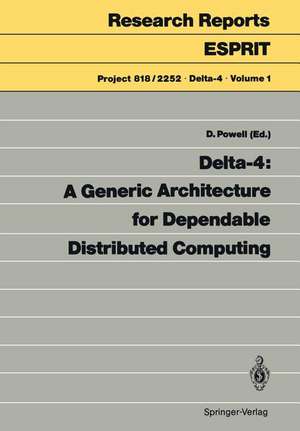
Delta-4: A Generic Architecture for Dependable Distributed Computing: Research Reports Esprit, cartea 1
Editat de David Powellen Limba Engleză Paperback – 13 noi 1991
Din seria Research Reports Esprit
- 20%
 Preț: 320.37 lei
 - 15%
 Preț: 632.50 lei
 - 20%
 Preț: 337.80 lei
 - 20%
 Preț: 617.06 lei
 - 20%
 Preț: 620.52 lei
 - 20%
 Preț: 316.28 lei
 - 20%
 Preț: 316.11 lei
 - 20%
 Preț: 622.77 lei
 - 20%
 Preț: 625.58 lei
 - 20%
 Preț: 619.26 lei
 - 20%
 Preț: 622.27 lei
 - 20%
 Preț: 617.38 lei
 - 20%
 Preț: 616.72 lei
 - 20%
 Preț: 318.97 lei
 - 20%
 Preț: 633.52 lei
 - 20%
 Preț: 620.38 lei
 - 20%
 Preț: 320.06 lei
 - 20%
 Preț: 318.97 lei
 - 20%
 Preț: 615.94 lei
 - 20%
 Preț: 615.45 lei
 - 20%
 Preț: 619.89 lei
 - 20%
 Preț: 614.83 lei
 - 20%
 Preț: 648.85 lei
 - 20%
 Preț: 319.75 lei
 - 20%
 Preț: 311.75 lei
 - 20%
 Preț: 315.26 lei
 - 20%
 Preț: 327.99 lei
 - 20%
 Preț: 315.04 lei
 -
 Preț: 390.13 lei
 - 15%
 Preț: 647.92 lei
 - 20%
 Preț: 324.28 lei
 - 20%
 Preț: 324.05 lei
 - 20%
 Preț: 333.13 lei
 - 20%
 Preț: 329.26 lei
 - 20%
 Preț: 332.91 lei
 -
 Preț: 365.31 lei
 - 20%
 Preț: 329.99 lei
 - 20%
 Preț: 642.79 lei
 -
 Preț: 370.42 lei
 - 20%
 Preț: 327.54 lei
 - 20%
 Preț: 329.74 lei
 - 20%
 Preț: 314.83 lei
 - 20%
 Preț: 324.28 lei
 - 20%
 Preț: 653.77 lei
 - 20%
 Preț: 316.48 lei
 - 20%
 Preț: 314.14 lei
Preț: 332.42 lei
Preț vechi: 415.53 lei
-20%
Puncte Express: 499
Carte tipărită la comandă
Livrare economică 27 noiembrie-11 decembrie
Livrare prin curier în România Termenul estimat este afișat lângă disponibilitate.
Transport gratuit de la 400.00 lei Plată online sau ramburs, în funcție de opțiunile comenzii.
Retur gratuit în 14 zile Comandă securizată și suport în română.
Specificații
ISBN-13: 9783540549857
ISBN-10: 3540549854
Pagini: 496
Ilustrații: X, 484 p. 23 illus.
Dimensiuni: 170 x 244 x 26 mm
Greutate: 0.78 kg
Ediția:Softcover reprint of the original 1st ed. 1991
Editura: Springer Berlin, Heidelberg
Colecția Springer
Seriile Research Reports Esprit, Projects 818/2252 Delta-4
Locul publicării:Berlin, Heidelberg, Germany
ISBN-10: 3540549854
Pagini: 496
Ilustrații: X, 484 p. 23 illus.
Dimensiuni: 170 x 244 x 26 mm
Greutate: 0.78 kg
Ediția:Softcover reprint of the original 1st ed. 1991
Editura: Springer Berlin, Heidelberg
Colecția Springer
Seriile Research Reports Esprit, Projects 818/2252 Delta-4
Locul publicării:Berlin, Heidelberg, Germany
V-ar putea interesa
-
 -40%Preț: 492.21 lei824.42 lei
 -
 -20%Preț: 225.84 lei282.30 lei
 -
 Preț: 291.45 lei
 -
 Software Architecture in PracticeLen Bass-20%Preț: 394.59 lei493.24 lei
 -
 -20%Preț: 428.14 lei535.18 lei
 -
 Patterns of Distributed SystemsUnmesh Joshi-20%Preț: 291.34 lei364.18 lei
 -
 Distributed SystemsGeorge Coulouris-20%Preț: 624.57 lei780.72 lei
 -
 Patterns of Enterprise Application ArchitectureMartin Fowler-20%Preț: 396.95 lei496.18 lei
 -
 Computer Architecture: A Quantitative ApproachJohn L. Hennessy-39%Preț: 534.37 lei882.55 lei
 -
 -20%Preț: 758.53 lei948.16 lei
 -
 MeditationsMarcus AureliusPreț: 34.00 lei
 -
 -20%Preț: 377.89 lei472.36 lei
 -
 Dependable Computing: Design and AssessmentRavishankar K. Iyer-20%Preț: 858.05 lei1072.56 lei
 -
 Security EngineeringRoss Anderson-20%Preț: 392.75 lei490.94 lei
 -
 Software Architecture FundamentalsMahbouba Gharbi-20%Preț: 245.98 lei307.47 lei
 -
 Think Distributed SystemsDominik Tornow-20%Preț: 332.09 lei415.11 lei
 -
 Architecting Dependable Systems VIIAntonio Casimiro-20%Preț: 311.50 lei389.38 lei
 -
 -20%Preț: 373.26 lei466.58 lei
 -
 AI and MicroservicesDileep Kumar Pandiya-20%Preț: 263.90 lei329.88 lei
 -
 .NET 10 RevealedKajetan Duszy¿ski-20%Preț: 240.60 lei300.75 lei
Public țintă
Professional/practitionerCuprins
1. Requirements and Objectives.- 1.1. Fields of Application.- 1.2. Architectural Attributes.- 2. Overview of the Architecture.- 2.1. Dependability and Real-Time Concepts.- 2.2. Dependability and Real-Time in Delta-4.- 2.3. Architectural Sub-Systems.- 2.4. Software Environment and Management Issues.- 2.5. Validation.- 3. Comparison with other Approaches.- 3.1. Commercial Fault-Tolerance Techniques.- 3.2. Comparison of Approaches by Concept/Technique.- 3.3. Comparison of Approaches by Target System Characteristics.- 3.4. Case Studies.- 3.5. Conclusion.- 4. Dependability Concepts.- 4.1. Basic Definitions.- 4.2. On the Introduction of Dependability as a Generic Concept.- 4.3. On System Function, Behavior, Structure and Specification.- 4.4. The Impairments to Dependability.- 4.5. The Means for Dependability.- 4.6. The Attributes of Dependability.- 5. Real-Time Concepts.- 5.1. Concepts and Definitions.- 5.2. Delta-4 Approach to Real-Time.- 5.3. Real-Time Communications Protocols.- 5.4. Summary of Real-Time System Requirements.- 5.5. Conclusions.- 6. Distributed Fault-Tolerance.- 6.1. Related Work.- 6.2. Node Hardware Characteristics.- 6.3. Models of Distributed Computation.- 6.4. Replicated Software Components.- 6.5. Active Replication.- 6.6. Passive Replication.- 6.7. Semi-Active Replication.- 6.8. Group Management and Fault Treatment.- 6.9. Communications Support.- 6.10. Conclusion.- 7. Delta-4 Application Support Environment (Deltase).- 7.1. Purpose and Background.- 7.2. Computational Model.- 7.3. Engineering Model.- 7.4. Deltase Support for Distributed Fault-Tolerance.- 7.5. Engineering Support for Fault-Tolerance.- 7.6. Dependable Databases.- 8. Open System Architecture (OSA).- 8.1. Multipoint Communication System (MCS).- 8.2. System Administration.- 9. Extra PerformanceArchitecture (XPA).- 9.1. Objectives and Definitions.- 9.2. Overview.- 9.3. Real-time and Performance.- 9.4. Dependability and Computational Models.- 9.5. Support for Distributed Real-Time Computing.- 9.6. XPA as an Integrated Machine.- 9.7. System Administration.- 10. The Atomic Multicast protocol (AMp).- 10.1. Notions about Reliable Group Communication.- 10.2. Related Work.- 10.3. System Architecture.- 10.4. Summary of xAMp Services.- 10.5. The Abstract Network.- 10.6. Two-Phase Accept Protocol.- 10.7. Performance and Real-Time.- 10.8. Implementation Issues.- 11. Fail-Silent Hardware for Distributed Systems.- 11.1. Fail-Silent Node Models.- 11.2. A Comparative Evaluation.- 11.3. Concluding Remarks.- 12. Input/Output: Interfacing the Real World.- 12.1. Inter-working with non-Delta-4 systems.- 12.2. Inter-working with the Physical Environment.- 12.3. Summary.- 13. Security.- 13.1. Principles of Intrusion-Tolerance.- 13.2. Fragmentation-Scattering Applied to File Archiving.- 13.3. Intrusion-Tolerant Security Server.- 13.4. Selection and Implementation of an Authorization Policy.- 13.5. Future Extensions.- 14. Software-Fault Tolerance.- 14.1. A Brief History — the State of the Art.- 14.2. Software-Fault Tolerance for Delta-4.- 14.3. Support Mechanisms and Features.- 14.4. Specifying Software Components for Software-fault Tolerance — Tradeoffs in an Object Environment.- 14.5. Concluding Remarks.- 15. Validation.- 15.1. Overview.- 15.2. Protocol Validation.- 15.3. Fault Injection.- 15.4. Dependability Evaluation.- 15.5. Software Reliability.- Annexes.- A. Safety-Critical and Safety-Related Systems.- B. Deterministic UNIX.- C. Statistical Effects with Schedules of many Activities.- D. Assigning Precedence Parameters.- E. Formal Failure Mode Assumptions.- F. AssumptionCoverage.- G. Propagate-before-Validate Error Processing Technique.- H. Interface between XPA and OSA.- I. Timing Characteristics of Preemption Points.- J. Formal Presentation of AMp.- K. Models for the Representation of Reactive Systems.- L. Service Specifications.- M. Co-existence with non-Delta-4 Stations on the same LAN.- Glossary of Abbreviations.- References.- Author Affiliations.- The Delta-4 Consortium.