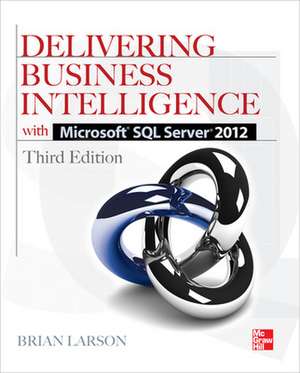
Delivering Business Intelligence with Microsoft SQL Server 2012 3/E
Autor Brian Larsonen Limba Engleză Paperback – 16 mai 2012
Implement a Robust BI Solution with Microsoft SQL Server 2012
Equip your organization for informed, timely decision making using the expert tips and best practices in this practical guide. Delivering Business Intelligence with Microsoft SQL Server 2012, Third Edition explains how to effectively develop, customize, and distribute meaningful information to users enterprise-wide. Learn how to build data marts and create BI Semantic Models, work with the MDX and DAX languages, and share insights using Microsoft client tools. Data mining and forecasting are also covered in this comprehensive resource.- Understand the goals and components of successful BI
- Design, deploy, and manage data marts and OLAP cubes
- Load and cleanse data with SQL Server Integration Services
- Manipulate and analyze data using MDX and DAX scripts and queries
- Work with SQL Server Analysis Services and the BI Semantic Model
- Author interactive reports using SQL Server Data Tools
- Create KPIs and digital dashboards
- Use data mining to identify patterns, correlations, and clusters
- Implement time-based analytics
- Embed BI reports in custom applications using ADOMD.NET
Preț: 253.21 lei
Preț vechi: 401.24 lei
-37%
Carte înlocuită de o ediție nouă
Specificații
ISBN-10: 0071759387
Pagini: 832
Dimensiuni: 185 x 229 x 38 mm
Greutate: 1.41 kg
Ediția:Revised
Editura: McGraw Hill Education
Colecția McGraw-Hill
Locul publicării:United States
V-ar putea interesa
-
 Microsoft Power BI Visual CalculationsJeroen Ter Heerdt-20%Preț: 282.41 lei353.01 lei
 -
 -20%Preț: 205.06 lei256.32 lei
 -
 -20%Preț: 225.89 lei282.35 lei
 -
 -20%Preț: 219.05 lei273.81 lei
 -
 The Data Model Resource Book, Volume 1Len Silverston-20%Preț: 498.45 lei623.05 lei
 -
 Data Analytics for Business: AI-ML-PBI-SQL-RWolfgang GarnPreț: 424.06 lei
 -
 The Data Warehouse ToolkitRalph Kimball-20%Preț: 407.53 lei509.41 lei
 -
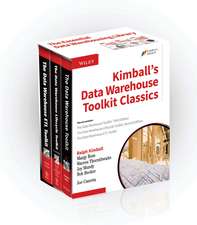 -20%Preț: 974.76 lei1218.45 lei
 -
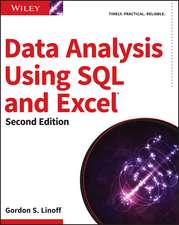 Data Analysis Using SQL and ExcelGordon S LinoffPreț: 408.25 lei
 -
 Data Visualization with Excel Dashboards and ReportsDick KusleikaPreț: 255.33 lei
 -
 -9%Preț: 581.31 lei638.79 lei
 -
 Dashboards That DeliverAndy CotgreavePreț: 213.30 lei
 -
 The Data Hero PlaybookMalcolm HawkerPreț: 202.67 lei
 -
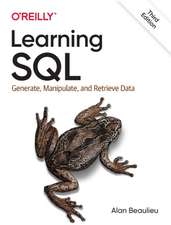 Learning SQL: Generate, Manipulate, and Retrieve DataAlan Beaulieu-20%Preț: 324.02 lei405.03 lei
 -
 Analyzing Data with Power BI and Power Pivot for ExcelAlberto FerrariPreț: 222.58 lei
 -
 Exam Ref 70-767 Implementing a SQL Data WarehouseJose Chinchilla-20%Preț: 205.86 lei257.33 lei
 -
 The Definitive Guide to DaxMarco Russo-20%Preț: 396.77 lei495.96 lei
 -
 -20%Preț: 206.39 lei257.99 lei
 -
 Microsoft Power BI Dashboards Step by StepErrin O'Connor-20%Preț: 238.18 lei297.74 lei
 -
 Business Analytics with R and PythonDavid L. Olson-20%Preț: 405.64 lei507.05 lei
Cuprins
Part I: Business Intelligence
Chapter 1. Equipping the Organization for Effective Decision Making
Chapter 2. Making the Most of What You've Got--Using Business Intelligence
Chapter 3. Seeking the Source--The Source of Business Intelligence
Chapter 4. Two, Two, Two Models in One--The BI Semantic Model
Chapter 5. First Steps--Beginning the Development of Business Intelligence
Part II: Defining Business Intelligence Structures
Chapter 6. Building Foundations--Creating Data Marts
Chapter 7. Transformers--Integration Service Structure and Components
Chapter 8. Fill 'er Up--Using Integration Services for Populating Data Marts
Part III: Working with a Multidimensional BI Semantic Model
Chapter 9. Cubism--Measures and Dimensions
Chapter 10. Bells and Whistles--Special Features of OLAP Cubes
Chapter 11. Writing a New Script--MDX Scripting
Chapter 12. Pulling It Out and Building It Up--MDX Queries
Part IV: Working with a Tabular BI Semantic Model
Chapter 13. Setting the Table--Creating a Tabular BI Semantic Model
Chapter 14. A Fancy Table--Tabular BI Semantic Model Advanced Features
Part V: Mining
Chapter 15. Panning for Gold--Introduction to Data Mining
Chapter 16. Building the Mine--Working with the Data Mining Model
Chapter 17. Spelunking--Exploration Using Data Mining
Part VI: Delivering
Chapter 18. Special Delivery--Microsoft Business Intelligence Client Tools
Chapter 19. Let's Get Together--Integrating Business Intelligence with Your Applications
Index
Notă biografică
Brian Larson, MCSD, served as a member of the Reporting Services development team and has contributed to the code base. He is the Chief of Technology for Superior Consulting Services (SCS), a Microsoft Certified Partner currently developing a client solution that uses Microsoft Reporting Services for report production and distribution. Brian has been invited to speak on Reporting Services at several conferences, including SQL Server Magazine Connections, and has written articles for SQL Server Magazine.
Descriere
Implement a Robust BI Solution with Microsoft SQL Server 2012
Equip your organization for informed, timely decision making using the expert tips and best practices in this practical guide. Delivering Business Intelligence with Microsoft SQL Server 2012, Third Edition explains how to effectively develop, customize, and distribute meaningful information to users enterprise-wide. Learn how to build data marts and create BI Semantic Models, work with the MDX and DAX languages, and share insights using Microsoft client tools. Data mining and forecasting are also covered in this comprehensive resource.
- Understand the goals and components of successful BI
- Design, deploy, and manage data marts and OLAP cubes
- Load and cleanse data with SQL Server Integration Services
- Manipulate and analyze data using MDX and DAX scripts and queries
- Work with SQL Server Analysis Services and the BI Semantic Model
- Author interactive reports using SQL Server Data Tools
- Create KPIs and digital dashboards
- Use data mining to identify patterns, correlations, and clusters
- Implement time-based analytics
- Embed BI reports in custom applications using ADOMD.NET