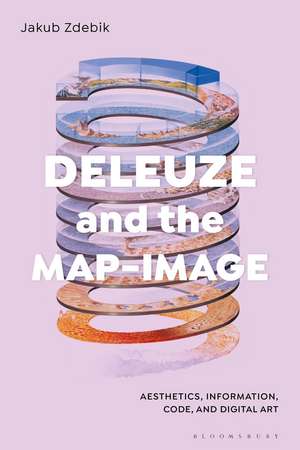
Deleuze and the Map-Image: Aesthetics, Information, Code, and Digital Art
Autor Dr Jakub Zdebiken Limba Engleză Hardback – 30 mai 2019
Deleuze and the Map-Image explores cartography from philosophical and aesthetic perspectives and argues that the concept of the map is a critical touchstone for contemporary multidisciplinary art. This book is an overview of Deleuze's cartographic thought read through the theories of Sloterdijk, Heidegger, and Virilio and the art criticism of Laura U. Marks, Carolyn L. Kane, and Alexander Galloway, shaping it into a critical tool through which to view the works of cutting edge artists such as Janice Kerbel and Hajra Waheed, who work with digital and analog art. After all, Deleuze did write that a map can be conceived as a work of art, and so herein art is critiqued through cartographic strategies.
Preț: 727.77 lei
Preț vechi: 1072.60 lei
-32%
Puncte Express: 1092
Carte tipărită la comandă
Livrare economică 07-21 decembrie
Livrare prin curier în România Termenul estimat este afișat lângă disponibilitate.
Transport gratuit pentru acest produs Plată online sau ramburs, în funcție de opțiunile comenzii.
Retur gratuit în 14 zile Comandă securizată și suport în română.
Specificații
ISBN-13: 9781501346781
ISBN-10: 1501346784
Pagini: 224
Ilustrații: 21 bw illus
Dimensiuni: 152 x 229 x 16 mm
Greutate: 0.57 kg
Editura: Bloomsbury Publishing
Colecția Bloomsbury Visual Arts
Locul publicării:New York, United States
ISBN-10: 1501346784
Pagini: 224
Ilustrații: 21 bw illus
Dimensiuni: 152 x 229 x 16 mm
Greutate: 0.57 kg
Editura: Bloomsbury Publishing
Colecția Bloomsbury Visual Arts
Locul publicării:New York, United States
V-ar putea interesa
-
 Image Science: Iconology, Visual Culture, and Media AestheticsProfessor W. J. T. MitchellPreț: 235.40 lei
 -
 Reclaiming Art in the Age of ArtificeJ. F. Martel-26%Preț: 101.28 lei136.33 lei
 -
 Abstract VideoGabrielle JenningsPreț: 255.73 lei
 -
 The Dehumanization of Art and Other Essays on Art, Culture, and LiteratureJosé Ortega Y. GassetPreț: 93.58 lei
 -
 Jean Baudrillard, Art and ArtefactInstitute of Modern Art (Brisbane QldPreț: 248.82 lei
 -
 Francis Bacon: The Logic of SensationGilles Deleuze-19%Preț: 161.97 lei200.98 lei
 -
 Drawing Analogies: Diagrams in Art, Theory and PracticeDavid Burrows-33%Preț: 549.59 lei821.20 lei
 -
 On Painting: Courses, March-June 1981Gilles DeleuzePreț: 208.50 lei
 -
 Digital TheoryM. Beatrice FaziPreț: 121.87 lei
 -
 We Live Here NowC. D. Rose-18%Preț: 89.03 lei108.67 lei
 -
 Medium HotHito SteyerlPreț: 135.95 lei
 -
 On Contemporary ArtCesar Aira-20%Preț: 61.34 lei76.81 lei
 -
 The World Through AI, Exploring Latent SpacesAntonio SomainiPreț: 266.06 leiNou
 -
 Grootens, J: Blind Maps and Blue DotsJoost Grootens-43%Preț: 168.66 lei297.59 lei
 -
 -16%Preț: 323.48 lei384.87 lei
 -
 Landscape Vision MotionChristophe GirotPreț: 166.41 lei
Cuprins
Acknowledgements
List of Illustrations
Introduction: Map as Fluctuating Image
1. Deleuze's Vermeer-Maps, Art, and Information
2. Map and Code in A Thousand Plateaus: Savard, Lagrange Paquet, and Data Art
3. Celluloid Film as Digital Art: Translation, Information, and Intermediality in Cory Arcangel
4. Virtual Images of Swarms and Grids: John F. Simon Jr.'s Posthuman Aesthetics
5. The Island/Image Apparatus: Virtual Networks in Kerbel, Bartholl, and Scott
6. Surveilling Aesthetics: Waheed's Overhead Images and Farocki's Operative Image
Conclusion: Tracing on the Map
Notes
Index
List of Illustrations
Introduction: Map as Fluctuating Image
1. Deleuze's Vermeer-Maps, Art, and Information
2. Map and Code in A Thousand Plateaus: Savard, Lagrange Paquet, and Data Art
3. Celluloid Film as Digital Art: Translation, Information, and Intermediality in Cory Arcangel
4. Virtual Images of Swarms and Grids: John F. Simon Jr.'s Posthuman Aesthetics
5. The Island/Image Apparatus: Virtual Networks in Kerbel, Bartholl, and Scott
6. Surveilling Aesthetics: Waheed's Overhead Images and Farocki's Operative Image
Conclusion: Tracing on the Map
Notes
Index
Recenzii
Deleuze and the Map-Image counts among the most exciting and provocative studies we have on Deleuze, art, and new media. Working with a panoply of artists and objects, Jakub Zbedik discerns in new modes of mediation, in digital aesthetics, and in posthuman theory a common and even pervasive cartographic imperative.
Deleuze and the Map-Image: Aesthetics, Information, Code, and Digital Art gives a thorough analysis of Deleuze's conceptualization of mapping and its formative presence in digital aesthetics. Zdebik charts a path into a domain of contemporary art practice in which digital technologies and Deleuze's thinking operate in concert. Further, his theorization of the map-image provides a refreshing new avenue by which to reconsider the critical roots and philosophical importance of digital art.
Deleuze and the Map-Image: Aesthetics, Information, Code, and Digital Art gives a thorough analysis of Deleuze's conceptualization of mapping and its formative presence in digital aesthetics. Zdebik charts a path into a domain of contemporary art practice in which digital technologies and Deleuze's thinking operate in concert. Further, his theorization of the map-image provides a refreshing new avenue by which to reconsider the critical roots and philosophical importance of digital art.