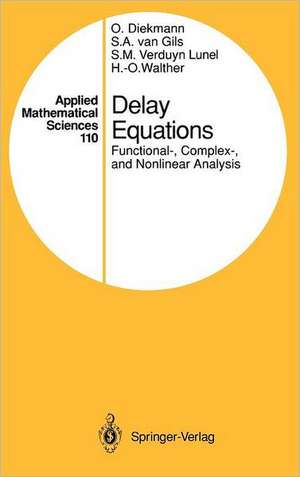
Delay Equations: Applied Mathematical Sciences, cartea 110
Autor Odo Diekmann, Stephan A. Van Gils, Sjoerd M. V. Lunel, Hans Otto Waltheren Limba Engleză Hardback – 9 mai 1995
Din seria Applied Mathematical Sciences
-
 Preț: 545.32 lei
 -
 Preț: 541.32 lei
 -
 Preț: 560.75 lei
 - 18%
 Preț: 797.46 lei
 - 24%
 Preț: 1034.80 lei
 - 18%
 Preț: 904.98 lei
 - 56%
 Preț: 495.89 lei
 - 18%
 Preț: 2186.79 lei
 -
 Preț: 419.28 lei
 - 24%
 Preț: 775.61 lei
 - 18%
 Preț: 907.08 lei
 - 15%
 Preț: 600.85 lei
 -
 Preț: 191.86 lei
 -
 Preț: 394.46 lei
 - 18%
 Preț: 1002.14 lei
 - 15%
 Preț: 618.64 lei
 - 15%
 Preț: 543.81 lei
 -
 Preț: 385.53 lei
 - 18%
 Preț: 758.64 lei
 - 18%
 Preț: 819.08 lei
 -
 Preț: 387.82 lei
 - 18%
 Preț: 1426.76 lei
 - 18%
 Preț: 1166.94 lei
 - 18%
 Preț: 1183.90 lei
 - 15%
 Preț: 627.93 lei
 -
 Preț: 398.68 lei
 - 15%
 Preț: 670.35 lei
 - 15%
 Preț: 662.95 lei
 -
 Preț: 372.15 lei
 - 18%
 Preț: 824.93 lei
 - 24%
 Preț: 857.73 lei
Preț: 1054.89 lei
Preț vechi: 1286.45 lei
-18%
Carte tipărită la comandă
Livrare economică 25 noiembrie-09 decembrie
Specificații
ISBN-10: 0387944168
Pagini: 552
Ilustrații: XII, 536 p.
Dimensiuni: 160 x 241 x 35 mm
Greutate: 0.94 kg
Ediția:1995
Editura: Springer
Colecția Applied Mathematical Sciences
Seria Applied Mathematical Sciences
Locul publicării:New York, NY, United States
V-ar putea interesa
-
 Codes and CryptographyDominic Welsh-31%Preț: 570.53 lei826.51 lei
 -
 Products of GroupsBernhard Amberg-33%Preț: 633.53 lei939.65 lei
 -
 -28%Preț: 541.14 lei754.18 lei
 -
 An Introduction to Ordinary Differential EquationsRavi P. Agarwal-15%Preț: 531.96 lei625.83 lei
 -
 Hyperbolic Partial Differential EquationsSerge AlinhacPreț: 461.98 lei
 -
 Critical Point Theory and Hamiltonian SystemsJean Mawhin-18%Preț: 1008.06 lei1229.34 lei
 -
 User and Task Analysis for Interface DesignJoann T Hackos-20%Preț: 520.79 lei650.99 lei
 -
 WaveletsLouis-9%Preț: 1259.02 lei1383.54 lei
 -
 -11%Preț: 446.62 lei501.82 lei
 -
 Numerical RecipesWilliam H. Press-14%Preț: 868.69 lei1010.10 lei
 -
 Integration and Modern AnalysisJohn J Benedetto-18%Preț: 831.29 lei1013.77 lei
 -
 Differential Equations and Mathematical BiologyD. S. Jones-18%Preț: 733.23 lei894.18 lei
 -
 -15%Preț: 661.07 lei777.73 lei
 -
 -18%Preț: 1241.29 lei1513.76 lei
 -
 -18%Preț: 1236.53 lei1507.97 lei
 -
 Equations in Mathematical PhysicsVictor P. PikulinPreț: 385.99 lei
 -
 Stability of Vector Differential Delay EquationsMichael I. Gil'Preț: 424.71 lei
 -
 Ordinary Differential EquationsVladimir I. Arnold-17%Preț: 525.45 lei633.08 lei
 -
 -18%Preț: 1400.04 lei1707.37 lei
 -
 Sobolev SpacesVladimir Maz'ya-18%Preț: 1186.04 lei1446.39 lei
 -
 Spectral Analysis on Graph-like SpacesOlaf PostPreț: 500.57 lei
 -
 Elements of Scientific ComputingAslak TveitoPreț: 402.42 lei
Public țintă
ResearchCuprins
Notă biografică
Yuri Aleksandrovich Kuznetsov (b. in Alma-Ata, USSR, September 8, 1957) received graduate degree in Theoretical Physics from the Rostov-on-Don State University, USSR, in 1979, and the Ph.D. in Physics and Mathematics from the Institute of Biophysics, USSR Academy of Sciences, Pushchino, Moscow Region, in 1986. From 1979 until 2007, he was affiliated with the Research Computing Center (later: Institute of Mathematical Problems of Biology), USSR /Russian Academy of Sciences, Pushchino, where he held different positions, including that of Senior Researcher. During 1991–1998, he visited as Invited Professor/Researcher IIASA (Laxenburg, Austria), Politecnico di Milano (Italy), CWI (Amsterdam, The Netherlands), and ENS (Paris/Lion, France). Since 1999 he is affiliated with Utrecht University (The Netherlands), being Associate Professor at the Department of Mathematics. In 2011, he was appointed as Professor of Numerical Bifurcation Methods at the University of Twente (Enschede, The Netherlands).
Wolf-Jürgen Beyn, born on April 6, 1949 in Hamburg (Germany), studied Mathematics, Physics, and Computer Science at the Universities of Hamburg and Münster (Germany). He graduated in Mathematics at the University of Münster in 1973 and received his PhD there in 1975. He worked as a Scientific Assistant at the Mathematics Institutes of the Universities of Münster (1976 – 1979) and Konstanz (1979 -1981). In 1981 he received his habilitation in Mathematics at the University of Konstanz, and he has been a lecturer ('Privatdozent') there till 1990. Research stays as visiting professor led him to the University of Calgary (Canada) in 1979, to the California Institute of Technology (Pasadena) in 1986, and to the Universities of New Mexico (Albuquerque) and Missouri (Columbia) during the period 1990-2011. In 1990 he was appointed Associate Professor of Mathematics at Bielefeld University (Germany), where he was promoted to full in 2002. Since then he has been the head of the Numerical Analysis group at the Faculty of Mathematics of Bielefeld University.
Odo Diekmann was born on April 14, 1948, in Diepenveen (the Netherlands). He studied mathematics and physics at the University of Amsterdam and received his PhD from that same university in 1978, with a thesis devoted to mathematical epidemiology of infectious diseases and nonlinear integral equations. He worked at the Centre for Mathematics and Computer Science CWI in Amsterdam from 1974 to 1995. From 1986 to 1995 this was combined with a part-time professorship (joint with J.A.J. Metz) at the Biology Department of Leiden University. In 1995 he became Professor in Applied Mathematics at Utrecht University (The Netherlands).