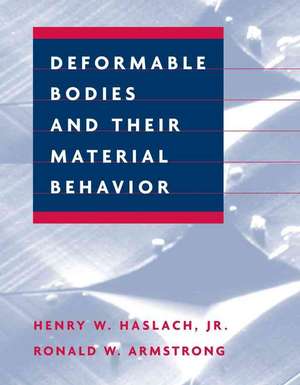
Deformable Bodies and Their Material Behavior
Autor Henry W Haslach, Ronald W Armstrongen Limba Engleză Hardback – 10 dec 2003
Preț: 1710.22 lei
Preț vechi: 2085.63 lei
-18% Nou
Puncte Express: 2565
Preț estimativ în valută:
302.63€ • 354.87$ • 265.77£
302.63€ • 354.87$ • 265.77£
Carte indisponibilă temporar
Doresc să fiu notificat când acest titlu va fi disponibil:
Se trimite...
Preluare comenzi: 021 569.72.76
Specificații
ISBN-13: 9780471125785
ISBN-10: 0471125784
Pagini: 560
Dimensiuni: 209 x 253 x 26 mm
Greutate: 1.22 kg
Editura: Wiley
ISBN-10: 0471125784
Pagini: 560
Dimensiuni: 209 x 253 x 26 mm
Greutate: 1.22 kg
Editura: Wiley
Textul de pe ultima copertă
ESSENTIAL TOOLS FOR AVOIDING MATERIAL FUNCTIONAL FAILURE
Offering comprehensive, organized, and detailed coverage, Henry Haslach and Ronald Armstrong's "Deformable Bodies and Their Material Behavior" present a quantitative description of the mechanical behavior of a broad range of deformable bodies under widely differing conditions and at a level sufficient to match real behavior, and introduces the key tools needed to avoid material functional failure.
Covering stress and deformation analysis, material failure modes, and mechanical rest evaluations of material properties, this text provides the tools, insights, and knowledge needed to build a strong foundation for the design of mechanical devices.
HIGHLIGHTS Considers most types of materials: metals, ceramics, fibered composites, concrete biological tissue, rubber, polymers, and wood. Focuses on the relationships between material properties of a deformable body and the forces and displacements applied to its boundary. Helps develop an appreciation for the approximations made in producing the mathematical models intended to predict mechanical response. Provides historical background on the definitions and models that designers commonly use, describing the practical reasons why these tools were invented.
Covering stress and deformation analysis, material failure modes, and mechanical rest evaluations of material properties, this text provides the tools, insights, and knowledge needed to build a strong foundation for the design of mechanical devices.
HIGHLIGHTS Considers most types of materials: metals, ceramics, fibered composites, concrete biological tissue, rubber, polymers, and wood. Focuses on the relationships between material properties of a deformable body and the forces and displacements applied to its boundary. Helps develop an appreciation for the approximations made in producing the mathematical models intended to predict mechanical response. Provides historical background on the definitions and models that designers commonly use, describing the practical reasons why these tools were invented.
Notă biografică
Henry W. Haslach Jr. and Ronald W. Armstrong are the authors of Deformable Bodies and Their Material Behavior, published by Wiley.