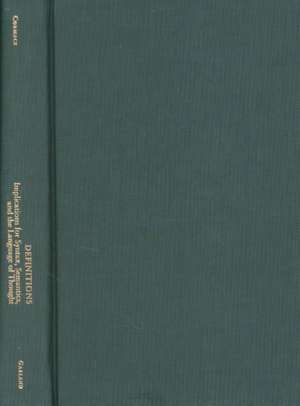
Definitions: Implications for Syntax, Semantics, and the Language of Thought: Outstanding Dissertations in Linguistics
Autor Annabel Cormacken Limba Engleză Hardback – aug 1998
The analyses argue that because phrases can be understood in isolation, some standard syntactic analyses must be modified. 'NP movement' has to be reanalysed as transmission of theta roles. These ideas are then applied to a variety of adjectives which take propositional complements. The final chapter argues that for definitions to be understood, the syntax of the Language of Thought must be close to that of Natural Language in specifiable way.
| Toate formatele și edițiile | Preț | Express |
|---|---|---|
| Paperback (1) | 335.85 lei 6-8 săpt. | |
| Taylor & Francis – 21 mai 2015 | 335.85 lei 6-8 săpt. | |
| Hardback (1) | 676.08 lei 6-8 săpt. | |
| Taylor & Francis – aug 1998 | 676.08 lei 6-8 săpt. |
Din seria Outstanding Dissertations in Linguistics
-
 Preț: 446.10 lei
 -
 Preț: 432.77 lei
 - 15%
 Preț: 427.58 lei
 -
 Preț: 449.44 lei
 - 15%
 Preț: 416.12 lei
 - 15%
 Preț: 412.51 lei
 -
 Preț: 444.04 lei
 - 18%
 Preț: 1010.87 lei
 -
 Preț: 450.54 lei
 - 18%
 Preț: 1015.58 lei
 - 15%
 Preț: 422.73 lei
 -
 Preț: 145.11 lei
 - 15%
 Preț: 409.36 lei
 -
 Preț: 445.14 lei
 -
 Preț: 442.38 lei
 -
 Preț: 448.71 lei
 -
 Preț: 318.38 lei
 -
 Preț: 442.76 lei
 -
 Preț: 443.89 lei
 - 15%
 Preț: 411.58 lei
 - 15%
 Preț: 406.68 lei
 - 15%
 Preț: 410.61 lei
 - 15%
 Preț: 426.47 lei
 - 18%
 Preț: 1013.30 lei
 -
 Preț: 335.85 lei
 -
 Preț: 138.26 lei
 - 15%
 Preț: 421.46 lei
 - 18%
 Preț: 1018.33 lei
 -
 Preț: 449.06 lei
 - 15%
 Preț: 411.22 lei
 -
 Preț: 447.75 lei
 - 18%
 Preț: 2371.76 lei
 -
 Preț: 423.07 lei
 -
 Preț: 446.10 lei
 - 34%
 Preț: 787.79 lei
 -
 Preț: 448.71 lei
 -
 Preț: 215.75 lei
 -
 Preț: 447.75 lei
 - 18%
 Preț: 1017.55 lei
 -
 Preț: 451.09 lei
 -
 Preț: 447.55 lei
 - 31%
 Preț: 511.67 lei
 - 18%
 Preț: 1010.73 lei
 - 15%
 Preț: 428.37 lei
Preț: 676.08 lei
Preț vechi: 795.38 lei
-15% Nou
Puncte Express: 1014
Preț estimativ în valută:
119.64€ • 140.29$ • 105.06£
119.64€ • 140.29$ • 105.06£
Carte tipărită la comandă
Livrare economică 05-19 februarie 26
Preluare comenzi: 021 569.72.76
Specificații
ISBN-13: 9780815331315
ISBN-10: 0815331312
Pagini: 374
Dimensiuni: 138 x 216 x 25 mm
Greutate: 0.59 kg
Ediția:1
Editura: Taylor & Francis
Colecția Routledge
Seria Outstanding Dissertations in Linguistics
Locul publicării:Oxford, United Kingdom
ISBN-10: 0815331312
Pagini: 374
Dimensiuni: 138 x 216 x 25 mm
Greutate: 0.59 kg
Ediția:1
Editura: Taylor & Francis
Colecția Routledge
Seria Outstanding Dissertations in Linguistics
Locul publicării:Oxford, United Kingdom
V-ar putea interesa
-
 Dictionary of Turkic LanguagesKurtulus Oztopcu-15%Preț: 622.18 lei731.97 lei
 -
 Routledge Intensive Russian CourseRobin AizlewoodPreț: 424.22 lei
 -
 Translation in the Digital AgeMichael CroninPreț: 418.74 lei
 -
 The Iranian LanguagesGernot Windfuhr-15%Preț: 651.55 lei766.52 lei
 -
 Spanish Grammar in ContextJuan Kattan-IbarraPreț: 354.06 lei
 -
 Preț: 109.48 lei
 -
 English G 21. Erweiterte Ausgabe D 3. WordmasterWolfgang NeudeckerPreț: 102.20 lei
 -
 Klick! Mathematik. Westliche Bundesländer 2. SchülerbuchSilke BurkhartPreț: 156.04 lei
 -
 Preț: 62.32 lei
 -
 Preț: 132.74 lei
 -
 Preț: 107.91 lei
Recenzii
"Cormack's thesis is overall a remarkably finished piece of work... A reader...will find Cormack's theis methodologically innovative, theoretically interesting, and intellectually challenging." -- Heidi Harley,Assistant Professor at the University of Arizona
Cuprins
Preface Acknowledgments 1 Theoretical Preliminaries Introduction A little simple syntax Reelevance theory The 'language of thought' hypothesis Model theoretic semantics The formal interpretation of defintions 2 Dictionary Definitions Introduction Simple nouns Simple adjectives Elimination of simple nouns and adjectives Dictionary definitions-elimination and complements Problem definitions 3 Text Definitions Introduction Characteristics of text definitions Interpretation of simple definitions Complex definitions with 'if' or 'when' Notes
Descriere
The answer to the question "How can we understand and use a definition?" provides new constraints on natural language and on the internal language in which meaning is mentally represented. Most syntax takes the sentence as the basic unit for well-formedness, but definitions force us to focus on words and phrases, and hence to focus on compositional syntax in parallel with compositional semantics. This study examines both dictionary definitions and definitions from textbooks, from the points of view of their syntax, semantics, and use for learning word meaning. The tools used throughout are Principles and Parameters syntax, Relevance theoretic pragmatics, Model theoretic semantics, and the formal theory of definitions.
The analyses argue that because phrases can be understood in isolation, some standard syntactic analyses must be modified. 'NP movement' has to be reanalysed as transmission of theta roles. These ideas are then applied to a variety of adjectives which take propositional complements. The final chapter argues that for definitions to be understood, the syntax of the Language of Thought must be close to that of Natural Language in specifiable way.
The analyses argue that because phrases can be understood in isolation, some standard syntactic analyses must be modified. 'NP movement' has to be reanalysed as transmission of theta roles. These ideas are then applied to a variety of adjectives which take propositional complements. The final chapter argues that for definitions to be understood, the syntax of the Language of Thought must be close to that of Natural Language in specifiable way.