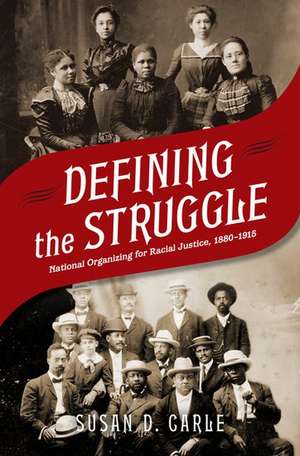
Defining the Struggle: National Organizing for Racial Justice, 1880-1915
Autor Susan D. Carleen Limba Engleză Hardback – 28 noi 2013
Recomandăm această lucrare ca o resursă esențială pentru nivelul de master și doctorat în disciplinele istoriei dreptului și sociologiei politice. În Defining the Struggle, observăm o reevaluare riguroasă a fundamentelor activismului pentru drepturi civile în Statele Unite, concentrându-se pe intervalul critic 1880-1915. Deși organizații precum NAACP sunt adesea considerate punctul de plecare al luptei sistematice, Susan D. Carle demonstrează că ideile fundamentale despre strategii juridice și organizare națională au fost cristalizate mult mai devreme de entități precum National Afro American Council sau Niagara Movement.
Descoperim aici o analiză care extinde cadrul propus de African American Civil Rights de Angela Jones; în timp ce Jones se concentrează pe sociologia Mișcării Niagara, Carle lărgește spectrul pentru a include moștenirea intelectuală transmisă generațiilor ulterioare de avocați. De asemenea, lucrarea completează perspectiva oferită de The Colored Conventions Movement, focalizându-se pe tranziția de la convențiile secolului al XIX-lea către structurile instituționalizate de la începutul secolului XX. Stilul este academic și dens, punând accent pe motivațiile liderilor și pe evoluția conceptului de justiție rasială în raport cu sistemul de drept american.
Suntem de părere că această monografie este o continuare firească a preocupărilor autoarei din Lawyers` Ethics and the Pursuit of Social Justic – A Critical Reader. Dacă în lucrarea anterioară Carle examina obligațiile etice ale avocaților în contextul dreptății sociale, aici ea aplică aceleași grile de analiză asupra istoriei uitate a pionierilor drepturilor civile, oferind o bază documentară solidă pentru înțelegerea mecanismelor juridice de emancipare.
Preț: 389.72 lei
Preț vechi: 505.23 lei
-23%
Carte tipărită la comandă
Livrare economică 26 noiembrie-02 decembrie
Specificații
ISBN-10: 0199945748
Pagini: 424
Dimensiuni: 236 x 163 x 41 mm
Greutate: 0.76 kg
Editura: Oxford University Press
Colecția OUP USA
Locul publicării:New York, United States
V-ar putea interesa
-
 The Oxford Guide to the United States GovernmentJohn J. Patrick-19%Preț: 233.14 lei286.88 lei
 -
 -31%Preț: 545.63 lei789.68 lei
 -
 -28%Preț: 379.29 lei529.01 lei
 -
 -23%Preț: 550.83 lei717.50 lei
 -
 Migration, Citizenship, and the European Welfare State: A European DilemmaCarl-Ulrik Schierup-21%Preț: 426.47 lei541.65 lei
 -
 Social Rights in EuropeGráinne de Búrca-24%Preț: 649.33 lei855.27 lei
 -
 Political Rights Under Stress in 21st Century EuropeWojciech Sadurski-21%Preț: 438.32 lei557.78 lei
 -
 Paul Robeson: The Artist as RevolutionaryGerald HornePreț: 150.05 lei
 -
 Ken Saro-WiwaRoy DoronPreț: 148.53 lei
 -
 Preț: 247.74 lei
 -
 It Was Never About a Hotdog and a CokeRodney L. HurstPreț: 120.06 lei
 -
 Human Rights in Russia: Citizens and the State from Perestroika to PutinProfessor Mary McAuley-25%Preț: 182.56 lei243.16 lei
 -
 Tear GasAnna FeigenbaumPreț: 138.33 lei
De ce să citești această carte
Această carte se adresează cercetătorilor și studenților la drept sau istorie care doresc să înțeleagă rădăcinile juridice ale mișcărilor pentru drepturi civile. Cititorul câștigă o perspectivă clară asupra modului în care strategiile de litigiu și organizare de dinainte de 1910 au modelat succesele ulterioare ale secolului XX, umplând un gol informațional despre organizațiile „uitate” care au definit lupta pentru egalitate.
Despre autor
Susan D. Carle este profesor de drept la Washington College of Law din cadrul American University, Washington, D.C. Expertiza sa academică se concentrează pe etica profesiei de avocat și pe istoria dreptului în contextul justiției sociale. Prin cercetările sale, Carle a adus contribuții semnificative la înțelegerea rolului pe care avocații și organizațiile juridice l-au jucat în mișcările de emancipare socială. Opera sa îmbină rigoarea juridică cu analiza istorică, fiind recunoscută pentru profunzimea cu care explorează legătura dintre practică etică și activismul pentru drepturi civile în Statele Unite.
Descriere
Recenzii
Susan Carle writes a clear and convincing history of the first generation of civil rights organizers and advocates-the movement that started the Movement. We all stand on their shoulders. Let us remember their names and know their stories.
Susan Carle's study of nineteenth-century social and legal activism is ground breaking. By shedding new light on the historical roots of the Second Reconstruction and mapping the intellectual links between modern civil rights groups and long-forgotten visionaries, Carle has made a remarkable contribution.
Susan Carle vividly recounts the long and difficult struggle for African American voting rights in the United States. Carle's inspiring stories of heroic figures who persevered in the face of seemingly impossible odds are not only amazing; they are also timely. In light of the Supreme Court's recent decisions, this is a must read for activists who seek to engage in new forms of organizing, and for scholars who seek to produce new venues for creative thinking about what it means to be a full citizen of the United States.
This remarkable book lifts the veil that has obscured from view an entire early generation of civil rights lawyers. We learn here of organizations like the Afro-American League, the Afro-American Council, the National Association of Colored Women, the Niagara Movement, and the newly-formed NAACP and Urban League. Working in often desperate circumstances against formidable opposition, these tiny groups pioneered the civil rights movements' strategies of litigating test cases, mobilizing for legislative gains, and building social-service institutions. Their goals were not just legal equality, but economic justice and social welfare. It is astonishing to discover, thanks to Susan Carle's very moving as well as illuminating account, how much they were able to accomplish.
Graduate students and scholars will find Susan Carle's Defining the Struggle informative, as it pushes the boundaries of the early legal history of racial justice advocacy and modern civil rights activism back into the late nineteenth century. Readers and researchers will appreciate the extensive endnotes and bibliography of primary sources and secondary literature.