
Decrypting Power: Global Critical Caribbean Thought
Editat de Ricardo Sanín-Restrepoen Limba Engleză Hardback – 14 sep 2018
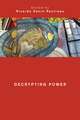
The theory of encryption of power understands that there is only a world where difference exists as the fundamental and sole order, but also that such a possibility is heavily obstructed by the concentration of power in forms of oppression. The world hangs on the thread of this entangled reality, made up of difference and its denial, of democracy and its simulations, of truth and its codifications. The decryption of power is then, above all, a theory of justice essential to radical democracy, which comes fully-equipped to prevail over the conditions that deny the possibility of an egalitarian world.











Preț: 838.78 lei
Preț vechi: 1191.50 lei
-30%
Puncte Express: 1258
Carte tipărită la comandă
Livrare economică 27 noiembrie-11 decembrie
Livrare prin curier în România Termenul estimat este afișat lângă disponibilitate.
Transport gratuit pentru acest produs Plată online sau ramburs, în funcție de opțiunile comenzii.
Retur gratuit în 14 zile Comandă securizată și suport în română.
Specificații
ISBN-13: 9781786609274
ISBN-10: 1786609274
Pagini: 320
Ilustrații: 4 BW Illustrations
Dimensiuni: 152 x 229 mm
Greutate: 1 kg
Editura: Bloomsbury Publishing
Colecția Rowman & Littlefield
Seria Global Critical Caribbean Thought
Locul publicării:New York, United States
ISBN-10: 1786609274
Pagini: 320
Ilustrații: 4 BW Illustrations
Dimensiuni: 152 x 229 mm
Greutate: 1 kg
Editura: Bloomsbury Publishing
Colecția Rowman & Littlefield
Seria Global Critical Caribbean Thought
Locul publicării:New York, United States
Cuprins
Part I: Introduction / Introduction: The Meaning of the Encryption of Power as the Razor's Edge of Politics, Ricardo Sanín-Restrepo / 1. The Encrypted Constitution: New Ways of Emancipation from Global Power, Gabriel Méndez-Hincapíe and Ricardo Sanín-Restrepo / Part II: Encryption Law and Power / 2. The Equivocation that Lies Like Truth, Angus McDonald / 3. Encrypted International Investment Law in the Age of Neo-Colonialism, Enrique Prieto-Rios / 4. Transnational Legal Production and its Encryption, Aleida Hernández-Cervantes / Part III: The Political Subject / 5. The Practices of the Commons Between Decryption and Insurgent Critique, Vito De Lucia / 6. Prohibition as Encryption: International Law and the Invitation into the Crypt of Modernity's Origin, Kojo Koram / 7. The Symbolic Force and the Encryption of Gender in Law: The Brazilian Example, Marinella Machado Araujo / Part IV: Encryption, Political Theory and Language / 8. Metaphors of Decryption: Designs, Poetics, Collaborations, Hanna Musiol / 9. The People vs. Hegel: The Mystifying Transcendence of Time and the Immanence of Radical Democracy, Ricardo Sanín-Restrepo / Part V: Decryption and Political Action / 10. Polyvalent Anarchism as a Hypothesis to Decrypt the Constitution, Gabriel Méndez-Hincapíe and Felipe Orozco / 11. Grounding Human Rights in Decryption, Alejandro Rosillo / 12. The Field of Popular Power and Transformative Constitutionalism in Venezuela, Heiner Fechner / 13. Decrypting Global Capitalism: Identifying with the Excluded Outcast in the Taiwanese Sunflower Movement, Ted Yao-Hung Huang / Index
Recenzii
Decrypting Power offers a series of excellent articles on one of the most perplexing concepts that has plagued the left for centuries. From theory to practice, the word power almost always appears in slogans, tracts, and theoretical work. But what is a leftist notion of power? What does it mean to seize power? What does it mean to hold power? How do we distinguish power from force? In these illuminating essays these difficult questions are addressed. The essays are powerfully argued and well written and they are a must read for anyone who takes seriously what it would mean for the left to be in power, whether in the form of the state or other kinds of organization, such as transnational federations or continental communities. Sanín-Restrepo has provided us with a much needed service and we are in his debt.
One of the most problematic aspects of critique these days is a fantasy about politics without power. This collection of powerful essays tackles the issue head on. What does it mean for progressive forces and the left to be in power? Power is not some ready-at-hand thing, a mere tool which can be wielded one way or another by progressives and reactionaries. Power institutions not only have a language of their own, but also a code. To participate in them is to engage with both. But if the left is to be in power, as it must, then it must also be ready to hack current institutional technologies, decrypt their code, and harness their performative force in new ceremonials and utopian technologies. Sanín-Restrepo has gifted us with the concepts to do so.
One of the most problematic aspects of critique these days is a fantasy about politics without power. This collection of powerful essays tackles the issue head on. What does it mean for progressive forces and the left to be in power? Power is not some ready-at-hand thing, a mere tool which can be wielded one way or another by progressives and reactionaries. Power institutions not only have a language of their own, but also a code. To participate in them is to engage with both. But if the left is to be in power, as it must, then it must also be ready to hack current institutional technologies, decrypt their code, and harness their performative force in new ceremonials and utopian technologies. Sanín-Restrepo has gifted us with the concepts to do so.