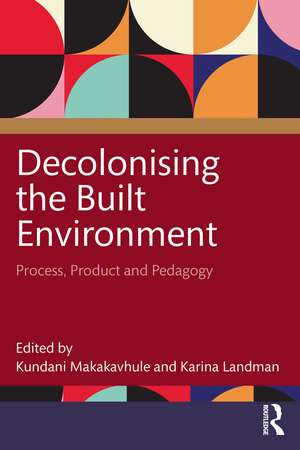
Decolonising the Built Environment: Process, Product, and Pedagogy
Editat de Kundani Makakavhule, Karina Landmanen Limba Engleză Hardback – 7 feb 2025
Essential reading for students, teachers, and practitioners, this book presents the project of decolonisation as a pedagogy and an ongoing process.
Preț: 1118.97 lei
Preț vechi: 1364.59 lei
-18%
Puncte Express: 1678
Carte tipărită la comandă
Livrare economică 24 noiembrie-08 decembrie
Livrare prin curier în România Termenul estimat este afișat lângă disponibilitate.
Transport gratuit pentru acest produs Plată online sau ramburs, în funcție de opțiunile comenzii.
Retur gratuit în 14 zile Comandă securizată și suport în română.
Specificații
ISBN-13: 9781032352435
ISBN-10: 1032352434
Pagini: 260
Ilustrații: 70
Dimensiuni: 152 x 229 mm
Greutate: 0.64 kg
Ediția:1
Editura: Taylor & Francis
Colecția Routledge
Locul publicării:Oxford, United Kingdom
ISBN-10: 1032352434
Pagini: 260
Ilustrații: 70
Dimensiuni: 152 x 229 mm
Greutate: 0.64 kg
Ediția:1
Editura: Taylor & Francis
Colecția Routledge
Locul publicării:Oxford, United Kingdom
V-ar putea interesa
-
 Decolonizing Language and Other Revolutionary IdeasNgugi Wa Thiong'OPreț: 140.57 lei
 -
 Preț: 383.89 leiRecomandat
 -
 Preț: 379.10 lei
 -
 Architectural Thinking in a Climate EmergencySofie PelsmakersPreț: 385.15 lei
 -
 Visual Redress in Africa from Indigenous and New Materialist PerspectivesElmarie CostandiusPreț: 407.48 lei
 -
 Preț: 386.48 lei
 -
 Preț: 379.53 lei
 -
 Preț: 380.83 lei
 -
 -24%Preț: 185.09 lei242.75 lei
 -
 Decolonizing GeographySarah A RadcliffePreț: 140.74 lei
 -
 We, the DecolonizedH. BéjiPreț: 138.11 lei
 -
 -22%Preț: 241.79 lei308.65 lei
 -
 Preț: 277.57 lei
 -
 An Architecture of HopeYvonne JewkesPreț: 135.46 lei
 -
 Reclaiming Colonial ArchitectureTania SenguptaPreț: 396.14 lei
 -
 BaukulturAnna Livia FrielPreț: 385.82 lei
 -
 -18%Preț: 353.32 lei432.20 lei
 -
 Decolonizing KnowledgeAssociate Sunera Thobani-12%Preț: 158.89 lei179.58 lei
Public țintă
Postgraduate, Professional, and Undergraduate AdvancedCuprins
1. Towards a Decolonial Turn in the Built Environment Part 1 From Paradigm to Process 2. Performing Space: Thoughts on Colonising, Decolonising, and the Concert Hall 3. Settler Colonial Critique and Indigenous Urbanisation 4. Place-Based Indigenous Knowledge Systems and Their Relevance to the Decolonisation of Urban Planning Practice in Namibia: The Olupale and the Omuvanda: Two Cultural Open Spaces 5. Place-Based Strategies for Transforming South African Urban Nature Places 6. An African Landscape Design Approach for Rural Development Part 2 From Process to Product and Pedagogy 7. Decolonising the Built Environment in and around a University Campus: The Incongruence between Intellectual Discourse and Lived (Institutional) Practices 8. Visual Redress at Stellenbosch University: Staff Reactions to the Decolonisation of Campus Spaces 9. The Invisible Users of the Street 10. Ubuntu Design Aesthetics and the Built Environment in South Africa 11. An Inquiry into Visual Art as a Critical Disruptor to Reveal Emergent Narratives and Authorship in Architecture 12. Kamĩrĩĩthũ: An Architecture for Decolonisation Part 3 Reflections on the Decolonial Turn in the Built Environment 13. Spaces of Erasure 14. Can the Master Speak? 15. Conclusion: Reconsidering the Decolonisation of the Built Environment
Notă biografică
Kundani Makakavhule is a senior lecturer in the Department of Town and Regional Planning at the University of Pretoria, specialising in the transformation of urban public open spaces at neighbourhood and precinct scales. Her research focuses on democracy, spatial appropriation, diversity, and active citizenship, exploring how these micro-scale dynamics influence broader urban planning processes. Drawing on theories from politics, sociology, and geography, her work addresses the social and political factors shaping planning in the developing world. By emphasising multidisciplinary approaches, she contributes to solving contemporary challenges in African urban spaces.
Karina Landman is a professor in the Department of Town and Regional Planning at the University of Pretoria with a background in urban design and architecture. Her work focuses on spatial transformation, including research on gated communities and safer and sustainable neighbourhoods, regenerative and resilient cities, and public space. Her work on public space revolves around issues of inclusivity, regeneration, and resilience. Her research on sustainable development focuses on urban resilience and regenerative development and design. She has published a book, Evolving Public Space in South Africa (2019).
Karina Landman is a professor in the Department of Town and Regional Planning at the University of Pretoria with a background in urban design and architecture. Her work focuses on spatial transformation, including research on gated communities and safer and sustainable neighbourhoods, regenerative and resilient cities, and public space. Her work on public space revolves around issues of inclusivity, regeneration, and resilience. Her research on sustainable development focuses on urban resilience and regenerative development and design. She has published a book, Evolving Public Space in South Africa (2019).
Descriere
This book provides an important and much-needed comprehensive overview of how decolonisation is shaping the built environment in theory, practice, and as a process/project today. Part one studies decolonisation conceptually; part two studies decolonisation as a process; and part three studies the products of decolonisation.