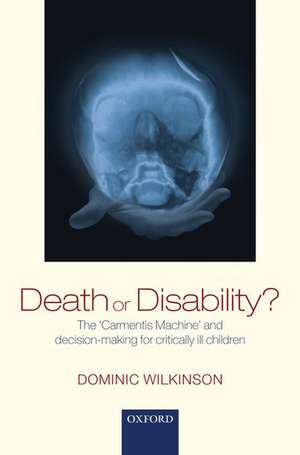
Death or Disability?: The 'Carmentis Machine' and decision-making for critically ill children
Autor Dominic Wilkinsonen Limba Engleză Hardback – 24 ian 2013
Preț: 818.07 lei
Preț vechi: 1073.84 lei
-24%
Puncte Express: 1227
Carte tipărită la comandă
Livrare economică 10-15 decembrie
Livrare prin curier în România Termenul estimat este afișat lângă disponibilitate.
Transport gratuit pentru acest produs Plată online sau ramburs, în funcție de opțiunile comenzii.
Retur gratuit în 14 zile Comandă securizată și suport în română.
Specificații
ISBN-13: 9780199669431
ISBN-10: 0199669430
Pagini: 320
Dimensiuni: 162 x 240 x 22 mm
Greutate: 0.63 kg
Editura: OUP OXFORD
Colecția OUP Oxford
Locul publicării:Oxford, United Kingdom
ISBN-10: 0199669430
Pagini: 320
Dimensiuni: 162 x 240 x 22 mm
Greutate: 0.63 kg
Editura: OUP OXFORD
Colecția OUP Oxford
Locul publicării:Oxford, United Kingdom
V-ar putea interesa
-
 -31%Preț: 617.04 lei888.00 lei
 -
 Preț: 278.27 lei
 -
 -23%Preț: 390.12 lei504.05 lei
 -
 -23%Preț: 590.28 lei768.46 lei
 -
 Consciousness and Moral ResponsibilityNeil Levy-29%Preț: 390.70 lei546.55 lei
 -
 Utilitarianism: A Very Short IntroductionKatarzyna de Lazari-Radek-19%Preț: 57.46 lei71.12 lei
 -
 -30%Preț: 610.54 lei870.11 lei
 -
 Virtue and Law in Plato and BeyondJulia Annas-27%Preț: 554.80 lei764.88 lei
 -
 Neuroethics: Anticipating the futureJudy Illes-30%Preț: 818.15 lei1174.82 lei
 -
 -30%Preț: 575.20 lei821.38 lei
 -
 -28%Preț: 374.87 lei522.91 lei
 -
 -18%Preț: 251.78 lei306.80 lei
 -
 Philosophical Progress: In Defence of a Reasonable OptimismDaniel Stoljar-29%Preț: 418.68 lei588.46 lei
 -
 Oxford Studies in Metaethics 12Russ Shafer-Landau-19%Preț: 300.26 lei368.76 lei
 -
 -31%Preț: 642.99 lei926.34 lei
 -
 Doing and Allowing HarmFiona Woollard-31%Preț: 608.80 lei882.31 lei
 -
 Ethical LifeWebb KeanePreț: 213.90 lei
 -
 Thinking about BriberyPhilip Nichols-27%Preț: 280.60 lei383.39 lei
 -
 Moral and Political Conceptions of Human RightsReidar Maliks-14%Preț: 746.46 lei867.98 lei
 -
 The Cambridge Handbook of Evolutionary EthicsMichael RusePreț: 252.58 lei
 -
 -15%Preț: 459.23 lei540.27 lei
 -
 The Blackwell Guide to Kant's EthicsThomas E. HillPreț: 359.51 lei
 -
 Preț: 257.59 lei
Recenzii
This book reflects a remarkable blend of philosophical sophistication and clinical expertise. ... Wilkinson's book will be mandatory reading for philosophers and clinical ethicists who are writing on, or working with, critically ill children and their parents.
[T]his book does represent an interesting approach to the ethical decision problems faced in a neonatal intensive care unit. Wilkinson defends his threshold framework using not only medical protocols but also philosophical arguments, showing that reasons about how to treat a critically ill newborn are not only medical but also have a philosophical and anthropological base.
this is a wonderful book: wise, clever, humane, realistic and humble. It will be, and richly deserves to be, the cornerstone of academic and practitioner debate about this terrible, and terribly important area of ethics and medicine.
His style, clear and simple for a work on a subject of considerable complexity, and yet profound in its way of dealing with issues more related to philosophy and ethics, make this book a read of great interest not only for professionals pediatric medicine, but also for affected families and for anyone who wants to know the problems of bioethics from a multidisciplinary perspective.
This is a book that must be read by everybody who is seriously interested in the bioethical issues that arise in neonatal intensive care or, more generally, in decision making for children with chronic, debilitating or life-threatening conditions. Wilkinson critically summarizes the work in this field over the last two decades and adds his own insights to that work.
the best book of the decade in bioethics... Dominic Wilkinson is a philosopher and neonatologist... His research focuses on the thorny ethical dilemmas that arise in the care of critically ill newborns. Wilkinson has been working out an approach to these difficult problems for the last decade. He has gathered his thoughts together in a marvelous, engaging and challenging book... this is a book that must be read by everybody who is seriously interested in the bioethical issues that arise in neonatal intensive care or, more generally, in decision making for children with chronic, debilitating or life-threatening conditions.
this was an interesting read, comprehensive, analytical, and thought-provoking... Wilkinson does a good job of articulating and providing evidence to support his point of view. He successfully accomplishes what he sets out to do, while keeping the reader entertained with historical points, clinical examples, and philosophical theories and vignettes.
The author skilfully draws on his training in philosophy, bioscience and clinical practice to offer an analysis that is original, not merely in content but also in form. Wilkinsons comparison of the Carmentis Machine with contemporary neuroimaging is inspired.
[T]his book does represent an interesting approach to the ethical decision problems faced in a neonatal intensive care unit. Wilkinson defends his threshold framework using not only medical protocols but also philosophical arguments, showing that reasons about how to treat a critically ill newborn are not only medical but also have a philosophical and anthropological base.
this is a wonderful book: wise, clever, humane, realistic and humble. It will be, and richly deserves to be, the cornerstone of academic and practitioner debate about this terrible, and terribly important area of ethics and medicine.
His style, clear and simple for a work on a subject of considerable complexity, and yet profound in its way of dealing with issues more related to philosophy and ethics, make this book a read of great interest not only for professionals pediatric medicine, but also for affected families and for anyone who wants to know the problems of bioethics from a multidisciplinary perspective.
This is a book that must be read by everybody who is seriously interested in the bioethical issues that arise in neonatal intensive care or, more generally, in decision making for children with chronic, debilitating or life-threatening conditions. Wilkinson critically summarizes the work in this field over the last two decades and adds his own insights to that work.
the best book of the decade in bioethics... Dominic Wilkinson is a philosopher and neonatologist... His research focuses on the thorny ethical dilemmas that arise in the care of critically ill newborns. Wilkinson has been working out an approach to these difficult problems for the last decade. He has gathered his thoughts together in a marvelous, engaging and challenging book... this is a book that must be read by everybody who is seriously interested in the bioethical issues that arise in neonatal intensive care or, more generally, in decision making for children with chronic, debilitating or life-threatening conditions.
this was an interesting read, comprehensive, analytical, and thought-provoking... Wilkinson does a good job of articulating and providing evidence to support his point of view. He successfully accomplishes what he sets out to do, while keeping the reader entertained with historical points, clinical examples, and philosophical theories and vignettes.
The author skilfully draws on his training in philosophy, bioscience and clinical practice to offer an analysis that is original, not merely in content but also in form. Wilkinsons comparison of the Carmentis Machine with contemporary neuroimaging is inspired.
Notă biografică
Dominic Wilkinson is Associate Professor of Neonatal Medicine and Bioethics at the University of Adelaide, and a senior research associate of the Oxford Uehiro Centre for Practical Ethics. He has worked as a doctor in neonatal, paediatric and adult intensive care, and is currently consultant neonatologist at the Women's and Children's Hospital in Adelaide. He has a DPhil in medical ethics from the University of Oxford, and has written a large number of academic articles relating to ethical issues in intensive care.