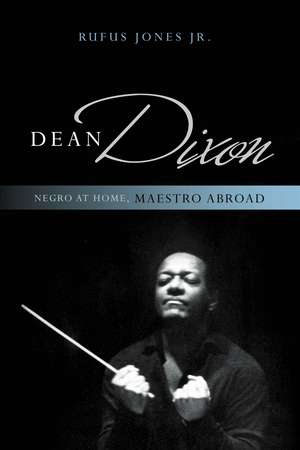
Dean Dixon: Negro at Home, Maestro Abroad: African American Cultural Theory and Heritage
Autor Rufus Jones Jr.en Limba Engleză Paperback – 15 iul 2018
Dean Dixon: Negro at Home, Maestro Abroad will interest anyone who wants to know more about Black American history, American musical culture, and Black American concert music and musicians.
More information is available at: www.maestroabroad.com




Preț: 255.81 lei
Preț vechi: 350.08 lei
-27%
Puncte Express: 384
Carte tipărită la comandă
Livrare economică 30 noiembrie-14 decembrie
Livrare prin curier în România Termenul estimat este afișat lângă disponibilitate.
Transport gratuit de la 400.00 lei Plată online sau ramburs, în funcție de opțiunile comenzii.
Retur gratuit în 14 zile Comandă securizată și suport în română.
Specificații
ISBN-13: 9781538120880
ISBN-10: 1538120887
Pagini: 206
Ilustrații: 20 b/w photos;
Dimensiuni: 155 x 229 x 13 mm
Greutate: 0.31 kg
Editura: Bloomsbury Publishing
Colecția Rowman & Littlefield
Seria African American Cultural Theory and Heritage
Locul publicării:New York, United States
ISBN-10: 1538120887
Pagini: 206
Ilustrații: 20 b/w photos;
Dimensiuni: 155 x 229 x 13 mm
Greutate: 0.31 kg
Editura: Bloomsbury Publishing
Colecția Rowman & Littlefield
Seria African American Cultural Theory and Heritage
Locul publicării:New York, United States
V-ar putea interesa
-
 Music for the PeopleGARETH MALONEPreț: 153.83 lei
 -
 -17%Preț: 257.14 lei308.96 lei
 -
 The Nibelungenlied: The Lay of the NibelungsCyril EdwardsPreț: 69.69 lei
 -
 A Dictionary of Opera CharactersJoyce Bourne-12%Preț: 90.69 lei102.65 lei
 -
 Wagner & CinemaJeongwon JoePreț: 240.90 lei
 -
 Preț: 120.12 lei
 -
 Mozart on the StageJohn A. RicePreț: 276.15 lei
 -
 The Cambridge Companion to Opera StudiesNicholas TillPreț: 285.66 lei
 -
 OperaRobert CannonPreț: 296.44 lei
 -
 Time to Say Hello: My AutobiographyKatherine Jenkins-25%Preț: 53.60 lei71.86 lei
 -
 Preț: 76.26 lei
 -
 The Secret Life of Glenn GouldMichael Clarkson-29%Preț: 140.97 lei197.65 lei
Cuprins
Foreword
Acknowledgments
Introduction
Prologue
Chapter 1: West Indians in Harlem
Chapter 2: Dean Dixon School of Music
Chapter 3: The Damrosch School
Chapter 4: Pursuing the Dream
Chapter 5: Eleanor Roosevelt
Chapter 6: The Plastic Carrot
Chapter 7: Search for Democracy
Chapter 8: Black and White
Chapter 9: Exodus
Chapter 10: Mary
Chapter 11: Drama, Down Under
Chapter 12: Prague
Chapter 13: Sojourn Home
Chapter 14: I'm Not Tired Yet
Chapter 15: Ritha
Epilogue: On My Shoulders
Appendix 1: In Memoriam
Appendix 2: Conductors Handbook
Selected Bibliography
Index
About the Author
Acknowledgments
Introduction
Prologue
Chapter 1: West Indians in Harlem
Chapter 2: Dean Dixon School of Music
Chapter 3: The Damrosch School
Chapter 4: Pursuing the Dream
Chapter 5: Eleanor Roosevelt
Chapter 6: The Plastic Carrot
Chapter 7: Search for Democracy
Chapter 8: Black and White
Chapter 9: Exodus
Chapter 10: Mary
Chapter 11: Drama, Down Under
Chapter 12: Prague
Chapter 13: Sojourn Home
Chapter 14: I'm Not Tired Yet
Chapter 15: Ritha
Epilogue: On My Shoulders
Appendix 1: In Memoriam
Appendix 2: Conductors Handbook
Selected Bibliography
Index
About the Author
Recenzii
[Dean Dixon's] story is so interesting yet largely unknown that it makes for a fascinating read. . . .[Dixon's] life is an inspirational story of a man overcoming the linked adversities of poverty and racism to rise to heights in his profession that no black man before him had reached in the United States, and within that framework, Jones tells the story well, and certainly more thoroughly than anybody before him, which is why this book is both needed and recommended.
Jones' book, Dean Dixon: Negro At Home, Maestro Abroad . . . is a narrative that appeals to a general audience, classical music enthusiasts, and those who follow civil rights issues in the U.S. . . .Filled with tribulations and triumph, the text engages readers in Dixon's passion for music and education. Beyond the book, this narrative should become a documentary and incorporated into school curriculum for the legacy of Dean Dixon, the first Negro maestro, to continue to inspire generations.
It's relatively rare to have a musical biography come from a scholar and researcher who is also a conductor; but such is the case with Dean Dixon: Negro at Home, Maestro Abroad, which outlines the saga of a great (but largely unheralded) Afro-American conductor. . . .This first full-length biography of Dixon. . . .[is] a cut above most biographical treatments, holding great social and political insights: thus, it belongs in not just music book collections, but the holdings of civil rights libraries and libraries strong in Afro-American history and the rise of black musicians. . . .[The book] goes far beyond the anticipated survey of one man's life to consider exactly what stood in his way, how he handled career obstacles, and how his choices directly led to an improved atmosphere for those who followed in his footsteps. It's this focus and attention to specifics that make [the book] such a powerful read, highly recommended for not just classical music collections, but any interested in racial issues and history in America.
The author has shown a great degree of balance in covering the childhood, formative years, and the eventful career of a world famous American.
Dean Dixon gave us hope. Despite the realities of U.S. life in the '60s, his remarkable international career proved to every aspiring black conductor what could be accomplished. When the New York Philharmonic invited him back in the early '70s to conduct on their subscription series, no one in his audience could have been more proud than I was.
Dean Dixon: Negro At Home, Maestro Abroad is a fantastic read! Dr. Jones has succeeded in re-creating the life story of an accomplished, virtually forgotten American musician who because of his race had no choice but to leave his homeland for unprecedented success abroad. I am particularly delighted to learn more about the life and challenges of a man, who for me prior to this book only existed as a symbolic role model.
For me Dean Dixon served as a powerful example both positively and negatively. Positively in that he was clearly a great conductor and had made a career in the field when it was almost not possible to do so. Negatively in that I always hoped that I would be able to work without moving to Europe, that is possible now because of pioneers like Dean Dixon, to have an American career. All of us carry his story and his inspiration with us wherever we go.
Jones' book, Dean Dixon: Negro At Home, Maestro Abroad . . . is a narrative that appeals to a general audience, classical music enthusiasts, and those who follow civil rights issues in the U.S. . . .Filled with tribulations and triumph, the text engages readers in Dixon's passion for music and education. Beyond the book, this narrative should become a documentary and incorporated into school curriculum for the legacy of Dean Dixon, the first Negro maestro, to continue to inspire generations.
It's relatively rare to have a musical biography come from a scholar and researcher who is also a conductor; but such is the case with Dean Dixon: Negro at Home, Maestro Abroad, which outlines the saga of a great (but largely unheralded) Afro-American conductor. . . .This first full-length biography of Dixon. . . .[is] a cut above most biographical treatments, holding great social and political insights: thus, it belongs in not just music book collections, but the holdings of civil rights libraries and libraries strong in Afro-American history and the rise of black musicians. . . .[The book] goes far beyond the anticipated survey of one man's life to consider exactly what stood in his way, how he handled career obstacles, and how his choices directly led to an improved atmosphere for those who followed in his footsteps. It's this focus and attention to specifics that make [the book] such a powerful read, highly recommended for not just classical music collections, but any interested in racial issues and history in America.
The author has shown a great degree of balance in covering the childhood, formative years, and the eventful career of a world famous American.
Dean Dixon gave us hope. Despite the realities of U.S. life in the '60s, his remarkable international career proved to every aspiring black conductor what could be accomplished. When the New York Philharmonic invited him back in the early '70s to conduct on their subscription series, no one in his audience could have been more proud than I was.
Dean Dixon: Negro At Home, Maestro Abroad is a fantastic read! Dr. Jones has succeeded in re-creating the life story of an accomplished, virtually forgotten American musician who because of his race had no choice but to leave his homeland for unprecedented success abroad. I am particularly delighted to learn more about the life and challenges of a man, who for me prior to this book only existed as a symbolic role model.
For me Dean Dixon served as a powerful example both positively and negatively. Positively in that he was clearly a great conductor and had made a career in the field when it was almost not possible to do so. Negatively in that I always hoped that I would be able to work without moving to Europe, that is possible now because of pioneers like Dean Dixon, to have an American career. All of us carry his story and his inspiration with us wherever we go.