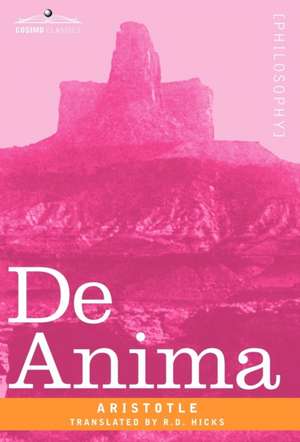
de Anima
Autor Aristotle Traducere de R D Hicksen Limba Engleză Hardback – dec 2008
Preț: 156.99 lei
Puncte Express: 235
Carte tipărită la comandă
Livrare economică 20 noiembrie-04 decembrie
Livrare prin curier în România Termenul estimat este afișat lângă disponibilitate.
Transport gratuit de la 400.00 lei Plată online sau ramburs, în funcție de opțiunile comenzii.
Retur gratuit în 14 zile Comandă securizată și suport în română.
Specificații
ISBN-13: 9781605204338
ISBN-10: 1605204331
Pagini: 108
Dimensiuni: 145 x 222 x 10 mm
Greutate: 0.29 kg
Editura: COSIMO INC
Locul publicării:United States
ISBN-10: 1605204331
Pagini: 108
Dimensiuni: 145 x 222 x 10 mm
Greutate: 0.29 kg
Editura: COSIMO INC
Locul publicării:United States
V-ar putea interesa
-
 RepublicPlatoPreț: 30.33 lei
 -
 Aristotle's De Anima: A GuideJosé Luis Bermúdez-20%Preț: 127.02 lei158.85 lei
 -
 The Art of PoetryAristotle-15%Preț: 256.03 lei301.92 lei
 -
 -29%Preț: 364.04 lei509.76 lei
 -
 Eudemian Ethics Books I, II, and VIIIAristotle-29%Preț: 364.10 lei509.25 lei
 -
 De Generatione et CorruptioneAristotle-29%Preț: 396.44 lei557.41 lei
 -
 -29%Preț: 467.85 lei656.90 lei
 -
 Aristotle, De motu animalium: Text and TranslationOliver Primavesi-30%Preț: 421.88 lei599.03 lei
 -
 Aristotle: Metaphysics Alpha and alphaThomas Kjeller Johansen-15%Preț: 185.46 lei219.30 lei
 -
 The PoliticsAristotle-17%Preț: 66.97 lei80.66 lei
 -
 PhysicsAristotle-18%Preț: 60.06 lei72.86 lei
 -
 The World as Will and Representation, Vol. 2Arthur Schopenhauer-35%Preț: 149.27 lei229.75 lei
 -
 PoeticsAristotle-20%Preț: 19.62 lei24.50 lei
 -
 MeditationsMarcus AureliusPreț: 33.99 lei
 -
 AristotleAristotlePreț: 193.55 lei
 -
 A History of Western PhilosophyBertrand RussellPreț: 196.17 lei
 -
 History of Animals, Volume IAristotlePreț: 228.42 lei
 -
 -14%Preț: 419.56 lei487.86 lei
 -
 -14%Preț: 418.63 lei486.77 lei
 -
 AnthropologySusan A RossPreț: 139.32 lei
 -
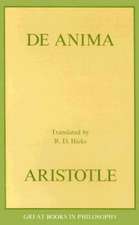 De AnimaAristotlePreț: 67.27 lei
 -
 On the SoulAristotlePreț: 38.27 lei
 -
 MetaphysicsAristotlePreț: 64.88 lei
 -
 The ProphetKahlil GibranPreț: 27.21 lei
 -
 Nicomachean EthicsAristotlePreț: 44.60 lei
 -
 de Anima (on the Soul)AristotlePreț: 48.53 lei
 -
 De AnimaAristotle-22%Preț: 170.30 lei219.32 lei
 -
 Great Is the Mystery of FaithPaul FergusonPreț: 101.19 lei
 -
 Nicomachean EthicsAristotlePreț: 43.55 lei
Notă biografică
Aristotle (Greek: ¿¿¿¿¿¿¿¿¿¿¿ Aristotél¿s, pronounced [aristotél¿¿s]; 384-322 BC)[A] was a Greek philosopher and polymath during the Classical period in Ancient Greece. Taught by Plato, he was the founder of the Lyceum, the Peripatetic school of philosophy, and the Aristotelian tradition. His writings cover many subjects. including physics, biology, zoology, metaphysics, logic, ethics, estheticspoetry, theatre, music, rhetoric, psychology, linguistics, economics, politics, and government. Aristotle provided a complex synthesis of the various philosophies existing prior to him. It was above all from his teachings that the West inherited its intellectual lexicon, as well as problems and methods of inquiry. As a result, his philosophy has exerted a unique influence on almost every form of knowledge in the West and it continues to be a subject of contemporary philosophical discussion. Little is known about his life. Aristotle was born in the city of Stagira in Northern Greece. His father, Nicomachus, died when Aristotle was a child, and he was brought up by a guardian. At seventeen or eighteen years of age he joined Plato's Academy in Athens and remained there until the age of thirty-seven (c. 347 BC).[4] Shortly after Plato died, Aristotle left Athens and, at the request of Philip II of Macedon, tutored Alexander the Great beginning in 343 BC.[5] He established a library in the Lyceum which helped him to produce many of his hundreds of books on papyrus scrolls. Though Aristotle wrote many elegant treatises and dialogues for publication, only around a third of his original output has survived, none of it intended for publication.[6] Aristotle's views on physical science profoundly shaped medieval scholarship. Their influence extended from Late Antiquity and the Early Middle Ages into the Renaissance, and were not replaced systematically until the Enlightenment and theories such as classical mechanics. Some of Aristotle's zoological observations found in his biology, such as on the hectocotyl (reproductive) arm of the octopus, were disbelieved until the 19th century. His works contain the earliest known formal study of logic, studied by medieval scholars such as Peter Abelard and John Buridan. Aristotle's influence on logic also continued well into the 19th century.
Descriere
Descriere de la o altă ediție sau format:
Aristotle's De Anima has a claim to be the first systematic treatment of issues in the philosophy of mind, and also to be one of the greatest works on the subject. This volume provides an accurate translation of Books II and III, together with some sections of Book I; particular attention has been given to the translation of difficult terms, to help the student of philosophy who does not know Greek. A brief Introduction discusses Aristotle's approach to his subject, while the Notes provide a continuous philosophical commentary on the text.Since the original publication of this volume, Aristotle's philosophy of mind has been the focus of lively scholarly debate; for this revised edition, Christopher Shields has added a substantial review of this recent work, together with a new bibliography.
Aristotle's De Anima has a claim to be the first systematic treatment of issues in the philosophy of mind, and also to be one of the greatest works on the subject. This volume provides an accurate translation of Books II and III, together with some sections of Book I; particular attention has been given to the translation of difficult terms, to help the student of philosophy who does not know Greek. A brief Introduction discusses Aristotle's approach to his subject, while the Notes provide a continuous philosophical commentary on the text.Since the original publication of this volume, Aristotle's philosophy of mind has been the focus of lively scholarly debate; for this revised edition, Christopher Shields has added a substantial review of this recent work, together with a new bibliography.
Recenzii
"Shiffman's fidelity both to Aristotle's text and to opening the complex thought contained therein to the contemporary reader is evident throughout this translation. It neither attempts to resolve difficulty nor drown the reader in obscurity; instead, it invites the reader to puzzle through this magnificent and difficult text herself. The wonderful introduction supplies any number of tools to do so and is a model of the rigorous and restrained articulation of essential themes and contemporary resonances. The glossary contains an indispensable and illuminating discussion of terms. Readable and thought-provoking, this translation is particularly well-suited for the classroom. Students at all levels will benefit from its lucidity and provocation to thought"
—Sara Brill, Fairfield University
The Focus Philosophical Library publishes clear, faithful editions by renowned scholars and teachers enabling access for modern students to essential ideas and wisdom of the world’s greatest thinkers.
"Shiffman's fidelity both to Aristotle's text and to opening the complex thought contained therein to the contemporary reader is evident throughout this translation. It neither attempts to resolve difficulty nor drown the reader in obscurity; instead, it invites the reader to puzzle through this magnificent and difficult text herself. The wonderful introduction supplies any number of tools to do so and is a model of the rigorous and restrained articulation of essential themes and contemporary resonances. The glossary contains an indispensable and illuminating discussion of terms. Readable and thought-provoking, this translation is particularly well-suited for the classroom. Students at all levels will benefit from its lucidity and provocation to thought." —Sara Brill, Fairfield University
Mark Shiffman, Assistant Professor of Humanities at Villanova University, is a graduate of St. John's College and received his PhD from the University of Chicago. His work in ancient thought has focused on Plato, Aristotle, Virgil, Plutarch and Augustine.
"Shiffman's fidelity both to Aristotle's text and to opening the complex thought contained therein to the contemporary reader is evident throughout this translation. It neither attempts to resolve difficulty nor drown the reader in obscurity; instead, it invites the reader to puzzle through this magnificent and difficult text herself. The wonderful introduction supplies any number of tools to do so and is a model of the rigorous and restrained articulation of essential themes and contemporary resonances. The glossary contains an indispensable and illuminating discussion of terms. Readable and thought-provoking, this translation is particularly well-suited for the classroom. Students at all levels will benefit from its lucidity and provocation to thought." —Sara Brill, Fairfield University
Mark Shiffman, Assistant Professor of Humanities at Villanova University, is a graduate of St. John's College and received his PhD from the University of Chicago. His work in ancient thought has focused on Plato, Aristotle, Virgil, Plutarch and Augustine.