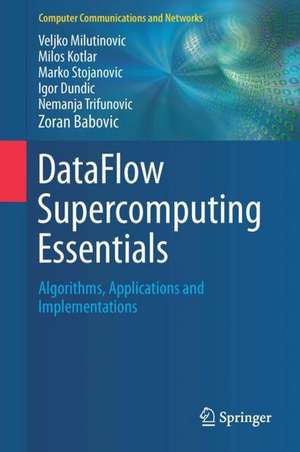
DataFlow Supercomputing Essentials: Computer Communications and Networks
Autor Veljko Milutinovic, Milos Kotlar, Marko Stojanovic, Igor Dundic, Nemanja Trifunovic, Zoran Babovicen Limba Engleză Hardback – 22 dec 2017
Topics and features: presents an implementation of Neural Networks using the DataFlow paradigm, as an alternative to the traditional ControlFlow approach; discusses a solution to the three-dimensional Poisson equation, using the Fourier method and DataFlow technology; examines how the performance of the Binary Search algorithm can be improved through implementation on a DataFlow architecture; reviews the different way of thinking required to best configure the DataFlow engines for the processing of data in space flowing through the devices; highlights how the DataFlow approach can efficiently support applications in big data analytics, deep learning, and the Internet of Things. This indispensable volume will benefit all researchers interested in supercomputing in general, and DataFlow computing in particular. Advanced undergraduate and graduate students involved in courses on Data Mining, Microprocessor Systems, and VLSI Systems, will also find the book to be an invaluable resource.
Din seria Computer Communications and Networks
- 20%
 Preț: 668.73 lei
 - 20%
 Preț: 383.24 lei
 - 20%
 Preț: 1178.43 lei
 - 20%
 Preț: 791.05 lei
 - 20%
 Preț: 710.50 lei
 - 20%
 Preț: 1045.82 lei
 - 20%
 Preț: 349.24 lei
 - 20%
 Preț: 348.68 lei
 - 20%
 Preț: 1001.24 lei
 - 20%
 Preț: 736.62 lei
 - 20%
 Preț: 342.90 lei
 - 20%
 Preț: 674.94 lei
 - 20%
 Preț: 1002.09 lei
 - 20%
 Preț: 966.51 lei
 - 20%
 Preț: 366.44 lei
 - 20%
 Preț: 357.72 lei
 - 20%
 Preț: 644.98 lei
 - 20%
 Preț: 650.00 lei
 - 20%
 Preț: 647.24 lei
 - 52%
 Preț: 773.59 lei
 - 20%
 Preț: 978.39 lei
 - 50%
 Preț: 299.10 lei
 - 20%
 Preț: 335.02 lei
 - 20%
 Preț: 341.58 lei
 - 20%
 Preț: 621.10 lei
 - 20%
 Preț: 679.34 lei
 - 20%
 Preț: 650.24 lei
 - 20%
 Preț: 618.53 lei
 - 20%
 Preț: 345.05 lei
 - 20%
 Preț: 673.26 lei
 - 20%
 Preț: 667.15 lei
 - 20%
 Preț: 646.40 lei
 - 15%
 Preț: 674.64 lei
 - 20%
 Preț: 548.25 lei
 - 20%
 Preț: 387.01 lei
 - 20%
 Preț: 967.10 lei
 - 20%
 Preț: 314.22 lei
 - 20%
 Preț: 1040.23 lei
 - 20%
 Preț: 616.26 lei
 - 20%
 Preț: 704.07 lei
 - 20%
 Preț: 646.40 lei
 - 20%
 Preț: 438.11 lei
Preț: 354.47 lei
Preț vechi: 443.09 lei
-20%
Puncte Express: 532
Carte tipărită la comandă
Livrare economică 24-30 noiembrie
Livrare prin curier în România Termenul estimat este afișat lângă disponibilitate.
Transport gratuit de la 400.00 lei Plată online sau ramburs, în funcție de opțiunile comenzii.
Retur gratuit în 14 zile Comandă securizată și suport în română.
Specificații
ISBN-13: 9783319661247
ISBN-10: 3319661248
Pagini: 164
Ilustrații: XI, 150 p. 52 illus., 50 illus. in color.
Dimensiuni: 160 x 241 x 15 mm
Greutate: 0.4 kg
Ediția:1st edition 2017
Editura: Springer
Colecția Computer Communications and Networks
Seria Computer Communications and Networks
Locul publicării:Cham, Switzerland
ISBN-10: 3319661248
Pagini: 164
Ilustrații: XI, 150 p. 52 illus., 50 illus. in color.
Dimensiuni: 160 x 241 x 15 mm
Greutate: 0.4 kg
Ediția:1st edition 2017
Editura: Springer
Colecția Computer Communications and Networks
Seria Computer Communications and Networks
Locul publicării:Cham, Switzerland
V-ar putea interesa
-
 -40%Preț: 492.21 lei824.42 lei
 -
 High Performance Computing: Modern Systems and PracticesThomas Sterling-40%Preț: 437.18 lei729.97 lei
 -
 -20%Preț: 225.84 lei282.30 lei
 -
 -20%Preț: 580.64 lei725.81 lei
 -
 -27%Preț: 465.12 lei640.28 lei
 -
 Computer Architecture: A Quantitative ApproachJohn L. Hennessy-39%Preț: 534.37 lei882.55 lei
 -
 -39%Preț: 394.79 lei646.62 lei
 -
 Artificial Intelligence Hardware DesignAlbert Chun-Chen Liu-20%Preț: 716.17 lei895.22 lei
 -
 Data Science Essentials for DummiesLillian Pierson-20%Preț: 76.56 lei95.69 lei
 -
 The Data Hero PlaybookMalcolm HawkerPreț: 202.67 lei
 -
 Move First, Align FastDeepika Chopra-20%Preț: 175.27 lei219.08 lei
 -
 Programming Neural Networks with PythonJoachim Steinwendner-20%Preț: 301.14 lei376.42 lei
 -
 Algorithms and Data Structures in ActionMarcello La Rocca-20%Preț: 396.11 lei495.14 lei
 -
 -27%Preț: 1331.22 lei1813.38 lei
 -
 Deep Learning Crash CourseGiovanni Volpe-35%Preț: 290.92 lei445.81 lei
 -
 Advances in AI for Cloud, Edge, and Mobile Computing ApplicationsShrikaant Kulkarni-20%Preț: 1296.62 lei1620.78 lei
 -
 -18%Preț: 998.50 lei1217.68 lei
 -
 -20%Preț: 1010.30 lei1262.87 lei
 -
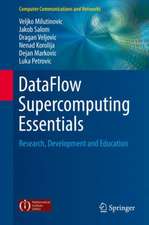 DataFlow Supercomputing EssentialsVeljko Milutinovic-20%Preț: 668.73 lei835.92 lei
Cuprins
Part I: Algorithms.- Implementing Neural Networks by Using the DataFlow Paradigm.- Part II: Applications.- Solving the Poisson Equation by Using Dataflow Technology.- Binary Search in the DataFlow Paradigm.- Part III: Implementations.- Introductory Overview on Implementation Tools.- DataFlow Systems: From Their Origins to Future Applications in Data Analytics, Deep Learning, and the Internet of Things.
Textul de pe ultima copertă
This illuminating text/reference reviews the fundamentals of programming for effective DataFlow computing. The DataFlow paradigm enables considerable increases in speed and reductions in power consumption for supercomputing processes, yet the programming model requires a distinctly different approach. The algorithms and examples showcased in this book will help the reader to develop their understanding of the advantages and unique features of this methodology. This work serves as a companion title to DataFlow Supercomputing Essentials: Research, Development and Education, which analyzes the latest research in this area, and the training resources available.
Topics and features:
Topics and features:
- Presents an implementation of Neural Networks using the DataFlow paradigm, as an alternative to the traditional ControlFlow approach
- Discusses a solution to the three-dimensional Poisson equation, using the Fourier method and DataFlow technology
- Examines how the performance of the Binary Search algorithm can be improved through implementation on a DataFlow architecture
- Reviews the different way of thinking required to best configure the DataFlow engines for the processing of data in space flowing through the devices
- Highlights how the DataFlow approach can efficiently support applications in big data analytics, deep learning, and the Internet of Things
Caracteristici
Reviews the advantages of the DataFlow paradigm for supercomputing Introduces the DataFlow programming model Provides a selection of algorithm examples that illuminate the DataFlow paradigm