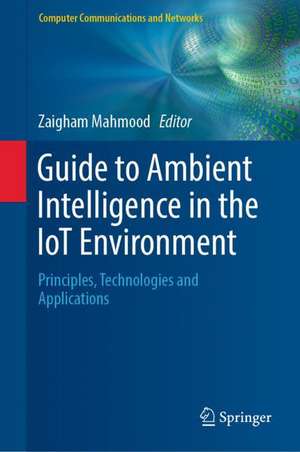
Guide to Ambient Intelligence in the IoT Environment: Computer Communications and Networks
Editat de Zaigham Mahmooden Limba Engleză Hardback – 16 ian 2019
În domeniul IoT (Internet of Things), convergența dintre senzorii omniprezenți și algoritmii de decizie transformă spațiile de locuit și de lucru în entități reactive. Guide to Ambient Intelligence in the IoT Environment analizează tocmai acest strat de inteligență ambientală (AmI) care permite interfețelor să recunoască prezența umană și să adapteze mediul în mod autonom. Dacă volumul Ambient Intelligence de Boris DeRuyter v-a oferit cadrul teoretic al mediilor interconectate, această lucrare, publicată în seria Computer Communications and Networks, oferă instrumentele practice și arhitecturile informaționale necesare implementării acestor concepte.
Descoperim aici o structură riguroasă, organizată în trei piloni esențiali. Prima parte explorează topologiile orașelor inteligente și adaptabilitatea sistemelor la runtime, folosind o abordare orientată pe componente. Partea a doua trece la metodologii concrete, prezentând soluții pentru detectarea prezenței prin WLAN și sisteme de control pentru siguranța mediului, cum este detectarea monoxidului de carbon. În final, volumul evaluează scenarii de utilizare care variază de la vehicule autonome la transformarea serviciilor fiscale în era IoT.
Considerăm că această lucrare reprezintă o evoluție naturală în opera editorului Zaigham Mahmood. După ce a explorat infrastructura de bază în Software Engineering in the Era of Cloud Computing și analiza masivă de date în Data Science and Big Data Computing, autorul își îndreaptă acum atenția către interacțiunea om-calculator (HCI) și procesul de decizie la nivelul dispozitivelor edge. Ritmul este unul tehnic, susținut de contribuțiile unor cercetători internaționali care pun accent pe interoperabilitate, scalabilitate și securitate în rețelele de senzori.
Din seria Computer Communications and Networks
- 20%
 Preț: 648.60 lei
 - 20%
 Preț: 1160.62 lei
 - 20%
 Preț: 766.83 lei
 - 20%
 Preț: 662.80 lei
 - 20%
 Preț: 1013.19 lei
 - 20%
 Preț: 339.68 lei
 - 20%
 Preț: 326.37 lei
 - 20%
 Preț: 1001.24 lei
 - 20%
 Preț: 736.62 lei
 - 20%
 Preț: 321.01 lei
 - 20%
 Preț: 654.58 lei
 - 20%
 Preț: 1002.09 lei
 - 20%
 Preț: 966.51 lei
 - 20%
 Preț: 366.44 lei
 - 20%
 Preț: 334.80 lei
 - 20%
 Preț: 644.98 lei
 - 20%
 Preț: 650.00 lei
 - 20%
 Preț: 647.24 lei
 - 52%
 Preț: 773.59 lei
 - 20%
 Preț: 978.39 lei
 - 50%
 Preț: 288.84 lei
 - 20%
 Preț: 335.02 lei
 - 20%
 Preț: 332.30 lei
 - 20%
 Preț: 621.10 lei
 - 20%
 Preț: 633.88 lei
 - 20%
 Preț: 650.24 lei
 - 20%
 Preț: 577.31 lei
 - 20%
 Preț: 345.05 lei
 - 20%
 Preț: 673.26 lei
 - 20%
 Preț: 622.58 lei
 - 20%
 Preț: 646.40 lei
 - 15%
 Preț: 654.27 lei
 - 20%
 Preț: 548.25 lei
 - 20%
 Preț: 376.22 lei
 - 20%
 Preț: 967.10 lei
 - 20%
 Preț: 314.22 lei
 - 20%
 Preț: 1040.23 lei
 - 20%
 Preț: 616.26 lei
 - 20%
 Preț: 704.07 lei
 - 20%
 Preț: 646.40 lei
 - 20%
 Preț: 409.52 lei
Preț: 358.52 lei
Preț vechi: 448.15 lei
-20%
Carte disponibilă
Livrare economică 30 octombrie-13 noiembrie
Specificații
ISBN-10: 3030041727
Pagini: 320
Ilustrații: XXIII, 295 p. 91 illus., 61 illus. in color.
Dimensiuni: 160 x 241 x 22 mm
Greutate: 0.71 kg
Ediția:1st ed. 2019
Editura: Springer
Colecția Computer Communications and Networks
Seria Computer Communications and Networks
Locul publicării:Cham, Switzerland
V-ar putea interesa
-
 Using Artificial Intelligence Absolute Beginner's GuideMichael Miller-20%Preț: 194.58 lei243.22 lei
 -
 Handbook of Ambient Intelligence and Smart EnvironmentsHideyuki Nakashima-20%Preț: 1327.58 lei1659.47 lei
 -
 Preț: 479.33 lei
 -
 -15%Preț: 436.67 lei513.73 lei
 -
 -20%Preț: 1371.39 lei1714.24 lei
 -
 Advances in AI for Cloud, Edge, and Mobile Computing ApplicationsShrikaant Kulkarni-20%Preț: 1296.62 lei1620.78 lei
 -
 Web, Artificial Intelligence and Network ApplicationsLeonard Barolli-20%Preț: 1255.62 lei1569.53 lei
 -
 Challenges in the IoT and Smart EnvironmentsReza Montasari-20%Preț: 1009.35 lei1261.68 lei
 -
 -20%Preț: 1261.65 lei1577.05 lei
 -
 Concise Guide to the Internet of ThingsMichael Mccarthy-20%Preț: 421.74 lei527.18 lei
 -
 -24%Preț: 981.00 lei1290.79 lei
 -
 Advances in Smart Medical, IoT & Artificial IntelligenceMohammed Serrhini-20%Preț: 1394.25 lei1742.81 lei
 -
 -20%Preț: 531.38 lei664.22 lei
 -
 -20%Preț: 311.50 lei389.38 lei
 -
 -20%Preț: 324.68 lei405.84 lei
 -
 -18%Preț: 1126.85 lei1374.20 lei
 -
 Recent Advances in Artificial Intelligence and Smart ApplicationsJyotsna K. Mandal-18%Preț: 1017.19 lei1240.48 lei
 -
 Intelligent Mobile Edge Computing and SensingWanming Hao-20%Preț: 1284.86 lei1606.07 lei
 -
 -20%Preț: 326.23 lei407.79 lei
 -
 AI and MicroservicesDileep Kumar Pandiya-20%Preț: 263.90 lei329.88 lei
De ce să citești această carte
Recomandăm această carte inginerilor de sistem și cercetătorilor care doresc să treacă de la simpla conectivitate IoT la sisteme autonome inteligente. Cititorul câștigă o înțelegere profundă a modului în care învățarea automată și context-awareness pot fi integrate în obiecte cotidiene. Este un ghid esențial pentru cei care proiectează soluții de smart city, vehicule autonome sau sisteme avansate de monitorizare industrială, oferind un echilibru între arhitectura de rețea și studiile de caz aplicate.
Despre autor
Zaigham Mahmood este un cercetător și editor recunoscut la nivel internațional, specializat în tehnologii emergente. Activitatea sa academică și editorială publicată de Springer acoperă domenii critice ale informaticii moderne, de la Connected Vehicles in the Internet of Things până la metodologii de inginerie software pentru cloud. Expertiza sa se concentrează pe integrarea sistemelor complexe și pe modul în care noile paradigme de calcul, precum Big Data și IoT, pot fi aplicate pentru a rezolva probleme structurale în mediile industriale și urbane. În volumul de față, el coordonează o echipă de experți pentru a defini viitorul inteligenței ambientale.