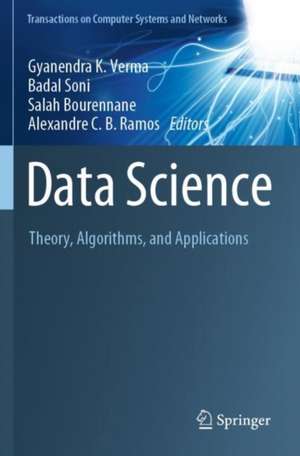
Data Science: Theory, Algorithms, and Applications: Transactions on Computer Systems and Networks
Editat de Gyanendra K. Verma, Badal Soni, Salah Bourennane, Alexandre C. B. Ramosen Limba Engleză Paperback – 21 aug 2022
Observăm în Data Science o trecere necesară de la teoria fundamentală a algoritmilor la complexitatea implementărilor în timp real. Un capitol central care ilustrează această tranziție este cel dedicat urmăririi vehiculelor cu ajutorul quadrocopterelor, unde autorii demonstrează cum arhitecturile Deep Learning pot fi optimizate pentru procesare video instantanee. Volumul nu se limitează la succesul modelelor pre-antrenate, ci analizează critic „aerul de incertitudine” care înconjoară modul în care rețelele neuronale profunde procesează informația, oferind o perspectivă rară asupra limitărilor actuale ale sistemelor „black box”.
Din punct de vedere al conținutului, găsim o structură echilibrată ce acoperă de la biometrie (prin fuziunea informațiilor NIR și VW pentru recunoașterea irisului) până la ingineria financiară, unde este prezentat un model de credit scoring în două etape. Această diversitate tematică extinde cadrul propus de Multi-faceted Deep Learning prin adăugarea unor date noi din domenii extrem de specifice, precum analiza performanței sistemelor big.LITTLE prin scheme de predicție a ramificațiilor.
Putem afirma că lucrarea reprezintă o evoluție firească față de volumul anterior al editorilor, Machine Learning, Image Processing, Network Security and Data Sciences, rafinând conceptele de prelucrare a imaginilor și securitate în contextul noilor provocări multi-modale. Spre deosebire de Deep Learning de Shuhao Wang, care se concentrează pe esența algoritmică, acest titlu publicat de Springer pune accent pe implementarea efectivă în biblioteci și framework-uri moderne, fiind un instrument de lucru pentru cei care doresc să depășească faza de simulare în proiectele lor de cercetare.
Din seria Transactions on Computer Systems and Networks
- 18%
 Preț: 1085.92 lei
 - 20%
 Preț: 1071.56 lei
 - 20%
 Preț: 642.10 lei
 - 20%
 Preț: 1079.54 lei
 - 20%
 Preț: 534.82 lei
 - 24%
 Preț: 963.96 lei
 - 20%
 Preț: 1125.52 lei
 - 20%
 Preț: 1118.18 lei
 - 18%
 Preț: 1122.78 lei
 - 5%
 Preț: 1427.79 lei
 - 23%
 Preț: 659.21 lei
 - 20%
 Preț: 888.94 lei
 - 20%
 Preț: 674.65 lei
 - 18%
 Preț: 1069.70 lei
 - 24%
 Preț: 906.33 lei
 - 20%
 Preț: 835.03 lei
 - 20%
 Preț: 1189.45 lei
 - 20%
 Preț: 485.53 lei
 - 20%
 Preț: 1418.17 lei
 - 20%
 Preț: 1009.17 lei
 - 24%
 Preț: 1112.25 lei
 - 24%
 Preț: 977.92 lei
 - 20%
 Preț: 1413.76 lei
 - 20%
 Preț: 1138.21 lei
 - 24%
 Preț: 1136.81 lei
 - 24%
 Preț: 996.34 lei
 - 24%
 Preț: 992.90 lei
Preț: 1145.63 lei
Preț vechi: 1432.04 lei
-20%
Carte tipărită la comandă
Livrare economică 02-09 noiembrie
Specificații
ISBN-10: 9811616833
Pagini: 437
Ilustrații: XXVII, 437 p. 239 illus., 166 illus. in color.
Dimensiuni: 155 x 235 mm
Ediția:1st ed. 2021
Editura: Springer Nature Singapore
Colecția Springer
Seria Transactions on Computer Systems and Networks
Locul publicării:Singapore, Singapore
V-ar putea interesa
-
 Deep Learning IllustratedAglae Bassens-20%Preț: 328.25 lei410.31 lei
 -
 Deep LearningIan Goodfellow-20%Preț: 603.73 lei754.66 lei
 -
 Understanding Deep LearningSimon J. D. Prince-29%Preț: 604.26 lei855.35 lei
 -
 Deep LearningJohn D. Kelleher-20%Preț: 86.38 lei107.97 lei
 -
 -39%Preț: 385.64 lei636.10 lei
 -
 -31%Preț: 607.05 lei885.58 lei
 -
 Driving Intelligence: The Green Book: Routes to AutonomyJ. Mark Bishop-20%Preț: 297.95 lei372.44 lei
 -
 The Essential Book of AIAnne Rooney-20%Preț: 74.07 lei92.59 lei
 -
 Math and Architectures of Deep LearningKrishnendu Chaudhury-20%Preț: 396.76 lei495.95 lei
 -
 Inside Deep Learning: Math, Algorithms, ModelsEdward Raff-20%Preț: 398.09 lei497.61 lei
 -
 Deep Learning: A Visual ApproachAndrew Glassner-36%Preț: 492.67 lei766.68 lei
 -
 -20%Preț: 240.65 lei300.81 lei
 -
 Deep Learning Crash CourseGiovanni Volpe-35%Preț: 284.05 lei439.72 lei
 -
 Practical Deep Learning, 2nd Edition: A Python-Based IntroductionRonald T. Kneusel-36%Preț: 324.86 lei507.78 lei
 -
 Deep Learning ArchitecturesOvidiu Calin-15%Preț: 498.66 lei586.66 lei
 -
 Materials Data ScienceStefan Sandfeld-15%Preț: 591.20 lei695.53 lei
 -
 -20%Preț: 1169.68 lei1462.10 lei
 -
 Practical Deep Learning with PyTorchDeepak Gowda-20%Preț: 225.42 lei281.77 lei
 -
 -5%Preț: 1240.38 lei1305.66 lei
 -
 Deep Learning and Visual Artificial IntelligenceVishal Goar-20%Preț: 1415.96 lei1769.95 lei
De ce să citești această carte
Recomandăm această carte cercetătorilor și studenților la masterat care au deja baze solide în machine learning și doresc să exploreze aplicații multimedia avansate. Cititorul câștigă o înțelegere practică a modului în care arhitecturile profunde sunt integrate în sisteme complexe, de la drone la diagnostic medical, beneficiind de metodologii riguroase pentru utilizarea framework-urilor de date masive precum Spark în contextul rețelelor neuronale.
Despre autor
Gyanendra K. Verma și Alexandre C. B. Ramos sunt cercetători cu o experiență vastă în coordonarea lucrărilor academice de înalt nivel, fiind recunoscuți pentru expertiza lor în procesarea imaginilor și sisteme de calcul. Gyanendra K. Verma a editat anterior volume de referință precum Machine Learning, Image Processing, Network Security and Data Sciences, concentrându-se pe intersecția dintre securitatea rețelelor și știința datelor. Alexandre C. B. Ramos, afiliat Universității Federale din Itajuba, aduce o perspectivă aplicată asupra roboticii și viziunii computerizate, elemente care se reflectă în calitatea studiilor de caz selectate pentru acest volum din seria Transactions on Computer Systems and Networks.
Cuprins
Notă biografică
Badal Soni is currently working as Assistant Professor at the Department of Computer Engineering, National Institute of Technology Silchar, India. He has completed his B. Tech. from Rajiv Gandhi Technical University (formerly RGPV) Bhopal, India, and M. Tech from Indian Institute of Information Technology, Design, and Manufacturing (IITDM), Jabalpur, India. He received Ph.D. from the National Institute of Technology Silchar, India. His all degrees are in Computer Science and Engineering. He has teaching and research experience of over seven years in the area of computer science and information technology with a special interest in computer graphics, image processing, speech and language processing. He has published more than 35 papers in refereed Journals, contributed books, and international conference proceedings. He is the Senior member of IEEE and professional members of various bodies like IEEE, ACM, IAENG & IACSIT.
Salah Bourennane received his Ph.D. degree from Institut National Polytechnique de Grenoble, France. Currently, he is a Full Professor at the Ecole Centrale Marseille, France. He is the head of the Multidimensional Signal Processing Group of Fresnel Institute. His research interests are in statistical signal processing, remote sensing, telecommunications, array processing, image processing, multidimensional signal processing, and performance analysis. He has published several papers in reputed international journals.
Alexandre Carlos B Ramos is the associate Professor of Mathematics and Computing Institute - IMC from Federal University of Itajubá - UNIFEI (MG). His interest areas are multimedia, artificial intelligence, human-computer interface, computer-based training, and e-learning. Dr. Ramos has over 18 years of research and teaching experience. He did his Post-doctorate at the EcoleNationale de l`AviationCivile - ENAC (France, 2013-2014), PhD and Master in Electronic and Computer Engineering from InstitutoTecnológico de Aeronáutica -ITA (1996 and 1992). He completed his graduation in Electronic Engineering from the University of Vale do Paraíba - UNIVAP (1985) and sandwich doctorate at Laboratoired'Analyse et d'Architecture des Systèmes - LAAS (France, 1995-1996). He has professional experience in the areas of Process Automation with an emphasis on chemical and petrochemical processes (Petrobras 1983-1995); and Computer Science, with emphasis on Information Systems (ITA/ Motorola 1997-2001), acting mainly on the following themes: Development of Training Simulators with the support of Intelligent Tutoring Systems, Hybrid Intelligent Systems, and Computer Based Training, Neural Networks in Trajectory Control in Unmanned Vehicles, Pattern Matching and Image Digital Processing.