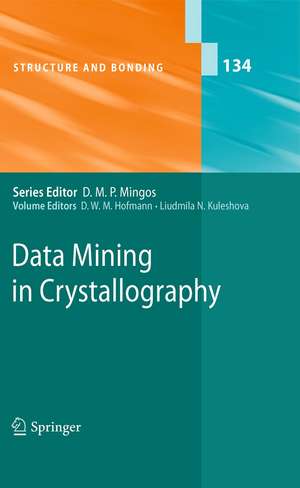
Data Mining in Crystallography
Editat de Liudmila N. Kuleshova, D. W. M. Hofmannen Limba Engleză Paperback – 14 mar 2012
Preț: 1165.36 lei
Preț vechi: 1421.17 lei
-18%
Puncte Express: 1748
Carte tipărită la comandă
Livrare economică 27 mai-10 iunie
Specificații
ISBN-13: 9783642261619
ISBN-10: 3642261612
Pagini: 188
Ilustrații: XIV, 172 p. 74 illus., 29 illus. in color.
Dimensiuni: 155 x 235 x 11 mm
Greutate: 0.3 kg
Ediția:2010
Editura: Springer Berlin, Heidelberg
Locul publicării:Berlin, Heidelberg, Germany
ISBN-10: 3642261612
Pagini: 188
Ilustrații: XIV, 172 p. 74 illus., 29 illus. in color.
Dimensiuni: 155 x 235 x 11 mm
Greutate: 0.3 kg
Ediția:2010
Editura: Springer Berlin, Heidelberg
Locul publicării:Berlin, Heidelberg, Germany
V-ar putea interesa
-
 Quantum InformationStephen Barnett-12%Preț: 306.72 lei347.72 lei
 -
 Time-Dependent Density-Functional Theory: Concepts and ApplicationsCarsten A. Ullrich-11%Preț: 487.62 lei548.71 lei
 -
 Theory of Fluctuations in SuperconductorsAnatoly Larkin-25%Preț: 568.97 lei756.84 lei
 -
 Ice PhysicsPeter V. Hobbs-24%Preț: 584.48 lei771.93 lei
 -
 The Physics of CloudsB. J. Mason-24%Preț: 569.63 lei753.98 lei
 -
 -23%Preț: 387.26 lei500.10 lei
 -
 -33%Preț: 625.07 lei929.04 lei
 -
 Layered Superconductors: Volume 1Richard A. Klemm-33%Preț: 881.20 lei1324.72 lei
 -
 Electronic Processes in Non-Crystalline MaterialsNevill Francis Mott-22%Preț: 514.05 lei660.03 lei
 -
 Electricity and Magnetism, Volume 1B. I. Bleaney-12%Preț: 329.64 lei374.40 lei
 -
 Electricity and Magnetism, Volume 2B. I. Bleaney-22%Preț: 429.39 lei551.88 lei
 -
 An Introduction to Statistical Mechanics and ThermodynamicsRobert H. Swendsen-22%Preț: 508.47 lei649.22 lei
 -
 -25%Preț: 622.33 lei826.38 lei
 -
 Molecular Relaxation in LiquidsBiman Bagchi-34%Preț: 676.82 lei1020.94 lei
 -
 Physics of Surfaces and InterfacesHarald Ibach-15%Preț: 691.59 lei813.63 lei
 -
 -18%Preț: 966.51 lei1178.66 lei
 -
 Solid-State PhysicsHarald Ibach-17%Preț: 396.60 lei477.83 lei
Public țintă
Professional/practitionerCuprins
An Introduction to Data Mining.- Data Mining in Organic Crystallography.- Data Mining for Protein Secondary Structure Prediction.- Data Mining and Inorganic Crystallography.- Data Bases, the Base for Data Mining.
Caracteristici
This series presents critical reviews of the present position and future trends in modern chemical research concerned with chemical structure and bonding Short and concise reports, each written by the world's renowned experts Still valid and useful after 5 or 10 years More information as well as the electronic version of the whole content available at: springerlink.com Includes supplementary material: sn.pub/extras