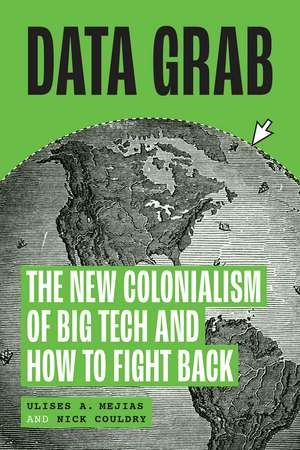
Data Grab: The New Colonialism of Big Tech and How to Fight Back
Autor Ulises A. Mejias, Nick Couldryen Limba Engleză Hardback – 14 mar 2024
În peisajul academic actual al sociologiei digitale și al studiilor politice, ne aflăm în fața unei lucrări care propune o paradigmă radicală pentru înțelegerea puterii tehnologice contemporane. Suntem de părere că Data Grab nu este doar o critică a supravegherii digitale, ci o reîncadrare istorică necesară a modului în care giganți precum Meta sau Alphabet operează la nivel global. Considerăm că autorii reușesc să demonstreze cum practicile extractive de astăzi nu sunt simple anomalii ale pieței, ci reprezintă o continuare directă a colonialismului istoric.
Lucrarea extinde cadrul teoretic propus anterior de Nick Couldry în The Costs of Connection cu date noi și o analiză aprofundată a modului în care inteligența artificială acționează ca motor al acestei noi „misiuni de civilizare”. Structura volumului este riguros organizată, pornind de la o introducere ce face tranziția de la acapararea terenurilor la cea a datelor, urmată de capitole ce analizează noile teritorii digitale și „clasa colonială” emergentă. Această progresie logică permite cititorului să înțeleagă cum algoritmii, departe de a fi neutri, încorporează constructe culturale și economice care adâncesc inegalitatea între Nordul Global și restul lumii.
Spre deosebire de Resisting Big Tech, care se concentrează pe impactul algoritmilor asupra vieții cotidiene (precum Google Maps), Data Grab adoptă o perspectivă macro-istorică, oferind totodată un ghid pentru rezistență. Analiza nu se oprește la diagnosticarea problemelor de confidențialitate, ci explorează modul în care extracția de date duce la precaritatea muncii și degradarea mediului, oferind o viziune holistică asupra noii ordini sociale. Este o lectură densă, dar accesibilă, esențială pentru cei care doresc să înțeleagă mecanismele de putere din spatele interfețelor prietenoase ale aplicațiilor pe care le folosim zilnic.
Preț: 154.41 lei
Carte disponibilă
Livrare economică 06-20 noiembrie
Specificații
ISBN-10: 0226832309
Pagini: 224
Dimensiuni: 152 x 229 x 25 mm
Greutate: 0.56 kg
Ediția:First Edition
Editura: University of Chicago Press
Colecția University of Chicago Press
V-ar putea interesa
-
 Technology is Not the ProblemTimandra HarknessPreț: 79.62 lei
 -
 Taming Silicon ValleyGary F. Marcus-16%Preț: 97.51 lei116.28 lei
 -
 Privacy is PowerCarissa Véliz-19%Preț: 64.48 lei79.20 lei
 -
 Digital Degrowth: Technology in the Age of SurvivalMichael KwetPreț: 151.97 lei
 -
 Resisting Big Tech: The Personalized is PoliticalNiels Niessen-16%Preț: 164.68 lei194.98 lei
 -
 -19%Preț: 99.37 lei122.26 leiRecomandat
 -
 The Costs of ConnectionNick Couldry-23%Preț: 730.45 lei948.63 lei
 -
 TechnofeudalismYanis Varoufakis-31%Preț: 64.27 lei92.97 lei
 -
 The Age of Surveillance CapitalismShoshana ZuboffPreț: 156.74 lei
 -
 -19%Preț: 98.91 lei121.99 lei
 -
 Algorithmic RealityDamian BradfieldPreț: 104.98 lei
 -
 The Age of Surveillance Capitalism: AN OBSERVER BEST BOOK OF THE CENTURYProfessor Shoshana ZuboffPreț: 91.15 lei
 -
 We Are Green and TremblingGabriela Cabezón CámaraPreț: 135.93 lei
 -
 The Internet ConCory DoctorowPreț: 84.06 lei
 -
 Cybernetic Circulation ComplexNick Dyer-WithefordPreț: 129.05 lei
 -
 How Silicon Valley Unleashed Techno-feudalismCédric DurandPreț: 99.52 lei
 -
 -19%Preț: 69.08 lei85.65 lei
 -
 The Age of ExtractionTim WuPreț: 107.56 lei
 -
 -19%Preț: 98.15 lei120.78 lei
 -
 Empire of AIKaren HaoPreț: 163.48 lei
De ce să citești această carte
Recomandăm această carte oricui este interesat de intersecția dintre tehnologie și dreptate socială. Veți câștiga o perspectivă critică asupra modului în care datele dumneavoastră personale sunt transformate în profit corporativ fără consimțământ real. Este un instrument teoretic prețios pentru studenții de la sociologie și științe politice, oferind argumente solide pentru necesitatea unei reglementări etice a inteligenței artificiale și a platformelor digitale.
Despre autor
Nick Couldry este profesor de media, comunicații și teorie socială la London School of Economics, fiind recunoscut la nivel internațional pentru cercetările sale asupra impactului social al mediilor digitale. Ulises A. Mejias este profesor de studii media la SUNY Oswego, specializat în teoria rețelelor și colonialismul datelor. Împreună, cei doi autori au definit conceptul de „colonialism al datelor”, colaborarea lor fiind esențială pentru dezvoltarea acestui nou domeniu de studiu care îmbină economia politică cu teoria post-colonială.
Descriere scurtă
Large technology companies like Meta, Amazon, and Alphabet have unprecedented access to our daily lives, collecting information when we check our email, count our steps, shop online, and commute to and from work. Current events are concerning—both the changing owners (and names) of billion-dollar tech companies and regulatory concerns about artificial intelligence underscore the sweeping nature of Big Tech’s surveillance and the influence such companies hold over the people who use their apps and platforms.
As trusted tech experts Ulises A. Mejias and Nick Couldry show in this eye-opening and convincing book, this vast accumulation of data is not the accidental stockpile of a fast-growing industry. Just as nations stole territories for ill-gotten minerals and crops, wealth, and dominance, tech companies steal personal data important to our lives. It’s only within the framework of colonialism, Mejias and Couldry argue, that we can comprehend the full scope of this heist.
Like the land grabs of the past, today’s data grab converts our data into raw material for the generation of corporate profit against our own interests. Like historical colonialism, today’s tech corporations have engineered an extractive form of doing business that builds a new social and economic order, leads to job precarity, and degrades the environment. These methods deepen global inequality, consolidating corporate wealth in the Global North and engineering discriminatory algorithms. Promising convenience, connection, and scientific progress, tech companies enrich themselves by encouraging us to relinquish details about our personal interactions, our taste in movies or music, and even our health and medical records. Do we have any other choice?
Data Grab affirms that we do. To defy this new form of colonialism we will need to learn from previous forms of resistance and work together to imagine entirely new ones. Mejias and Couldry share the stories of voters, workers, activists, and marginalized communities who have successfully opposed unscrupulous tech practices. An incisive discussion of the digital media that’s transformed our world, Data Grab is a must-read for anyone concerned about privacy, self-determination, and justice in the internet age.
Notă biografică
Cuprins
Introduction: From Landgrab to Data Grab
The Four X’s of Colonialism
Terms and Conditions
Raw Materials
Reading the Present through a Colonial Lens
Your Guide to the Book
1. A New Colonialism
No Capitalism without Colonialism
Data and the Continuation of Colonial Violence by Other Means
The Colonial Roots of AI
The Resilience of Colonialism
We Need Not Be Passive Victims
2. Data Territories
When Society Becomes the Territory
New Data Relations Mean New Power Relations
Data, AI and the Environment 76
There’s a Data Grab Happening (Very) Near You
Data Territories and the Transformation of Work
Global Inequality, Redux
3. Data’s New Civilising Mission
The Emperor’s New ‘Civilising’ Clothes
Civilising Narrative #1: Everyone Wants an Easier Life (aka Data Extraction as Convenience)
Civilising Narrative #2: This Is How We Connect!
Civilising Narrative #3: AI Is Smarter than Humans
Why Civilisational Stories Work
4. The New Colonial Class
The Social Quantification Sector
The Big Data Harvesters
The Wider Colonial Class
Serving the Algorithmic State
Data’s Lone Adventurers
We the Consumers
5. Voices of Defiance
Colonialism’s Witnesses
No Modernity without Colonialism
Warnings from an Earlier Computer Age
Imagining the Battle to Come
Resources for Resistance?
6. A Playbook for Resistance
Resistance Is Already Here, and Nothing Can Stop It
Radically Reimagining How We Use Data
Introducing the Playbook
Play #1: Working within the System
Play #2: Working against the System
Play #3: Working beyond the System
Conclusion: And If We Don’t Resist?
Notes
Further Reading Suggestions
Index
Recenzii
“An extremely useful, well-rounded whole that connects all actors participating in the data chain, the strategies they use and the consequences of their actions.”
“Data Grab . . . is accessible to a broad readership, including those for whom English is not their first language. . . . Prioritizing praxis does not, however, compromise the theoretical depth or bibliographic richness of the volume, which is supported by over 500 citations and accompanied by an excellent, topically organized guide to further reading. . . . An engaging read, driven by an almost breathless sense of urgency.”