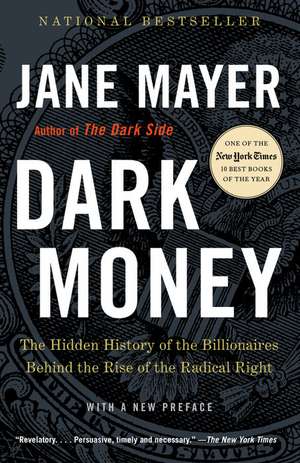
Dark Money
Autor Jane Mayeren Limba Engleză Paperback – 24 ian 2017
Urgența înțelegerii mecanismelor din spatele Dark Money nu a fost niciodată mai mare; trăim într-o eră în care deciziile politice majore par tot mai deconectate de voința populară. Considerăm că această lucrare este esențială pentru a demonta mitul conform căruia ascensiunea conservatorismului radical în SUA a fost o mișcare pur populistă. Ne-a atras atenția rigoarea cu care Jane Mayer documentează modul în care o elită restrânsă a utilizat averi colosale pentru a rescrie regulile jocului democratic. Ca și Kurt Andersen în Evil Geniuses, autoarea distilează experiență reală în principii acționabile de analiză, demonstrând cum idei politice considerate odinioară marginale au devenit norma prin finanțarea strategică a unor grupuri de reflecție și instituții academice. Merită menționat că Mayer nu se limitează la teorii, ci urmărește traseul banilor prin labirinturi birocratice complexe, oferind portrete vii ale figurilor din spatele acestei noi oligarhii americane. Față de lucrarea sa anterioară, The Dark Side, unde analiza politicile de securitate națională, în Dark Money Mayer își extinde viziunea asupra întregului ecosistem economic și legislativ. Cititorul va învăța cum „filantropia” a fost transformată într-o armă politică și cum grupuri precum cele conduse de frații Koch au reușit să blocheze reforme vitale de mediu sau fiscale, protejându-și interesele sub masca libertății individuale. Este o cronică a modului în care puterea financiară brută poate paraliza mecanismele statului de drept.
Preț: 117.46 lei
Carte disponibilă
Livrare economică 12-18 noiembrie
Livrare express 30 octombrie-05 noiembrie pentru 20.17 lei
Specificații
ISBN-10: 0307947904
Pagini: 576
Dimensiuni: 135 x 199 x 35 mm
Greutate: 0.48 kg
Editura: Random House LLC US
Colecția Anchor Books
V-ar putea interesa
-
 How to Win Friends and Influence PeopleDale CarnegiePreț: 63.37 lei
 -
 Peter the Great: A BiographyLindsey HughesPreț: 134.43 lei
 -
 From the Corner of the OvalBeck Dorey-SteinPreț: 109.97 lei
 -
 The Death of TruthMichiko KakutaniPreț: 117.65 lei
 -
 -35%Preț: 203.30 lei312.21 lei
 -
 Preț: 32.18 lei
 -
 Z: A Novel of Zelda FitzgeraldTherese Anne FowlerPreț: 111.11 lei
 -
 Trump Must GoBill PressPreț: 150.43 lei
 -
 Do States Have the Right to Exclude Immigrants?Christopher BertramPreț: 147.83 lei
 -
 Why Does Patriarchy Persist?Carol GilliganPreț: 93.11 lei
 -
 Ecomodernism: Technology, Politics and the Climate CrisisJonathan SymonsPreț: 159.10 lei
 -
 -26%Preț: 69.50 lei93.37 lei
 -
 Preț: 233.56 lei
 -
 Days of RefugeeNathaniel NyokPreț: 122.51 lei
 -
 Preț: 154.75 lei
 -
 Happy Money: The New Science of Smarter SpendingElizabeth DunnPreț: 79.03 lei
 -
 Invisible Women: Exposing Data Bias in a World Designed for MenCaroline Criado Perez-18%Preț: 77.07 lei94.11 lei
 -
 Jurassic ParkMichael Crichton-17%Preț: 61.56 lei73.73 lei
 -
 Violent BordersReece JonesPreț: 91.21 lei
 -
 Age of FollyLewis H LaphamPreț: 278.84 lei
 -
 Virtue and TerrorMaximilien RobespierrePreț: 96.78 lei
 -
 A Companion to Marx's CapitalDavid HarveyPreț: 208.59 lei
 -
 Atomic HabitsJames Clear-22%Preț: 107.16 lei136.87 leiRecomandat
De ce să citești această carte
Recomandăm această carte oricărui cititor interesat de economie politică și de sănătatea democrației moderne. Veți câștiga o înțelegere profundă a modului în care „banii negri” influențează legislația și percepția publică fără ca alegătorul obișnuit să realizeze sursa presiunii. Este un ghid indispensabil pentru a descifra retorica politică actuală și pentru a identifica interesele corporative ascunse sub etichete ideologice.
Despre autor
Jane Mayer este o jurnalistă de investigație americană de renume, scriind pentru The New Yorker din 1995. Este recunoscută pentru curajul de a aborda subiecte sensibile legate de putere și influență, fiind finalistă a National Book Critics Circle Award pentru The Dark Side. În Dark Money, Mayer își folosește experiența vastă în jurnalismul politic pentru a expune rețelele de finanțare care subminează procesele democratice, consolidându-și reputația de observator critic al elitei americane.
Descriere scurtă
The conventional answer is that a popular uprising against "big government" led to the ascendancy of a broad-based conservative movement. But as Jane Mayer shows in this powerful, meticulously reported history, a network of exceedingly wealthy people with extreme libertarian views bankrolled a systematic, step-by-step plan to fundamentally alter the American political system.
The network has brought together some of the richest people on the planet. Their core beliefs--that taxes are a form of tyranny; that government oversight of business is an assault on freedom--are sincerely held. But these beliefs also advance their personal and corporate interests: Many of their companies have run afoul of federal pollution, worker safety, securities, and tax laws.
The chief figures in the network are Charles and David Koch, whose father made his fortune in part by building oil refineries in Stalin's Russia and Hitler's Germany. The patriarch later was a founding member of the John Birch Society, whose politics were so radical it believed Dwight Eisenhower was a communist. The brothers were schooled in a political philosophy that asserted the only role of government is to provide security and to enforce property rights.
When libertarian ideas proved decidedly unpopular with voters, the Koch brothers and their allies chose another path. If they pooled their vast resources, they could fund an interlocking array of organizations that could work in tandem to influence and ultimately control academic institutions, think tanks, the courts, statehouses, Congress, and, they hoped, the presidency. Richard Mellon Scaife, the mercurial heir to banking and oil fortunes, had the brilliant insight that most of their political activities could be written off as tax-deductible "philanthropy."
These organizations were given innocuous names such as Americans for Prosperity. Funding sources were hidden whenever possible. This process reached its apotheosis with the allegedly populist Tea Party movement, abetted mightily by the Citizens United decision--a case conceived of by legal advocates funded by the network.
The political operatives the network employs are disciplined, smart, and at times ruthless. Mayer documents instances in which people affiliated with these groups hired private detectives to impugn whistle-blowers, journalists, and even government investigators. And their efforts have been remarkably successful. Libertarian views on taxes and regulation, once far outside the mainstream and still rejected by most Americans, are ascendant in the majority of state governments, the Supreme Court, and Congress. Meaningful environmental, labor, finance, and tax reforms have been stymied.
Jane Mayer spent five years conducting hundreds of interviews-including with several sources within the network-and scoured public records, private papers, and court proceedings in reporting this book. In a taut and utterly convincing narrative, she traces the byzantine trail of the billions of dollars spent by the network and provides vivid portraits of the colorful figures behind the new American oligarchy.
Dark Money is a book that must be read by anyone who cares about the future of American democracy.