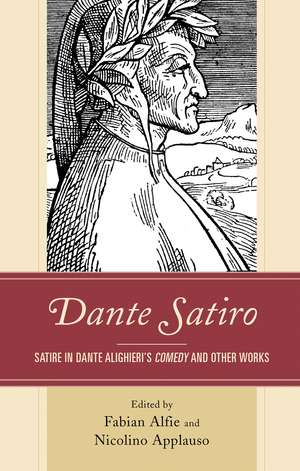
Dante Satiro: Satire in Dante Alighieri's Comedy and Other Works: Studies in Medieval Literature
Editat de Fabian Alfie, Nicolino Applausoen Limba Engleză Hardback – 19 mai 2020
Din seria Studies in Medieval Literature
- 18%
 Preț: 713.80 lei
 - 27%
 Preț: 256.91 lei
 - 36%
 Preț: 525.43 lei
 - 27%
 Preț: 270.03 lei
 -
 Preț: 255.81 lei
 - 26%
 Preț: 280.53 lei
 - 28%
 Preț: 222.91 lei
 - 34%
 Preț: 597.96 lei
 - 32%
 Preț: 490.04 lei
 - 32%
 Preț: 649.46 lei
 - 26%
 Preț: 258.91 lei
 - 36%
 Preț: 862.51 lei
 - 32%
 Preț: 536.49 lei
 - 32%
 Preț: 596.30 lei
 - 30%
 Preț: 536.95 lei
 - 29%
 Preț: 552.75 lei
Preț: 582.35 lei
Preț vechi: 863.44 lei
-33%
Puncte Express: 874
Carte tipărită la comandă
Livrare economică 04-18 decembrie
Livrare prin curier în România Termenul estimat este afișat lângă disponibilitate.
Transport gratuit pentru acest produs Plată online sau ramburs, în funcție de opțiunile comenzii.
Retur gratuit în 14 zile Comandă securizată și suport în română.
Specificații
ISBN-13: 9781793621719
ISBN-10: 1793621713
Pagini: 262
Dimensiuni: 161 x 228 x 21 mm
Greutate: 0.48 kg
Editura: Bloomsbury Publishing
Colecția Lexington Books
Seria Studies in Medieval Literature
Locul publicării:New York, United States
ISBN-10: 1793621713
Pagini: 262
Dimensiuni: 161 x 228 x 21 mm
Greutate: 0.48 kg
Editura: Bloomsbury Publishing
Colecția Lexington Books
Seria Studies in Medieval Literature
Locul publicării:New York, United States
Descriere
This collection of essays is the first comprehensive study on Dante and satire within his entire corpus that has been published. Its title evokes the moment when Virgil leads Dante through Limbo, the uppermost portion of Hell. There, they are joined by four classical poets, and Virgil describes one of them as "Horace the satirist" ("Orazio satiro," 4:89). By applying the expression to Dante himself, this volume seeks to explore the satirical elements in his works. Although Dante is not typically described as a satirist, anyone familiar with his works will recognize the strong satirical element in his many writings. Ultimately, this study shows that Dante engages in satire in order to attain the primary literary tool at his disposal for his prophetic objectives: the castigation of vice.
Cuprins
Introduction: Dante Satiro - Fabian Alfie and Nicolino Applauso
Part 1: Satire in Dante's Commedia
Chapter 1: The Ontoso Metro of Dante's Sinners: Inferno 7 - Franco Suitner
Chapter 2: Inverted Popes, the Apostolic Succession, and Dante's Vocation as Satirist - Ronald L. Martinez
Chapter 3: "Ed elli avea del cul fatto trombetta" (Inferno 21.139): Satire and Sodomy in Dante's Inferno - Mary Watt
Chapter 4: "Se io mi trascoloro, non ti maravigliar": Peter's Invective and colores rhetorici in Paradiso 27 - Maggie Fritz-Morkin
Part 2: Satire in Dante's Minor Works
Chapter 5: "Ut exinde potionare possimus dolcissimum ydromellum" (DVE 1.1.1): 'Dante Satiro' and the De vulgari eloquentia - Anthony Nussmeier
Chapter 6: Invective and Emotional Tones in Dante's Convivio - Beatrice Arduini
Chapter 7: The Conundrum of Genre: Dante's "Doglia mi reca" - Fabian Alfie
Chapter 8: Scelestissimis fiorentinis: Violence, Satire, and Prophecy in the ars dictaminis and Dante's Political Epistles - Nicolino Applauso
C
Part 1: Satire in Dante's Commedia
Chapter 1: The Ontoso Metro of Dante's Sinners: Inferno 7 - Franco Suitner
Chapter 2: Inverted Popes, the Apostolic Succession, and Dante's Vocation as Satirist - Ronald L. Martinez
Chapter 3: "Ed elli avea del cul fatto trombetta" (Inferno 21.139): Satire and Sodomy in Dante's Inferno - Mary Watt
Chapter 4: "Se io mi trascoloro, non ti maravigliar": Peter's Invective and colores rhetorici in Paradiso 27 - Maggie Fritz-Morkin
Part 2: Satire in Dante's Minor Works
Chapter 5: "Ut exinde potionare possimus dolcissimum ydromellum" (DVE 1.1.1): 'Dante Satiro' and the De vulgari eloquentia - Anthony Nussmeier
Chapter 6: Invective and Emotional Tones in Dante's Convivio - Beatrice Arduini
Chapter 7: The Conundrum of Genre: Dante's "Doglia mi reca" - Fabian Alfie
Chapter 8: Scelestissimis fiorentinis: Violence, Satire, and Prophecy in the ars dictaminis and Dante's Political Epistles - Nicolino Applauso
C
Recenzii
The essays in this volume examine satire in Dante's Divine Comedy, lyric poetry, and prose works. Alfie (Univ. of Arizona) and Applauso (Loyola Univ. Maryland) understand satire as "the genre dedicated to the reprehension of vice" (p. 3). The editors' introduction will be much appreciated since it both positions the volume within Dante criticism and provides a brief accessible overview of medieval European understandings of satire. The volume is divided into two parts: the first (four essays) focuses on the Comedy, and the second (also four essays) looks at satire in the minor works. Highlights among the essays include a reassessment of Paradiso 27 by Maggie Fritz-Morkin (Univ. of North Carolina at Chapel Hill) and a novel analysis of satire in the De vulgari eloquentia by Anthony Nussmeier (Univ. of Dallas). The volume finishes with a lighthearted essay by Arielle Saiber (Bowdoin College) exploring how Dante has become an enduring reference in modern popular culture and humor. Summing Up: Recommended. Upper-division undergraduates through faculty.
A well-rounded study that fleshes out one of the most contemporary aspects of Dante's work: its use of satire as a means to reprehend vice and establish ethical values. Alfie and Applauso have put together an excellent volume with international reach, probing the classical, medieval, and ever-current aspects of the great poet's satirical art. From the rotten pit of Hell to the celestial heights of Paradise, Dante spares no one and pulls no punches, targeting popes and emperors in both the Divine Comedy and his other works. Dante Satiro collects captivating readings by top Dante scholars, each of whom offers a compelling analysis of satire from the Middle Ages to its resonances with today's media satirists: seven hundred years after his death, Dante is alive and well. Indeed, as one contributor to this volume reminds us, we should keep in mind Osip Mandelstam's words: "It is unthinkable to read the cantos of Dante without aiming them in the direction of the present day . They are missiles for capturing the future."
We all know a lot about Dante "comico" and his style. But on the other hand no one has ever tried to read his works as belonging to satirical genre, as if he used the poetic code as a way to struggle with the vices of his time. This is what Dante Satiro: Satire in Dante Alighieri's Comedy and Other Works is made up of for the first time, not only relating to his masterpiece (the Commedia), but also looking for a satirical tone where it's not expected, like in the linguistic treaty De vulgari eloquentia, or pointing out his influence on contemporary satire.
A well-rounded study that fleshes out one of the most contemporary aspects of Dante's work: its use of satire as a means to reprehend vice and establish ethical values. Alfie and Applauso have put together an excellent volume with international reach, probing the classical, medieval, and ever-current aspects of the great poet's satirical art. From the rotten pit of Hell to the celestial heights of Paradise, Dante spares no one and pulls no punches, targeting popes and emperors in both the Divine Comedy and his other works. Dante Satiro collects captivating readings by top Dante scholars, each of whom offers a compelling analysis of satire from the Middle Ages to its resonances with today's media satirists: seven hundred years after his death, Dante is alive and well. Indeed, as one contributor to this volume reminds us, we should keep in mind Osip Mandelstam's words: "It is unthinkable to read the cantos of Dante without aiming them in the direction of the present day . They are missiles for capturing the future."
We all know a lot about Dante "comico" and his style. But on the other hand no one has ever tried to read his works as belonging to satirical genre, as if he used the poetic code as a way to struggle with the vices of his time. This is what Dante Satiro: Satire in Dante Alighieri's Comedy and Other Works is made up of for the first time, not only relating to his masterpiece (the Commedia), but also looking for a satirical tone where it's not expected, like in the linguistic treaty De vulgari eloquentia, or pointing out his influence on contemporary satire.