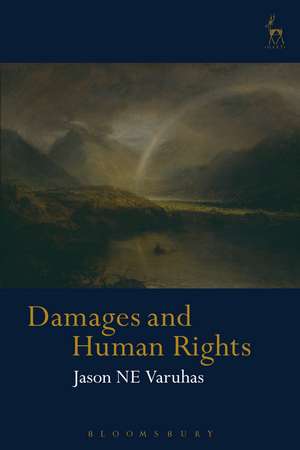
Damages and Human Rights
Autor Professor Jason NE Varuhasen Limba Engleză Paperback – noi 2018
This book explores the theoretical foundations of human rights damages and examines when such damages ought to be awarded, how they ought to be assessed, and the range of damages that ought to be available to remedy a rights-breach.
Preț: 486.45 lei
Preț vechi: 702.49 lei
-31%
Puncte Express: 730
Carte tipărită la comandă
Livrare economică 09-23 iunie
Specificații
ISBN-13: 9781509924448
ISBN-10: 1509924442
Pagini: 552
Dimensiuni: 156 x 234 x 28 mm
Greutate: 0.77 kg
Ediția:NIPPOD
Editura: Bloomsbury Publishing
Colecția Hart Publishing
Locul publicării:London, United Kingdom
ISBN-10: 1509924442
Pagini: 552
Dimensiuni: 156 x 234 x 28 mm
Greutate: 0.77 kg
Ediția:NIPPOD
Editura: Bloomsbury Publishing
Colecția Hart Publishing
Locul publicării:London, United Kingdom
V-ar putea interesa
-
 Terrorism Documents of International and Local Control: Volume 88Douglas C Jr Lovelace-29%Preț: 510.98 lei722.30 lei
 -
 -35%Preț: 1219.40 lei1876.55 lei
 -
 -6%Preț: 177.96 lei188.82 lei
 -
 On Fantasy Island: Britain, Europe, and Human RightsConor Gearty-23%Preț: 273.39 lei354.94 lei
 -
 -34%Preț: 888.39 lei1343.92 lei
 -
 Preț: 330.23 lei
 -
 Economic Rights: Conceptual, Measurement, and Policy IssuesShareen HertelPreț: 383.82 lei
 -
 -19%Preț: 530.75 lei655.24 lei
 -
 Discrimination, Copyright and EqualityPaul Harpur-20%Preț: 447.57 lei559.64 lei
 -
 -14%Preț: 856.56 lei996.00 lei
 -
 Anti-Impunity and the Human Rights AgendaKaren Engle-17%Preț: 268.34 lei322.07 lei
 -
 The Child in International Refugee LawJason M. PobjoyPreț: 399.01 lei
 -
 Equitable Compensation and Disgorgement of ProfitProfessor Simone Degeling-34%Preț: 739.55 lei1114.73 lei
 -
 -33%Preț: 744.16 lei1117.57 lei
 -
 Remedies for Breach of PrivacyProfessor Jason NE Varuhas-39%Preț: 625.42 lei1024.80 lei
 -
 The Age of Dignity: Human Rights and Constitutionalism in EuropeDr Catherine Dupré-27%Preț: 205.12 lei279.41 lei
 -
 -24%Preț: 259.91 lei342.73 lei
 -
 Reed and Murdoch: Human Rights Law in ScotlandJim L Murdoch-22%Preț: 876.68 lei1129.44 lei
 -
 The Rule of Law, Freedom of Expression and Islamic LawProfessor Hossein Esmaeili-34%Preț: 587.69 lei884.41 lei
 -
 Securing LegalityDr Liora Lazarus-26%Preț: 244.60 lei330.67 lei
 -
 Security and Human RightsBenjamin J Goold-29%Preț: 337.53 lei473.49 lei
 -
 Governing (Through) RightsBal Sokhi-Bulley-31%Preț: 480.46 lei698.93 lei
 -
 -34%Preț: 554.88 lei836.83 lei
Cuprins
1. Introduction
Part 1: A Tort-Based Approach to Damages for Human Rights Breaches
2. The Tort Framework
3. A Tort-Based Approach to Human Rights Damages
Part 2: Human Rights Damages and the Public Law - Private Law Distinction
4. The Public Law - Private Law Distinction
SECTION 1. THE PUBLIC LAW - PRIVATE LAW DISTINCTION AS A TOOL FOR LEGAL DEVELOPMENT
SECTION 2. THE PUBLIC LAW - PRIVATE LAW DISTINCTION AND HUMAN RIGHTS DAMAGES
Part 3: Alternative Approaches to Damages for Human Rights Breaches
5. Human Rights Damages and 'Just Satisfaction' :
SECTION 1. THE TERMS OF THE HRA
SECTION 2. THE SUPRANATIONAL DIMENSION
SECTION 3. THE METHODOLOGY OF THE MIRROR APPROACH
SECTION 4. THE FUTURE OF THE MIRROR APPROACH POST- FAULKNER
SECTION 5. OVERVIEW
6. Interest-Balancing Approaches
SECTION 1: DOCTRINAL ANALYSIS OF THE INTEREST-BALANCING APPROACH
SECTION 2: NORMATIVE ANALYSIS OF THE INTEREST-BALANCING APPROACH
SECTION 3. CONCLUSIONS
7. Other Methods of Limiting Human Rights Damages
8. Conclusion
Part 1: A Tort-Based Approach to Damages for Human Rights Breaches
2. The Tort Framework
3. A Tort-Based Approach to Human Rights Damages
Part 2: Human Rights Damages and the Public Law - Private Law Distinction
4. The Public Law - Private Law Distinction
SECTION 1. THE PUBLIC LAW - PRIVATE LAW DISTINCTION AS A TOOL FOR LEGAL DEVELOPMENT
SECTION 2. THE PUBLIC LAW - PRIVATE LAW DISTINCTION AND HUMAN RIGHTS DAMAGES
Part 3: Alternative Approaches to Damages for Human Rights Breaches
5. Human Rights Damages and 'Just Satisfaction' :
SECTION 1. THE TERMS OF THE HRA
SECTION 2. THE SUPRANATIONAL DIMENSION
SECTION 3. THE METHODOLOGY OF THE MIRROR APPROACH
SECTION 4. THE FUTURE OF THE MIRROR APPROACH POST- FAULKNER
SECTION 5. OVERVIEW
6. Interest-Balancing Approaches
SECTION 1: DOCTRINAL ANALYSIS OF THE INTEREST-BALANCING APPROACH
SECTION 2: NORMATIVE ANALYSIS OF THE INTEREST-BALANCING APPROACH
SECTION 3. CONCLUSIONS
7. Other Methods of Limiting Human Rights Damages
8. Conclusion
Recenzii
Public lawyers and private lawyers (if that distinction has real meaning), human-rights lawyers and legal theorists, and everyone with an interest in having a principled regime for making ubi ius, ibi remedium a practical reality, will find much food for thought in the book; even those who reject the conclusions will benefit from having to confront the manifest strengths of the argument. The book will quickly become the standard point of reference in its field. It is a pleasure to congratulate Dr Varuhas on this sustained, intellectually powerful and practically important piece of legal scholarship, and to commend it to the many readers, in many parts of the world, where it will, I hope, stimulate new approaches to the practice and theory of the subject.
a significant work of original scholarship (...) I cannot help but to have the feeling that the book is destined to be instrumental in changing the perception of human rights as lying in a realm of public law, and of tort as lying in a separate realm of private law (...) On any view, this is a book that is likely to be read, widely and often.
...a thought-provoking book which represents a valuable contribution to legal scholarship. It treats a subject of significance to lawyers, to judges and, most importantly, to those who wish to use the law to protect and vindicate their human rights.
Varuhas cites several cases which I decided at first instance. If I had had the benefit of some of his arguments, I might have made different decisions in some of those cases, and given better reasons in others. Any advocate or court considering these arguments will be greatly indebted to this scholarly, comprehensive and thoughtful work.
a significant work of original scholarship (...) I cannot help but to have the feeling that the book is destined to be instrumental in changing the perception of human rights as lying in a realm of public law, and of tort as lying in a separate realm of private law (...) On any view, this is a book that is likely to be read, widely and often.
...a thought-provoking book which represents a valuable contribution to legal scholarship. It treats a subject of significance to lawyers, to judges and, most importantly, to those who wish to use the law to protect and vindicate their human rights.
Varuhas cites several cases which I decided at first instance. If I had had the benefit of some of his arguments, I might have made different decisions in some of those cases, and given better reasons in others. Any advocate or court considering these arguments will be greatly indebted to this scholarly, comprehensive and thoughtful work.