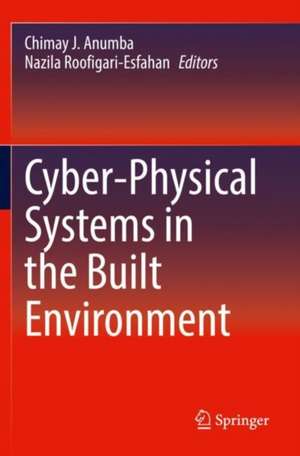
Cyber-Physical Systems in the Built Environment
Editat de Chimay J. Anumba, Nazila Roofigari-Esfahanen Limba Engleză Paperback – 29 mai 2021
This book introduces researchers and practitioners to Cyber-Physical Systems (CPS) and its applications in the built environment. It begins with a fundamental introduction to CPS technology and associated concepts.It then presents numerous examples of applications from managing construction projects to smart transportation systems and smart cities. It concludes with a discussion of future directions for CPS deployment in the construction, operation and maintenance of constructed facilities. Featuring internationally recognized experts as contributors, Cyber-Physical Systems in the Built Environment, is an ideal resource for engineers, construction managers, architects, facilities managers, and planners working on a range of building and civil infrastructure projects.
Preț: 558.49 lei
Preț vechi: 689.49 lei
-19%
Puncte Express: 838
Carte tipărită la comandă
Livrare economică 04-10 iunie
Specificații
ISBN-13: 9783030415624
ISBN-10: 3030415627
Pagini: 376
Ilustrații: XV, 359 p. 172 illus., 137 illus. in color.
Dimensiuni: 155 x 235 x 20 mm
Greutate: 0.65 kg
Ediția:1st edition 2020
Editura: Springer
Locul publicării:Cham, Switzerland
ISBN-10: 3030415627
Pagini: 376
Ilustrații: XV, 359 p. 172 illus., 137 illus. in color.
Dimensiuni: 155 x 235 x 20 mm
Greutate: 0.65 kg
Ediția:1st edition 2020
Editura: Springer
Locul publicării:Cham, Switzerland
V-ar putea interesa
-
 Cyber Physical Systems: Architectures, Protocols and ApplicationsChi (Harold) Liu-20%Preț: 501.83 lei627.28 lei
 -
 Design-Tech: Building Science for ArchitectsJason Alread-8%Preț: 450.24 lei489.39 leiRecomandat
 -
 Construction Project ManagementS Keoki Sears-11%Preț: 602.55 lei677.02 lei
 -
 -19%Preț: 427.71 lei528.03 lei
 -
 Managing Construction TechnologyKurt Maldovan-19%Preț: 426.42 lei526.44 lei
 -
 Construction Project Scheduling and ControlSaleh A. Mubarak-23%Preț: 812.65 lei1055.39 lei
 -
 -23%Preț: 1189.60 lei1544.93 lei
 -
 -24%Preț: 1772.14 lei2331.77 lei
 -
 Emergence of Cyber Physical System and IoT in Smart Automation and RoboticsKrishna Kant Singh-18%Preț: 1318.19 lei1607.55 lei
 -
 -15%Preț: 619.69 lei729.05 lei
 -
 -18%Preț: 1511.85 lei1843.72 lei
 -
 Machine Learning for Cyber-Physical SystemsOliver NiggemannPreț: 302.87 lei
 -
 Cyber-Physical SystemsAlla G. Kravets-18%Preț: 1074.34 lei1310.17 lei
 -
 Sustainable Smart Cities 2.0Priyanka Mishra-24%Preț: 773.56 lei1017.85 lei
 -
 -20%Preț: 511.28 lei639.09 lei
 -
 -18%Preț: 913.62 lei1114.17 lei
 -
 Innovations in Cyber Physical SystemsJawar Singh-24%Preț: 1292.22 lei1700.29 lei
 -
 Data-Driven Cyber Physical SystemsFangyu Li-18%Preț: 969.72 lei1182.58 lei
 -
 -18%Preț: 973.96 lei1187.76 lei
Cuprins
Fundamentals of Cyber Physical Systems.- Technology Requirements for CPS.- CPS Use in Other Industries.- CPS-Based Approach to improve management of Heavy Construction Projects.- Progress Monitoring using CPS.- Human-in-the-Loop Cyber-Physical Systems (HiLCPS) for Safer Construction Sites.- Cyber-physical systems for temporary structure monitoring.- Cyber-Physical Systems (CPS) in Intelligent Crane Operations.- Smart Construction Objects.- A Computational Framework for Improved Building Energy Estimation using Occupant Behavior Sensing and Agent Simulation.- Model Checking a Temporary Structures Monitoring System: A Case Study.- Structural-infrastructure Health Monitoring.- Smart Transportation Systems.- Industry Case Studies.- Cyber-Social Physical Systems.- CPS in Future Homes.- Role of CPS in Smart Cities.- Conclusions and Future Directions for CPS in the Built Environment.
Notă biografică
Prof. Chinemelu J. Anumba is a Professor and Dean of the College of Design, Construction and Planning University of Florida, Gainesville FL.
Prof. Nazila Roofigari-Esfahan is an assistant professor in the Department of Building Construction, Myers-Lawson School of Construction at Virginia Tech, Blacksburg, VA.
Prof. Nazila Roofigari-Esfahan is an assistant professor in the Department of Building Construction, Myers-Lawson School of Construction at Virginia Tech, Blacksburg, VA.
Textul de pe ultima copertă
This book introduces researchers and practitioners to Cyber-Physical Systems (CPS) and its applications in the built environment. It begins with a fundamental introduction to CPS technology and associated concepts.It then presents numerous examples of applications from managing construction projects to smart transportation systems and smart cities. It concludes with a discussion of future directions for CPS deployment in the construction, operation and maintenance of constructed facilities. Featuring internationally recognized experts as contributors, Cyber-Physical Systems in the Built Environment, is an ideal resource for engineers, construction managers, architects, facilities managers, and planners working on a range of building and civil infrastructure projects.
-Introduces Cyber-Physical Systems (CPS) and its application to the built environment for the first time in book form;
-Introduces Cyber-Physical Systems (CPS) and its application to the built environment for the first time in book form;
-Contextualizes CPS with an overview of its fundamentals as well as applications in construction and civil engineering as well as other industries;
-Illuminates in the promise of CPS as an emerging technology with examples from many sectors as well as a discussion of future research.