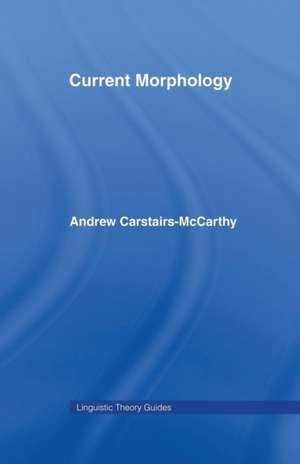
Current Morphology: Linguistic Theory Guides
Autor Andrew Carstairs-McCarthyen Limba Engleză Paperback – 8 mai 2015
Preț: 437.44 lei
Preț vechi: 514.64 lei
-15%
Puncte Express: 656
Carte tipărită la comandă
Livrare economică 07-21 decembrie
Livrare prin curier în România Termenul estimat este afișat lângă disponibilitate.
Transport gratuit pentru acest produs Plată online sau ramburs, în funcție de opțiunile comenzii.
Retur gratuit în 14 zile Comandă securizată și suport în română.
Specificații
ISBN-13: 9781138868410
ISBN-10: 1138868418
Pagini: 304
Dimensiuni: 138 x 216 x 20 mm
Greutate: 0.39 kg
Ediția:1
Editura: Taylor & Francis
Colecția Routledge
Seria Linguistic Theory Guides
Locul publicării:Oxford, United Kingdom
ISBN-10: 1138868418
Pagini: 304
Dimensiuni: 138 x 216 x 20 mm
Greutate: 0.39 kg
Ediția:1
Editura: Taylor & Francis
Colecția Routledge
Seria Linguistic Theory Guides
Locul publicării:Oxford, United Kingdom
V-ar putea interesa
-
 Type-theoretical GrammarAarne Ranta-35%Preț: 633.77 lei981.25 lei
 -
 Principles and Parameters: An Introduction to Syntactic TheoryPeter W. Culicover-27%Preț: 403.65 lei550.56 lei
 -
 Core Syntax: A Minimalist ApproachDavid Adger-11%Preț: 273.48 lei305.98 lei
 -
 Preț: 243.76 lei
 -
 Between You & MeMary NorrisPreț: 88.10 lei
 -
 Grammar and Context: An Advanced Resource BookAnn Hewings-15%Preț: 432.59 lei508.92 lei
 -
 -15%Preț: 455.36 lei535.71 lei
 -
 Exploring English Grammar: From formal to functionalCaroline CoffinPreț: 504.82 lei
 -
 English for Journalists: Twentieth Anniversary EditionWynford HicksPreț: 302.69 lei
 -
 Using ItalianJ. J. Kinder-19%Preț: 529.15 lei653.27 lei
 -
 An Introduction to Cognitive LinguisticsFriedrich Ungerer-15%Preț: 512.79 lei603.27 lei
 -
 Preț: 109.69 lei
 -
 Merriam-Webster's Guide to Punctuation and StyleMerriam-WebsterPreț: 37.76 lei
 -
 A Situated Theory of Agreement (RLE Linguistics B: Grammar)Michael BarlowPreț: 472.22 lei
 -
 Accessing Noun-Phrase AntecedentsMira ArielPreț: 472.48 lei
 -
 Categorial Grammars (RLE Linguistics B: Grammar)Mary McGee WoodPreț: 477.59 lei
 -
 Categorial Morphology (RLE Linguistics B: Grammar)Jack HoeksemaPreț: 464.26 lei
 -
 Preț: 311.10 lei
 -
 Preț: 464.26 lei
 -
 Other WordlyYee-Lum Mak-9%Preț: 72.31 lei79.89 lei
 -
 How Good Is Your Grammar?: (Probably Better Than You Think)John Sutherland-28%Preț: 64.80 lei90.51 lei
 -
 -10%Preț: 43.50 lei48.36 lei
 -
 Preț: 52.09 lei
 -
 The Elements of StyleStrunk Jr. WilliamPreț: 52.26 lei
 -
 Essential Japanese Kanji Volume 2: (JLPT Level N4 / AP Exam Prep) Learn the Essential Kanji Characters Needed for Everyday Interactions in JapanUniversity of Tokyo, Kanji Research GroupPreț: 116.37 lei
Recenzii
'It's a superb summary and guide to the literature, as well as being elegantly and clearly argued: the chapter on typology is as good as I can imagine a chapter being.' - Roger Lass, University of Capetown, South Africa
Cuprins
Part I INTRODUCTION 1 Aims and scope 2 Morphology and the lexicon Part II THE CHOMSKYAN IMPETUS IN MORPHOLOGICAL RESEARCH 3 Morphology and phonology 4 Morphology and syntax Part III OTHER IMPETUSES IN MORPHOLOGICAL RESEARCH 5 Typological and diachronic issues 6 Meaning-based approaches to morphology 7 Morphosyntactic properties and their realisation 8 Natural Morphology and related approaches Part IV CONCLUSIONS 9 What morphology can contribute to general linguistic theory
Notă biografică
Andrew Carstairs-McCarthy teaches linguistics at the University of Canterbury, Christchurch, New Zealand. He is the author of Allomorphy in Inflexion and is a regular contributor to linguistic journals.
Descriere
A comprehensive introduction to approaches to morphology in linguistic theory over the last twenty years. It highlights neglected European theoretical developments and discusses Chomskyan, generative and non-generative approaches.