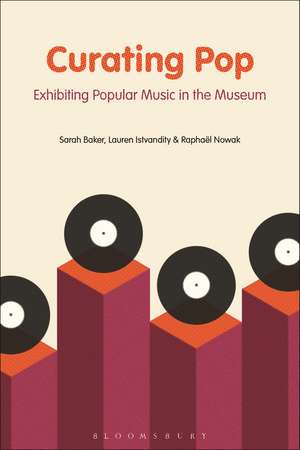
Curating Pop: Exhibiting Popular Music in the Museum
Autor Dr Sarah Baker, Dr. Lauren Istvandity, Dr. Raphaël Nowaken Limba Engleză Paperback – 27 iun 2019
Preț: 178.77 lei
Preț vechi: 238.72 lei
-25%
Puncte Express: 268
Carte tipărită la comandă
Livrare economică 23 noiembrie-07 decembrie
Livrare prin curier în România Termenul estimat este afișat lângă disponibilitate.
Transport gratuit de la 400.00 lei Plată online sau ramburs, în funcție de opțiunile comenzii.
Retur gratuit în 14 zile Comandă securizată și suport în română.
Specificații
ISBN-13: 9781501343582
ISBN-10: 1501343580
Pagini: 192
Dimensiuni: 146 x 226 x 14 mm
Greutate: 0.32 kg
Editura: Bloomsbury Publishing
Colecția Bloomsbury Academic
Locul publicării:New York, United States
ISBN-10: 1501343580
Pagini: 192
Dimensiuni: 146 x 226 x 14 mm
Greutate: 0.32 kg
Editura: Bloomsbury Publishing
Colecția Bloomsbury Academic
Locul publicării:New York, United States
V-ar putea interesa
-
 Light My Fire - My Life With The DoorsRay Manzarek-18%Preț: 76.91 lei94.14 lei
 -
 Wonderland Avenue: Tales of Glamour and ExcessDanny Sugerman-26%Preț: 79.30 lei106.94 lei
 -
 Music Video and the Politics of RepresentationDiane Railton-17%Preț: 178.19 lei214.92 lei
 -
 Jethro Tull's AqualungProfessor Allan Moore-32%Preț: 51.50 lei76.16 lei
 -
 The Afghan Whigs' GentlemenBob Gendron-33%Preț: 50.87 lei75.90 lei
 -
 Pavement's Wowee ZoweeBryan Charles-33%Preț: 50.58 lei75.08 lei
 -
 Little Richard: The Birth of Rock 'n' RollDavid Kirby-38%Preț: 216.34 lei347.76 lei
 -
 -39%Preț: 155.44 lei253.67 lei
 -
 Jeff Beck: Crazy FingersAnnette CarsonPreț: 115.50 lei
 -
 Shed Bashing with the BeatlesPhilip David MathisonPreț: 75.59 lei
 -
 -17%Preț: 109.18 lei131.22 lei
 -
 Reverberations of Dissent: Identity and Expression in Iran's Illegal Music SceneDr. Bronwen Robertson-16%Preț: 255.87 lei303.86 lei
 -
 Dinosaur Jr.'s You're Living All Over MeNick Attfield-33%Preț: 50.48 lei75.01 lei
 -
 Portishead's DummyR.J. Wheaton-30%Preț: 53.97 lei77.60 lei
 -
 Stop! Look! Listen!MR Tony DeatonPreț: 82.12 lei
 -
 Bad Moon RisingHank BordowitzPreț: 135.31 lei
 -
 -33%Preț: 50.27 lei75.09 lei
 -
 Preț: 108.29 lei
 -
 Close to the EdgeChris WelchPreț: 112.27 lei
 -
 Preț: 108.17 lei
 -
 Making of U2s the Joshua TreeDave Thompson-5%Preț: 46.64 lei49.20 lei
Cuprins
List of figures and tables
Acknowledgments
1. Curatorial practice in popular music museums: an introduction
2. Canonic representations: the celebration of dominant (and hidden) histories
3. Selling the museum experience: curation, economies, and visitor experience
4. Popular music and place: local, national and global stories
5. Treating objects like art: curating material culture
6. Telling stories: narratives of popular music's past
7. Curator subjectivity: influence and bias in popular music exhibitions
8. Living history: nostalgia as affective curatorial practice
9. Managing the music: Sound in the popular music museum
10. Beyond the typology: concluding thoughts
References
Index
Museums covered:
Country Music Hall of Fame and Museum (Nashville, United States)
Arts Centre Melbourne (Melbourne, Australia)
KD's Elvis Presley Museum (Hawera, North Island, New Zealand)
Powerhouse Museum (Sydney, Australia)
Australian Country Music Hall of Fame (Tamworth, Australia)
Rock and Roll Hall of Fame and Museum (Cleveland, United States)
Georgia Music Hall of Fame (Macon, United States)
Experience Music Project (EMP) (Seattle, United States)
Heart of Texas Country Music Museum (Brady, United States)
PopMuseum (Prague, Czech Republic)
Hector Country Music Museum (Hector, South Island, New Zealand)
Museum RockArt (Hoek van Holland, the Netherlands)
Reykjanes Museum of Heritage (Reykjanes Peninsula, Iceland)
Ramones Museum (Berlin, Germany)
Nederlands Instituut voor Beeld en Geluid (Hilversum, the Netherlands)
The Grammy Museum (Los Angeles, United States)
British Music Experience (BME) (London, United Kingdom)
Tónlistarsafn Íslands (Kópavogur, Iceland)
National Museum of African American Music (Nashville, United States)
Acknowledgments
1. Curatorial practice in popular music museums: an introduction
2. Canonic representations: the celebration of dominant (and hidden) histories
3. Selling the museum experience: curation, economies, and visitor experience
4. Popular music and place: local, national and global stories
5. Treating objects like art: curating material culture
6. Telling stories: narratives of popular music's past
7. Curator subjectivity: influence and bias in popular music exhibitions
8. Living history: nostalgia as affective curatorial practice
9. Managing the music: Sound in the popular music museum
10. Beyond the typology: concluding thoughts
References
Index
Museums covered:
Country Music Hall of Fame and Museum (Nashville, United States)
Arts Centre Melbourne (Melbourne, Australia)
KD's Elvis Presley Museum (Hawera, North Island, New Zealand)
Powerhouse Museum (Sydney, Australia)
Australian Country Music Hall of Fame (Tamworth, Australia)
Rock and Roll Hall of Fame and Museum (Cleveland, United States)
Georgia Music Hall of Fame (Macon, United States)
Experience Music Project (EMP) (Seattle, United States)
Heart of Texas Country Music Museum (Brady, United States)
PopMuseum (Prague, Czech Republic)
Hector Country Music Museum (Hector, South Island, New Zealand)
Museum RockArt (Hoek van Holland, the Netherlands)
Reykjanes Museum of Heritage (Reykjanes Peninsula, Iceland)
Ramones Museum (Berlin, Germany)
Nederlands Instituut voor Beeld en Geluid (Hilversum, the Netherlands)
The Grammy Museum (Los Angeles, United States)
British Music Experience (BME) (London, United Kingdom)
Tónlistarsafn Íslands (Kópavogur, Iceland)
National Museum of African American Music (Nashville, United States)
Recenzii
[Contributes] to an ongoing body of academic knowledge, in generating typologies that would be useful for further research.
Research across an impressive global sample of nineteen museums and their staff forms the basis of Curating Pop, a comprehensive and critical examination of the range of policies and practices used in the curation of popular music. This vital and authoritative survey has both depth and breadth, shaping a rich combination of overview with critical insight into why popular music matters, and how we should manage it. Curating Pop demonstrates how popular music has found its place within authorised and "DIY" heritage institutions and in cultural discourse more broadly. This excellent and important book, and the typology of approaches it presents, will shape practice for years to come.
Whether you're delighted or mystified by the continuing rise of exhibitions centred around popular music, this book is for you. Using personal reflections from curators across the globe, Curating Pop cleverly unpacks the myriad challenges and rewards involved in getting mute objects to 'sing'.
As this book argues, popular music has found its place amidst the heritage sector, in innovative exhibitions in which materials are presented and preserved across a variety of museums and archives. However, as the authors demonstrate, the mediation of pop as heritage object raises questions about the security of its cultural value as it becomes subject to a range of curatorial responses, institutional challenges and economic insecurities.
In their approach to this fascinating subject, Baker, Istvandity and Nowack are admirably clear in purpose and systematic in their exploration of curatorial approaches to pop. The authors survey an impressive range of secondary material drawn from a rapidly growing field that will aid any reader's understanding of issues in popular music heritage and its place in the museum. This material is allied with a wealth of insightful and candid interviews with curators who reflect on their motives and work. They are afforded space for expression and in turn provide readers with a valuable resource for examining this practice. Attuned to the dispositions and storytelling role of curators, the book relates the ways in which they manage the weight of the canon or seek to expose other, hidden histories as they deal with the politics of pop, its prejudices and pleasures. Analysis is concerned as much with the commercial pressures of managing music exhibitions as it is with with the lure of nostalgia or the challenges of how sound plays a part (or does not) in the creative work of curators.
Offering much to think about and with, this work will appeal to museologists (old and new), as much as musicians, museum-goers and music consumers alike.
After decades of curating pop - in documentaries, archives and magazines - this book brings vital reflections about structuring concepts in curatorial practice. Based on earlier research on the topic and interviews with pop museum professionals, Curating Pop is a timely, sobering and inspiring read.
Research across an impressive global sample of nineteen museums and their staff forms the basis of Curating Pop, a comprehensive and critical examination of the range of policies and practices used in the curation of popular music. This vital and authoritative survey has both depth and breadth, shaping a rich combination of overview with critical insight into why popular music matters, and how we should manage it. Curating Pop demonstrates how popular music has found its place within authorised and "DIY" heritage institutions and in cultural discourse more broadly. This excellent and important book, and the typology of approaches it presents, will shape practice for years to come.
Whether you're delighted or mystified by the continuing rise of exhibitions centred around popular music, this book is for you. Using personal reflections from curators across the globe, Curating Pop cleverly unpacks the myriad challenges and rewards involved in getting mute objects to 'sing'.
As this book argues, popular music has found its place amidst the heritage sector, in innovative exhibitions in which materials are presented and preserved across a variety of museums and archives. However, as the authors demonstrate, the mediation of pop as heritage object raises questions about the security of its cultural value as it becomes subject to a range of curatorial responses, institutional challenges and economic insecurities.
In their approach to this fascinating subject, Baker, Istvandity and Nowack are admirably clear in purpose and systematic in their exploration of curatorial approaches to pop. The authors survey an impressive range of secondary material drawn from a rapidly growing field that will aid any reader's understanding of issues in popular music heritage and its place in the museum. This material is allied with a wealth of insightful and candid interviews with curators who reflect on their motives and work. They are afforded space for expression and in turn provide readers with a valuable resource for examining this practice. Attuned to the dispositions and storytelling role of curators, the book relates the ways in which they manage the weight of the canon or seek to expose other, hidden histories as they deal with the politics of pop, its prejudices and pleasures. Analysis is concerned as much with the commercial pressures of managing music exhibitions as it is with with the lure of nostalgia or the challenges of how sound plays a part (or does not) in the creative work of curators.
Offering much to think about and with, this work will appeal to museologists (old and new), as much as musicians, museum-goers and music consumers alike.
After decades of curating pop - in documentaries, archives and magazines - this book brings vital reflections about structuring concepts in curatorial practice. Based on earlier research on the topic and interviews with pop museum professionals, Curating Pop is a timely, sobering and inspiring read.
Notă biografică
Sarah Baker is Professor in Cultural Sociology at Griffith University in Queensland, Australia. She is the author of Creative Labour: Media Work in Three Cultural Industries (2011), Teaching Youth Studies Through Popular Culture (2014), Community Custodians of Popular Music's Past: A DIY Approach to Heritage (2017) and the editor of Redefining Mainstream Popular Music (2013), Youth Cultures and Subcultures: Australian Perspectives(2015), Preserving Popular Music Heritage: Do-it-Yourself, Do-It-Together(2015), The Routledge Companion to Popular Music History and Heritage (2018) and Remembering Popular Music's Past: Memory-Heritage-History (2019).