
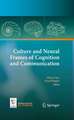
Culture and Neural Frames of Cognition and Communication: On Thinking, cartea 3
Editat de Shihui Han, Ernst Pöppelen Limba Engleză Hardback – 5 ian 2011
| Toate formatele și edițiile | Preț | Express |
|---|---|---|
| Paperback (1) | 1327.75 lei 6-8 săpt. | |
| Springer Berlin, Heidelberg – 27 feb 2013 | 1327.75 lei 6-8 săpt. | |
| Hardback (1) | 1332.46 lei 6-8 săpt. | |
| Springer Berlin, Heidelberg – 5 ian 2011 | 1332.46 lei 6-8 săpt. |

Preț: 1332.46 lei
Preț vechi: 1624.95 lei
-18% Nou
Puncte Express: 1999
Preț estimativ în valută:
235.77€ • 276.85$ • 206.95£
235.77€ • 276.85$ • 206.95£
Carte tipărită la comandă
Livrare economică 27 ianuarie-10 februarie 26
Preluare comenzi: 021 569.72.76
Specificații
ISBN-13: 9783642154225
ISBN-10: 3642154220
Pagini: 312
Ilustrații: XII, 314 p.
Dimensiuni: 155 x 235 x 28 mm
Greutate: 0.6 kg
Ediția:2011
Editura: Springer Berlin, Heidelberg
Colecția Springer
Seria On Thinking
Locul publicării:Berlin, Heidelberg, Germany
ISBN-10: 3642154220
Pagini: 312
Ilustrații: XII, 314 p.
Dimensiuni: 155 x 235 x 28 mm
Greutate: 0.6 kg
Ediția:2011
Editura: Springer Berlin, Heidelberg
Colecția Springer
Seria On Thinking
Locul publicării:Berlin, Heidelberg, Germany
V-ar putea interesa
-
 Brain On Fire: My Month of MadnessSusannah Cahalan-21%Preț: 59.76 lei75.26 lei
 -
 Corticospinal Function and Voluntary MovementRobert Porter-27%Preț: 769.12 lei1055.90 lei
 -
 Calcium Ions in Nerve Cell FunctionPlaton G. Kostyuk-50%Preț: 556.07 lei1101.35 lei
 -
 -27%Preț: 493.65 lei672.88 lei
 -
 The Autisms: Molecules to Model SystemsCraig M. Powell-35%Preț: 1230.59 lei1884.11 lei
 -
 Brain Aromatase, Estrogens, and BehaviorJacques Balthazart-35%Preț: 864.06 lei1323.69 lei
 -
 Brain, Mind, and the Structure of RealityPaul L. Nunez-18%Preț: 336.59 lei412.35 lei
 -
 Incomplete Nature – How Mind Emerged from MatterTerrence W. DeaconPreț: 271.63 lei
 -
 Preț: 108.76 lei
 -
 Metabolic Basis of ObesityRexford S. Ahima-5%Preț: 754.51 lei794.23 lei
 -
 -15%Preț: 631.23 lei742.62 lei
 -
 -30%Preț: 1117.46 lei1606.08 lei
 -
 Language and Action in Cognitive NeuroscienceYann Coello-18%Preț: 1022.09 lei1246.45 lei
 -
 -18%Preț: 1081.48 lei1318.88 lei
 -
 -18%Preț: 915.29 lei1116.22 lei
Public țintă
ResearchCuprins
Neuroplasticity: Biological Evolution’s Contribution to Cultural Evolution .- Cultural Neuroscience of Social Cognition.- The Brain and Its Self: Concepts of Self and the Cortical Midline Structures.- Self Identity in Sociocultural Contexts: Implications from Studies of Self-face Recognition.- The Relation Between the Self and Others: A Transcultural Neuroimaging Approach.- Unconscious Self-processing: Subconscious, Unintentional or Subliminal?.- Brain, Behavior, and Culture: Insights from Cognition, Perception, and Emotion.- Psychological Time, Time Perspective, Culture and Conflict Resolution.- Co-creation Systems: Ma and Communication.- Hearing Loss and Auditory Processing Disorders: Clinical and Experimental Perspectives.- Broca’s Area: Linking Perception and Production in Language and Actions.- Language Attrition and Identity.- The Logic of Constellations: A Complementary Mode of Thinking that is Crucial for Understanding How Reality Actually Takes Place.- Three Modes of Knowledge as Basis for Intercultural Cognition and Communication: A Theoretical Perspective.- Two Modes of Thinking: Evidence from Cross-Cultural Psychology.- Outcome Evaluation in Decision Making: ERP Studies.- Mindfulness in Leadership: Does Being Mindful Enhance Leaders’ Business Success?
Textul de pe ultima copertă
Cultural neuroscience combines brain imaging techniques such as functional magnetic resonance imaging and event-related brain potentials with methods of social and cultural psychology to investigate whether and how cultures influence the neural mechanisms of perception, attention, emotion, social cognition, and other human cognitive processes. The findings of cultural neuroscience studies improve our understanding of the relation between human brain function and sociocultural contexts and help to reframe the “big question” of nature versus nurture. This book is organized so that two chapters provide general views of the relation between biological evolution, cultural evolution and recent cultural neuroscience studies, while other chapters focus on several aspects of human cognition that have been shown to be strongly influenced by sociocultural factors such as self-concept representation, language processes, emotion, time perception, and decision-making. The main goal of this work is to address how thinking actually takes place and how the underlying neural mechanisms are affected by culture and identity.
Caracteristici
Discusses the cultural influences on human cognition and the underlying neural mechanisms Gives general views of the relation between biological evolution and cultural evolution and recent cultural neuroscience studies Focuses on aspects of human cognition that have been shown to be strongly influenced by sociocultural factors Includes supplementary material: sn.pub/extras