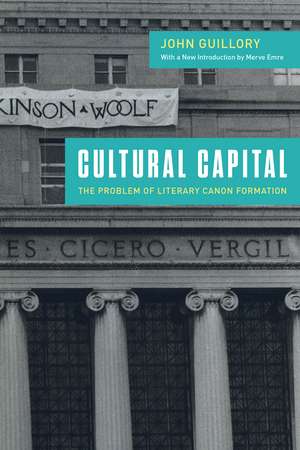
Cultural Capital: The Problem of Literary Canon Formation
Autor Professor John Guillory Introducere de Merve Emreen Limba Engleză Paperback – 21 oct 2023
Recomandăm această ediție aniversară, în format paperback, a lucrării Cultural Capital, un text fundamental pentru înțelegerea modului în care se constituie și se menține canonul literar. La trei decenii de la apariția sa inițială, volumul revine într-o formă extinsă, beneficiind de o introducere semnată de Merve Emre, care recalibrează argumentele lui Professor John Guillory pentru contextul actual al „decolonizării curriculumului” și al pedagogiei antirasiste. Lucrarea nu se limitează la o simplă critică a listelor de lecturi, ci investighează, prin lentila sociologiei lui Pierre Bourdieu, cum instituțiile de învățământ funcționează ca distribuitori de capital cultural.
Suntem de părere că forța acestui studiu rezidă în structura sa riguroasă, organizată în trei părți: Critică, Studii de caz și Estetică. Professor John Guillory analizează tranziția de la canonul vernacular al lui Gray și Wordsworth până la influența curentului New Criticism și a deconstrucției reprezentate de Paul de Man. Această abordare extinde cadrul propus de Critical Theory And The Literary Canon de E. Dean Kolbas, aducând în discuție nu doar condițiile materiale ale producției de text, ci și modul în care valoarea estetică este codificată social. În comparație cu The Making of the Modern Canon de Jan Gorak, care explorează procesul de formare din unghiuri multidisciplinare, Guillory se concentrează pe „capitalul lingvistic” și pe modul în care accesul la literatură este, în esență, o formă de putere reglementată instituțional. Această ediție este esențială pentru a înțelege cum dezbaterea despre „marile cărți” a evoluat în criza contemporană a științelor umaniste.
Preț: 203.30 lei
Carte disponibilă
Livrare economică 18 mai-01 iunie
Livrare express 01-07 mai pentru 37.17 lei
Specificații
ISBN-10: 0226830594
Pagini: 440
Dimensiuni: 152 x 229 x 43 mm
Greutate: 0.65 kg
Ediția:Mărită
Editura: University of Chicago Press
Colecția University of Chicago Press
V-ar putea interesa
-
 Skeptical Music: Essays on Modern PoetryDavid BromwichPreț: 243.12 lei
 -
 Bengal Nights: MaitreyiMircea EliadePreț: 111.26 lei
 -
 Practicing New HistoricismCatherine GallagherPreț: 223.50 lei
 -
 The Limits of CritiqueRita FelskiPreț: 174.66 lei
 -
 Death of a DisciplineGayatri C SpivakPreț: 184.82 lei
 -
 Literature and Globalization: A ReaderLiam Connell-15%Preț: 420.89 lei495.16 lei
 -
 After TheoryTerry EagletonPreț: 153.00 lei
 -
 The Illusions of PostmodernismT EagletonPreț: 264.90 lei
 -
 Preț: 287.60 lei
 -
 Preț: 284.81 lei
 -
 Law and LiteratureRichard A PosnerPreț: 227.73 lei
 -
 What Is World Literature?David DamroschPreț: 368.68 lei
 -
 Preț: 226.57 lei
 -
 Preț: 243.97 lei
 -
 Historical RepresentationF. AnkersmitPreț: 220.51 lei
 -
 Production of Presence: What Meaning Cannot ConveyHans GumbrechtPreț: 144.36 lei
 -
 The Literary in TheoryJonathan CullerPreț: 166.96 lei
 -
 Life.After.TheoryJohn SchadPreț: 118.69 lei
 -
 Death of the CriticRonan Mcdonald-42%Preț: 67.80 lei116.43 lei
 -
 Preț: 269.43 lei
 -
 The Task of the CriticTerry EagletonPreț: 228.92 lei
 -
 Figures of DissentTerry EagletonPreț: 146.05 lei
De ce să citești această carte
Spre deosebire de alte volume care tratează canonul doar ca pe o listă de titluri, această lucrare oferă un instrumentar sociologic critic pentru a înțelege inegalitatea în educație. Cititorul va câștiga o perspectivă profundă asupra modului în care judecata estetică este legată de accesul la cunoaștere. Este o resursă indispensabilă pentru cadre didactice, studenți la litere și cercetători interesați de politicile culturale ale lecturii.
Despre autor
Professor John Guillory este un distins specialist în teorie literară și istoria disciplinelor umaniste, recunoscut pentru analizele sale sociologice asupra instituțiilor academice. Lucrarea sa de referință, Cultural Capital, a redefinit discuția despre canon în anii '90. În volume mai recente, precum Professing Criticism, autorul continuă să exploreze istoria studiilor literare ca profesie, în timp ce în On Close Reading analizează tehnicile culturale de lectură. Opera sa investighează constant tensiunea dintre disciplina academică și valoarea socială a literaturii, fiind o voce autoritară în dezbaterile privind viitorul educației umaniste.
Descriere scurtă
Since its publication in 1993, John Guillory’s Cultural Capital has been a signal text for understanding the codification and uses of the literary canon. Cultural Capital reconsiders the social basis for aesthetic judgment and exposes the unequal distribution of symbolic and linguistic knowledge on which culture has long been based. Drawing from Pierre Bourdieu’s sociology, Guillory argues that canon formation must be understood less as a question of the representation of social groups and more as a question of the distribution of cultural capital in schools, which regulate access to literacy, to the practices of reading and writing.
Now, as the crisis of the canon has evolved into the so-called crisis of the humanities, Guillory’s groundbreaking, incisive work has never been more urgent. As scholar and critic Merve Emre writes in her introduction to this enlarged edition: “Exclusion, selection, reflection, representation—these are the terms on which the canon wars of the last century were fought, and the terms that continue to inform debates about, for instance, decolonizing the curriculum and the rhetoric of antiracist pedagogy.”
Notă biografică
Cuprins
Preface
Acknowledgments
Part One: Critique
1 Canonical and Noncanonical: The Current Debate
Part Two: Case Studies
2 Mute Inglorious Miltons: Gray, Wordsworth, and the Vernacular Canon
3 Ideology and Canonical Form: The New Critical Canon
4 Literature after Theory: The Lesson of Paul de Man
Part Three: Aesthetics
5 The Discourse of Value: From Adam Smith to Barbara Herrnstein Smith
Notes
Index