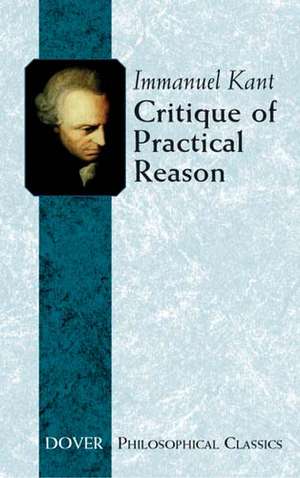
Critique of Practical Reason
Autor Immanuel Kant Traducere de Abbott Thomas Kingsmillen Limba Engleză Paperback – 2 feb 2004
Preț: 52.10 lei
Puncte Express: 78
Carte disponibilă
Livrare economică 16-30 mai
Specificații
ISBN-13: 9780486434452
ISBN-10: 0486434451
Pagini: 172
Dimensiuni: 135 x 209 x 11 mm
Greutate: 0.16 kg
Editura: Dover Publications
Locul publicării:United States
ISBN-10: 0486434451
Pagini: 172
Dimensiuni: 135 x 209 x 11 mm
Greutate: 0.16 kg
Editura: Dover Publications
Locul publicării:United States
V-ar putea interesa
-
 Kant: A Very Short IntroductionRoger Scruton-21%Preț: 53.41 lei67.74 lei
 -
 Baumgarten and Kant on the Foundations of Practical PhilosophyCourtney D. Fugate-31%Preț: 517.29 lei747.10 lei
 -
 Groundwork for the Metaphysics of MoralsImmanuel Kant-22%Preț: 57.99 lei74.06 lei
 -
 Kant on Mind, Action, and EthicsJulian Wuerth-33%Preț: 637.32 lei954.60 lei
 -
 On What Matters: Volume OneDerek Parfit-16%Preț: 200.78 lei238.16 lei
 -
 Kant's Critique of Practical ReasonDavid Mills DanielPreț: 72.29 lei
 -
 Critique Of Pure Reason: Kant : Critique Of Pure ReasonImmanuel Kant-26%Preț: 77.32 lei104.54 lei
 -
 The World as Will and Representation, Vol. 1Arthur Schopenhauer-19%Preț: 130.78 lei162.39 lei
 -
 The World as Will and Representation, Vol. 2Arthur Schopenhauer-36%Preț: 143.36 lei222.29 lei
 -
 MeditationsMarcus AureliusPreț: 31.49 lei
 -
 -20%Preț: 488.19 lei607.53 lei
 -
 The Great Philosophers:KantRalph Walker-30%Preț: 32.91 lei46.85 lei
 -
 The Critique of JudgementImmanuel KantPreț: 58.33 lei
 -
 Nicomachean EthicsAristotlePreț: 44.60 lei
 -
 Groundwork for the Metaphysics of MoralsImmanuel Kant-12%Preț: 132.78 lei150.84 lei
 -
 KantImmanuel KantPreț: 62.20 lei
 -
 Kant's Critique of Practical ReasonOtfried Hoffe-8%Preț: 610.77 lei663.88 lei
 -
 The Critique of JudgmentImmanuel KantPreț: 106.49 lei
Descriere
Descriere de la o altă ediție sau format:
With this volume, Werner Pluhar completes his work on Kant's three Critiques, an accomplishment unique among English language translators of Kant. At once accurate, fluent, and accessible, Pluhar's rendition of the Critique of Practical Reason meets the standards set in his widely respected translations of the Critique of Judgment (1987) and the Critique of Pure Reason (1996).
Stephen Engstrom's Introduction discusses the place of the second Critique in Kant's critical philosophy, its relation to Kant's ethics, and its practical purpose and provides an illuminating outline of Kant's argument.
Stephen Engstrom's Introduction discusses the place of the second Critique in Kant's critical philosophy, its relation to Kant's ethics, and its practical purpose and provides an illuminating outline of Kant's argument.
Notă biografică
Immanuel Kant war ein deutscher Philosoph der Aufklärung. Kant zählt zu den bedeutendsten Vertretern der abendländischen Philosophie. Sein Werk Kritik der reinen Vernunft kennzeichnet einen Wendepunkt in der Philosophiegeschichte und den Beginn der modernen Philosophie.
Kant schuf eine neue, umfassende Perspektive in der Philosophie, welche die Diskussion bis ins 21. Jahrhundert maßgeblich beeinflusst. Dazu gehört nicht nur sein Einfluss auf die Erkenntnistheorie und Metaphysik mit der Kritik der reinen Vernunft, sondern auch auf die Ethik mit der Kritik der praktischen Vernunft und die Ästhetik mit der Kritik der Urteilskraft. Zudem verfasste Kant bedeutende Schriften zur Religions-, Rechts- und Geschichtsphilosophie sowie Beiträge zur Astronomie und den Geowissenschaften.
Kant schuf eine neue, umfassende Perspektive in der Philosophie, welche die Diskussion bis ins 21. Jahrhundert maßgeblich beeinflusst. Dazu gehört nicht nur sein Einfluss auf die Erkenntnistheorie und Metaphysik mit der Kritik der reinen Vernunft, sondern auch auf die Ethik mit der Kritik der praktischen Vernunft und die Ästhetik mit der Kritik der Urteilskraft. Zudem verfasste Kant bedeutende Schriften zur Religions-, Rechts- und Geschichtsphilosophie sowie Beiträge zur Astronomie und den Geowissenschaften.