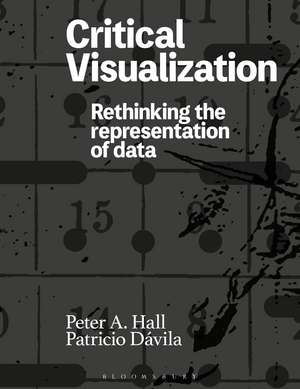
Critical Visualization: Rethinking the Representation of Data
Autor Peter A. Hall, Patricio Dávilaen Limba Engleză Paperback – 29 dec 2022
Preț: 186.85 lei
Preț vechi: 243.87 lei
-23%
Puncte Express: 280
Carte disponibilă
Livrare economică 06-17 noiembrie
Livrare express 24-30 octombrie pentru 101.35 lei
Livrare prin curier în România Termenul estimat este afișat lângă disponibilitate.
Transport gratuit de la 400.00 lei Plată online sau ramburs, în funcție de opțiunile comenzii.
Retur gratuit în 14 zile Comandă securizată și suport în română.
Specificații
ISBN-13: 9781350077249
ISBN-10: 1350077240
Pagini: 256
Ilustrații: 100 colour illus
Dimensiuni: 186 x 248 x 14 mm
Greutate: 0.7 kg
Editura: Bloomsbury Publishing
Colecția Bloomsbury Visual Arts
Locul publicării:London, United Kingdom
ISBN-10: 1350077240
Pagini: 256
Ilustrații: 100 colour illus
Dimensiuni: 186 x 248 x 14 mm
Greutate: 0.7 kg
Editura: Bloomsbury Publishing
Colecția Bloomsbury Visual Arts
Locul publicării:London, United Kingdom
V-ar putea interesa
-
 Atlas of the InvisibleJames CheshirePreț: 126.51 lei
 -
 Functional Art, TheAlberto CairoPreț: 326.65 lei
 -
 The Truthful ArtAlberto Cairo-20%Preț: 280.56 lei350.70 lei
 -
 Sum of Us: A History of the UK in DataGeorgina Sturge-25%Preț: 91.56 lei122.44 lei
 -
 Preț: 267.25 lei
 -
 Visualize ThisNathan Yau-20%Preț: 233.34 lei291.67 lei
 -
 Data Design: Visualising Quantities, Locations, ConnectionsProfessor Per Mollerup-36%Preț: 200.30 lei312.82 lei
 -
 Being with Data: The Dashboarding of Everyday LifeNathaniel TkaczPreț: 157.13 lei
 -
 Forms of the VisiblePhilippe DescolaPreț: 290.51 lei
 -
 Public Data CulturesJonathan W. Y. GrayPreț: 139.47 lei
 -
 Radical CartographyWilliam Rankin-44%Preț: 133.07 lei237.71 lei
 -
 The Book of TreesManuel Lima-8%Preț: 132.55 lei143.66 lei
 -
 W. E. B. Du Bois's Data PortraitsThe W E B Du Bois Center at the University of Massachusetts Amherst-25%Preț: 144.62 lei193.51 lei
 -
 Visualizing EgyptPaulina Banas-8%Preț: 479.11 lei520.77 lei
 -
 Speak DataGiorgia Lupi-20%Preț: 174.41 lei218.02 lei
 -
 Grootens, J: Blind Maps and Blue DotsJoost Grootens-43%Preț: 168.66 lei297.59 lei
 -
 Seeing the Unseeable: Data, Design, ArtJulie JoycePreț: 355.74 lei
 -
 Understanding the WorldSandra Rendgen-20%Preț: 302.67 lei378.34 lei
 -
 Information GraphicsSandra RendgenPreț: 206.48 lei
Cuprins
1. An Introduction to Critical Visualization
Defining the field
Looking at Visualization beyond Western Paradigms
Alternative Western perspectives: Distributed Cognition and Humanistic Approaches
2. Disruptive Histories
Positivism and Objectivity
A History of Progress
Critical Cartography: a 'Defining Moment'
A Few Examples: Not a Canon
- Haptic Visualization: the Quipu (1200-1532)
- Plan and Sections of a Slave Ship (1789)
- Polar Area Diagram (1859)
- Great Trigonometrical Survey of India (1802-1875)
- Data Visualization at the Paris Exposition, W.E.B. Du Bois (1900)
- Community-building with Isotype: Otto and Marie Neurath
Conclusion
Focus: Anna Ridler, Myriad (Tulips) 2018
3. Making Data
Qualitative and Quantitative Data
The Role of Categorization
Focus: Data4Change
- Keepiton
- Hear the Blind Spot
- Perceiving Yemen
4. Data and the Self
Taylorism Within?
Comic Critique
What is Normal?
Biometrics and Risk-Profiling
Challenging Norms
The Examined Life
Focus: Margaret Pearce and Michael Hermann, They Would Not Take Me There: People, Places, and Stories from Champlain's Travels in Canada, 1603-1616
5. Data and the City
Participatory planning: HECTOR
Focus: Heath Bunting: Status Project
6. Aesthetics and Representation
Aesthetics and Representation
Representation as Translation
7. Beyond Critical Visualization Practice
Defining the field
Looking at Visualization beyond Western Paradigms
Alternative Western perspectives: Distributed Cognition and Humanistic Approaches
2. Disruptive Histories
Positivism and Objectivity
A History of Progress
Critical Cartography: a 'Defining Moment'
A Few Examples: Not a Canon
- Haptic Visualization: the Quipu (1200-1532)
- Plan and Sections of a Slave Ship (1789)
- Polar Area Diagram (1859)
- Great Trigonometrical Survey of India (1802-1875)
- Data Visualization at the Paris Exposition, W.E.B. Du Bois (1900)
- Community-building with Isotype: Otto and Marie Neurath
Conclusion
Focus: Anna Ridler, Myriad (Tulips) 2018
3. Making Data
Qualitative and Quantitative Data
The Role of Categorization
Focus: Data4Change
- Keepiton
- Hear the Blind Spot
- Perceiving Yemen
4. Data and the Self
Taylorism Within?
Comic Critique
What is Normal?
Biometrics and Risk-Profiling
Challenging Norms
The Examined Life
Focus: Margaret Pearce and Michael Hermann, They Would Not Take Me There: People, Places, and Stories from Champlain's Travels in Canada, 1603-1616
5. Data and the City
Participatory planning: HECTOR
Focus: Heath Bunting: Status Project
6. Aesthetics and Representation
Aesthetics and Representation
Representation as Translation
7. Beyond Critical Visualization Practice
Recenzii
Debunking the idea that data is ever 'raw' or unbiased, this book brings information anxiety to a new level as it goes deep into the underlying power structures at play in the assemblage of data and the motivations of those who amass it. Hall and Dávila explain how design's focus on clarity and statistical accuracy can serve to enhance dominant narratives inherent in the data and challenge designers to activate their agency to visualize the kind of world in which we want to live. This should be required reading in any data visualization or information design curriculum.
Hall and Dávila make a compelling argument for a critical approach to data visualization. Through a comprehensive survey of extant literature, a rereading of canonical images through decolonizing frameworks, and discussion of highly topical debates, they arrive at a rich examination of current projects drawn from a wide array of activities. They address self-quantification, smart cities, emotional cartography, and a whole host of specific and activist interventions in conventional data practices. Ultimately, they argue for visualizations that might create alternatives to dominant conventions and the oppressive power asymmetries of the status quo.
With acuity and depth, Hall and Dávila demonstrate just how much history, culture and context matter for the design and interpretation of data visualization. Their book is timely and important, and will usher in a new era of critical data practice.
Hall and Dávila make a compelling argument for a critical approach to data visualization. Through a comprehensive survey of extant literature, a rereading of canonical images through decolonizing frameworks, and discussion of highly topical debates, they arrive at a rich examination of current projects drawn from a wide array of activities. They address self-quantification, smart cities, emotional cartography, and a whole host of specific and activist interventions in conventional data practices. Ultimately, they argue for visualizations that might create alternatives to dominant conventions and the oppressive power asymmetries of the status quo.
With acuity and depth, Hall and Dávila demonstrate just how much history, culture and context matter for the design and interpretation of data visualization. Their book is timely and important, and will usher in a new era of critical data practice.
Notă biografică
Peter A. Hall is Reader in Graphic Design at CCW, University of the Arts London, UK. His publications include Sagmeister: Made You Look (2009), Else/Where: Mapping - New Cartographies of Networks and Territories, co-edited with Janet Abrams (2005) and Tibor Kalman: Perverse Optimist (2002).Patricio Dávila is a designer, artist, researcher and educator. He is Associate Professor in the
Department of Cinema and Media Arts in the School of the Arts, Media, Performance and Design
at York University, Canada. His most recent publication is Diagrams of Power (2019) based on
the international exhibition he curated on critical practice in mapping.
Caracteristici
Data visualisation is a hot topic, and this book takes a fresh approach, pointing out that information design is never a neutral practice.