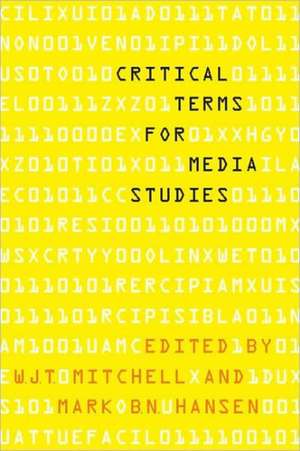
Critical Terms for Media Studies: Critical Terms
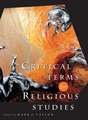
Editat de Professor W. J. T. Mitchell, Mark B. N. Hansenen Limba Engleză Paperback – 15 mar 2010
Observăm că, deși domeniul studiilor media a proliferat rapid, literatura academică a dus lipsă de un instrument teoretic care să unifice discipline disparate precum filosofia, cultura digitală și teoria filmului sub un vocabular comun și riguros. Critical Terms for Media Studies vine să completeze exact această lacună, propunând o cartografiere a conceptelor care definesc intersecția dintre tehnologie, politică și cultură. Ne-a atras atenția modul în care editorii W. J. T. Mitchell și Mark B. N. Hansen au structurat volumul: nu ca pe un simplu glosar, ci ca pe o serie de intervenții teoretice grupate în trei piloni fundamentali. Prima secțiune, „Estetica”, analizează experiența senzorială; „Tehnologia” explorează infrastructura materială și digitală; iar „Societatea” investighează sistemele care permit funcționarea mediilor.
Această lucrare extinde cadrul propus de Keywords for Media Studies de Laurie Ouellette prin includerea unor perspective mai tehnice și filosofice asupra materialității și biopoliticii. În contextul operei editorului W. J. T. Mitchell, volumul reprezintă o rafinare a conceptelor dezvoltate în What Do Pictures Want?, mutând accentul de pe imaginea individuală către sistemele complexe de mediere. De asemenea, capitolul despre limbaj semnat de Cary Wolfe rezonează cu temele eticii post-umaniste explorate de acesta în Animal Rites. Progresia de la termeni precum „Corp” și „Imagine” către „Software” și „Rețele” indică o acoperire exhaustivă a peisajului media contemporan, oferind cititorului o tranziție logică de la percepția individuală la structurile sociale globale.
Preț: 233.99 lei
Carte disponibilă
Livrare economică 16-30 mai
Livrare express 02-08 mai pentru 29.100 lei
Specificații
ISBN-10: 0226532550
Pagini: 376
Ilustrații: 4 halftones, 6 line drawings
Dimensiuni: 152 x 229 x 26 mm
Greutate: 0.48 kg
Editura: University of Chicago Press
Colecția University of Chicago Press
Seria Critical Terms
V-ar putea interesa
-
 Feed-Forward: On the Future of Twenty-First-Century MediaMark B. N. HansenPreț: 202.36 lei
 -
 Preț: 246.70 lei
 -
 Media Borders, Multimodality and IntermedialityL. Elleström-18%Preț: 701.32 lei855.27 lei
 -
 Multimedia PerformanceRosemary Klich-18%Preț: 224.04 lei274.78 lei
 -
 Digital PerformanceSteve DixonPreț: 416.61 lei
 -
 The Language of New MediaLev Manovich-8%Preț: 268.18 lei290.19 lei
 -
 The Triple Thinkers: Twelve Essays on Literary SubjectsEdmund WilsonPreț: 121.68 lei
 -
 Preț: 383.65 lei
 -
 The Cambridge Companion to Merleau-PontyTaylor CarmanPreț: 280.81 lei
 -
 InterpretationPeter D. JuhlPreț: 436.04 lei
 -
 HeterocosmicaLubomir DolezelPreț: 267.51 lei
 -
 The Humanities and the Understanding of RealityThomas B. StroupPreț: 106.40 lei
 -
 Leopardi and the Theory of PoetryG. SinghPreț: 222.68 lei
 -
 Screens: Viewing Media Installation ArtKate MondlochPreț: 205.83 lei
 -
 Conditions of the Present – Selected EssaysLindon BarrettPreț: 278.95 lei
 -
 A History of Video ArtProf. Chris Meigh-Andrews-23%Preț: 275.93 lei357.18 lei
 -
 A Companion to Digital ArtChristiane PaulPreț: 360.46 lei
 -
 Preț: 212.31 lei
 -
 Film Art: An Introduction ISEDavid Bordwell-21%Preț: 465.53 lei589.29 lei
 -
 Ricoeur, Literature and ImaginationDr. Sophie Vlacos-14%Preț: 736.51 lei856.40 lei
 -
 Genres and Genre Theory in TransitionGiuliana GarzonePreț: 216.44 lei
 -
 Literature MattersJ. Hillis MillerPreț: 124.11 lei
 -
 A History of Experimental Film and VideoA.L. Rees-24%Preț: 226.26 lei299.28 lei
 -
 Preț: 276.08 lei
De ce să citești această carte
Această resursă este esențială pentru studenții și cercetătorii din științele comunicării și studii culturale care doresc să depășească intuițiile superficiale despre media. Cititorul câștigă acces la o terminologie actualizată, definită de experți de top, utilă pentru analiza critică a noilor tehnologii. Este un ghid teoretic dens care transformă concepte abstracte în instrumente de lucru precise pentru mediul academic.
Despre autor
W. J. T. Mitchell este profesor la Universitatea din Chicago și o figură marcantă în teoria mediului și iconologie, fiind cunoscut pentru conceptualizarea „turnurii picturale”. Mark B. N. Hansen este un teoretician influent, specializat în media digitală și fenomenologie. Împreună, aceștia au reunit în acest volum contribuții de la autori de renume, precum Cary Wolfe sau Johanna Drucker, oferind o perspectivă interdisciplinară asupra modului în care tehnologia modelează experiența umană.
Descriere scurtă
Communications, philosophy, film and video, digital culture: media studies straddles an astounding array of fields and disciplines and produces a vocabulary that is in equal parts rigorous and intuitive. Critical Terms for Media Studies defines, and at times, redefines, what this new and hybrid area aims to do, illuminating the key concepts behind its liveliest debates and most dynamic topics.
Part of a larger conversation that engages culture, technology, and politics, this exciting collection of essays explores our most critical language for dealing with the qualities and modes of contemporary media. Edited by two outstanding scholars in the field, W. J. T. Mitchell and Mark B. N. Hansen, the volume features works by a team of distinguished contributors. These essays, commissioned expressly for this volume, are organized into three interrelated groups: “Aesthetics” engages with terms that describe sensory experiences and judgments, “Technology” offers entry into a broad array of technological concepts, and “Society” opens up language describing the systems that allow a medium to function.
A compelling reference work for our media landscape, Critical Terms for Media Studies will engage and deepen any reader’s knowledge of one of our most important new fields.
Notă biografică
Cuprins
Aesthetics
1. Art Johanna Drucker
2. Body Bernadette Wegenstein
3. Image W. J. T. Mitchell
4. Materiality Bill Brown
5. Memory Bernard Stiegler, with an introduction by Mark B. N. Hansen
6. Senses Caroline Jones
7. Time and Space W. J. T. Mitchell and Mark B. N. Hansen
Technology
8. Biomedia Eugene Thacker
9. Communication Bruce Clarke
10. Cybernetics N. Katherine Hayles
11. Information Bruce Clarke
12. New Media Mark B. N. Hansen
13. Hardware/Software/Wetware Geoffrey Winthrop-Young
14. Technology John Johnston
Society
15. Exchange David Graeber
16. Language Cary Wolfe
17. Law Peter Goodrich
18. Mass Media John Durham Peters
19. Networks Alexander R. Galloway
20. Systems David Wellbery
21. Writing Lydia H. Liu
Contributors
Index