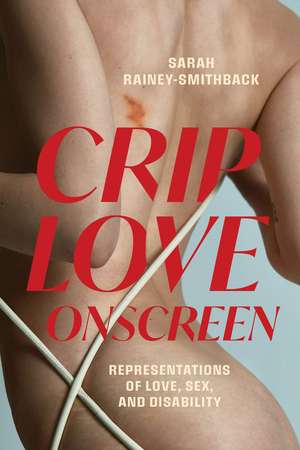
Crip Love Onscreen: Representations of Love, Sex, and Disability
Autor Sarah Rainey-Smithbacken Limba Engleză Paperback – 30 ian 2026
Crip Love Onscreen: Representations of Love, Sex, and Disability examines how disabled people’s sexual lives—including pleasure/sex, love, pregnancy, and sexual violence—are represented in popular film and television. Analyzing a variety of films and TV shows from the United States, Canada, and the United Kingdom, Sarah Rainey-Smithback traces patterns in disability representation that ignore or distort many of the realities of crip sexuality. These patterns of sexual representation tend to uphold compulsory able-bodiedness, heteronormativity, and privacy norms—what Rainey-Smithback terms “neoliberal love values,” or standards that celebrate normative forms of sexual desire, bodies, and intimacy practices.
As disability representation increases, though, new possibilities are emerging. Crip Love Onscreen also draws attention to the exceptional through a close reading of screen narratives (such as 50 First Dates,Love and Other Drugs,American Horror Story: Freak Show, and more) that push against neoliberal, heteronormative, and ableist values. Drawing on the work of queer/crip scholars and activists, Rainey-Smithback uncovers glimpses of what Tobin Siebers calls a “sexual culture for disabled people”—a space and way of being that expands sexual access and sexual experience.
As disability representation increases, though, new possibilities are emerging. Crip Love Onscreen also draws attention to the exceptional through a close reading of screen narratives (such as 50 First Dates,Love and Other Drugs,American Horror Story: Freak Show, and more) that push against neoliberal, heteronormative, and ableist values. Drawing on the work of queer/crip scholars and activists, Rainey-Smithback uncovers glimpses of what Tobin Siebers calls a “sexual culture for disabled people”—a space and way of being that expands sexual access and sexual experience.
| Toate formatele și edițiile | Preț | Express |
|---|---|---|
| Paperback (1) | 245.73 lei Precomandă | |
| Ohio State University Press – 30 ian 2026 | 245.73 lei Precomandă | |
| Hardback (1) | 617.83 lei Precomandă | |
| Ohio State University Press – 30 ian 2026 | 617.83 lei Precomandă |
Preț: 245.73 lei
Precomandă
Puncte Express: 369
Preț estimativ în valută:
43.48€ • 50.99$ • 38.19£
43.48€ • 50.99$ • 38.19£
Carte nepublicată încă
Doresc să fiu notificat când acest titlu va fi disponibil:
Se trimite...
Preluare comenzi: 021 569.72.76
Specificații
ISBN-13: 9780814259672
ISBN-10: 0814259677
Pagini: 184
Dimensiuni: 152 x 229 x 15 mm
Greutate: 0.25 kg
Editura: Ohio State University Press
Colecția Ohio State University Press
ISBN-10: 0814259677
Pagini: 184
Dimensiuni: 152 x 229 x 15 mm
Greutate: 0.25 kg
Editura: Ohio State University Press
Colecția Ohio State University Press
Recenzii
“Crip Love Onscreen showcases the radical ways that disabled sexuality can dismantle cultural assumptions not only about disabled people but about sex and sexuality more broadly. Taking neoliberalism to task, Rainey-Smithback reveals how crip sex and interabled relationships present powerful opportunities to reconfigure intimacy and reimagine care.” —Cynthia Barounis, author of Vulnerable Constitutions: Queerness, Disability, and the Remaking of American Manhood
“Moving beyond notions of ‘authenticity’ and ‘accuracy’ that often inform conversations about cultural representations of disabled people and their sexualities, Rainey-Smithback instead interrogates the cultural values embedded in such representations. Wide-ranging and ambitious, Crip Love Onscreen offers insights and conceptual tools that will prove indispensable to anyone interested in sex, disability, television, and film.” —Anna Mollow, coeditor of Sex and Disability
Notă biografică
Sarah Rainey-Smithback is Associate Professor of Women’s, Gender, and Sexuality Studies at Bowling Green State University. She is the author of Love, Sex, and Disability: The Pleasures of Care.
Extras
Rather than approach my study of sex and disability narratives through accuracy and visibility, I approach onscreen representations, including film, television, and social media, as important cultural sites that circulate values. Representations reflect our collective feelings, beliefs, and attitudes about sex and disability; and we use representations to narrate new meanings. In an inaccessible world, TV and film are important sources of entertainment for disabled people, and, increasingly, people with disabilities turn to media to organize, raise awareness, and break down barriers. Onscreen disability visibility is also crucial to nondisabled audiences. As numerous disability film scholars have noted, film and television may be the only contact with disability for many nondisabled audiences. People with disabilities—especially those with visibly different bodies—have historically been kept from public sight, confined to institutions, or discouraged from being out in the community. Even today, institutional barriers and ableist attitudes make it difficult for disabled people to be fully integrated into society. Disabled students are still isolated in separate classrooms; social clubs and venues are still built for nondisabled bodies. As film scholar James Cherney explains, “we form our first impression of disability from images of disability in our homes, our communities, and in the media.” Considering the paucity of disability in the community, I concur with Cherney’s assertion that film “plays a substantial role in the construction of the able-bodied imagination of disability.” How disability is portrayed in various types of film and television is thus an important component of the treatment and understanding of disabled people.
Onscreen representations also circulate ideas about sex and sexuality. In her analysis of onscreen sexual behavior, Linda Williams points out that one of our very first pieces of cinema in the United States—Thomas Edison’s The Kiss (1896)—establishes conventions in how to show kissing as a form of heterosexual intimacy. These conventions, including distance and duration of shots and the male active / female passive positioning, continue to be used today. As Williams provocatively states, “moving images are surely the most powerful sex education most of us will ever receive." Although popular beliefs about sexual intimacy and desire maintain that sex is “natural,” even instinctual, the reality is that we learn much of our erotic drives from the world around us. And this popular “sex education” has only proliferated in recent decades, securing the connection between media and sexuality. Writing about the strong link between film/TV and sexuality, James Cherney explains: “We look to film to learn what is sexy, we look to film to realize our erotic fantasies, and we look to film to validate our beliefs.”
Despite the appeal of representation as a site to explore sex and disability, few scholars have. As noted above, disability scholars and activists have been very attuned to the power of onscreen representations, but sex and intimate relationships are rarely the focus of this work. Similarly, feminist sexuality scholars and activists have centered as key to our understandings of power, identity, and culture. Yet disabled sex and love are largely overlooked. Crip Love Onscreen positions film, TV, and social media as fertile sites to explore the intersection of sexuality and disability. I look at a variety of mainstream, largely “Western,” representations, organized by domains of sexual life, including love, sex, violence, and reproduction. Drawing on a range of interdisciplinary scholarship about sex and disability, I aim to contribute with a holistic analysis of sex and disability in our popular imagination. In the next section I position my approach in the activist and academic work at the intersection of sex and disability.
Onscreen representations also circulate ideas about sex and sexuality. In her analysis of onscreen sexual behavior, Linda Williams points out that one of our very first pieces of cinema in the United States—Thomas Edison’s The Kiss (1896)—establishes conventions in how to show kissing as a form of heterosexual intimacy. These conventions, including distance and duration of shots and the male active / female passive positioning, continue to be used today. As Williams provocatively states, “moving images are surely the most powerful sex education most of us will ever receive." Although popular beliefs about sexual intimacy and desire maintain that sex is “natural,” even instinctual, the reality is that we learn much of our erotic drives from the world around us. And this popular “sex education” has only proliferated in recent decades, securing the connection between media and sexuality. Writing about the strong link between film/TV and sexuality, James Cherney explains: “We look to film to learn what is sexy, we look to film to realize our erotic fantasies, and we look to film to validate our beliefs.”
Despite the appeal of representation as a site to explore sex and disability, few scholars have. As noted above, disability scholars and activists have been very attuned to the power of onscreen representations, but sex and intimate relationships are rarely the focus of this work. Similarly, feminist sexuality scholars and activists have centered as key to our understandings of power, identity, and culture. Yet disabled sex and love are largely overlooked. Crip Love Onscreen positions film, TV, and social media as fertile sites to explore the intersection of sexuality and disability. I look at a variety of mainstream, largely “Western,” representations, organized by domains of sexual life, including love, sex, violence, and reproduction. Drawing on a range of interdisciplinary scholarship about sex and disability, I aim to contribute with a holistic analysis of sex and disability in our popular imagination. In the next section I position my approach in the activist and academic work at the intersection of sex and disability.
Cuprins
Contents
List of Illustrations
Introduction
Chapter 1 The Burden and Tragedy of Disabled Love
Chapter 2 Loving the Other: Fantastic Films and Unlikely Couples
Chapter 3 Watching Rape and Disability
Chapter 4 Pregnancy and Parenting: Representing Reproductive Fitness
Chapter 5 “What Does That Make You?”: Disability, Perversion, and Desire
Conclusion
Acknowledgments
Appendix List of Films and Television Shows in Content Analysis
Bibliography
Index
List of Illustrations
Introduction
Chapter 1 The Burden and Tragedy of Disabled Love
Chapter 2 Loving the Other: Fantastic Films and Unlikely Couples
Chapter 3 Watching Rape and Disability
Chapter 4 Pregnancy and Parenting: Representing Reproductive Fitness
Chapter 5 “What Does That Make You?”: Disability, Perversion, and Desire
Conclusion
Acknowledgments
Appendix List of Films and Television Shows in Content Analysis
Bibliography
Index
Descriere
Examines how disabled people’s sexual lives are represented in Western popular film and television, with a close look at sources that push back against heteronormative and ableist values.